

The Depamu Chemical Dosing System (Injection Package) for Boiler Feedwater Treatment: A Comprehensive Technical Overview
Abstract
Boiler feedwater treatment is a critical process in industrial and utility steam generation, directly influencing equipment longevity, thermal efficiency, and operational safety. At the heart of modern water treatment programs lies the chemical dosing system—a skid-mounted assembly designed for precise, reliable injection of treatment chemicals. This article provides a comprehensive technical overview of the Depamu Chemical Dosing System (Injection Package), examining its core components, application-specific configurations, automation capabilities, and role within the broader boiler feedwater treatment framework.
1. Introduction: The Critical Role of Chemical Dosing in Boiler Feedwater Treatment
Boiler feedwater quality is paramount to the safe and efficient operation of steam-generating systems. Raw water, regardless of its source, contains impurities—dissolved salts (calcium, magnesium, sodium), dissolved gases (oxygen and carbon dioxide), and suspended solids—that, if left untreated, lead to scale formation, corrosion, and fouling of heat transfer surfaces. These phenomena directly reduce thermal efficiency, increase fuel consumption, and can result in catastrophic equipment failure.
Boiler feedwater treatment typically comprises three stages: main water treatment (pre-treatment and ion exchange), chemical dosing, and condensate polishing. While mechanical deaeration removes the bulk of dissolved oxygen, chemical dosing serves as the critical final barrier against residual oxygen and pH imbalance. The Depamu Chemical Dosing System, referred to as an "Injection Package," is a skid-mounted, integrated solution designed to perform this function with precision and reliability.
2. System Architecture and Core Components of the Depamu Injection Package
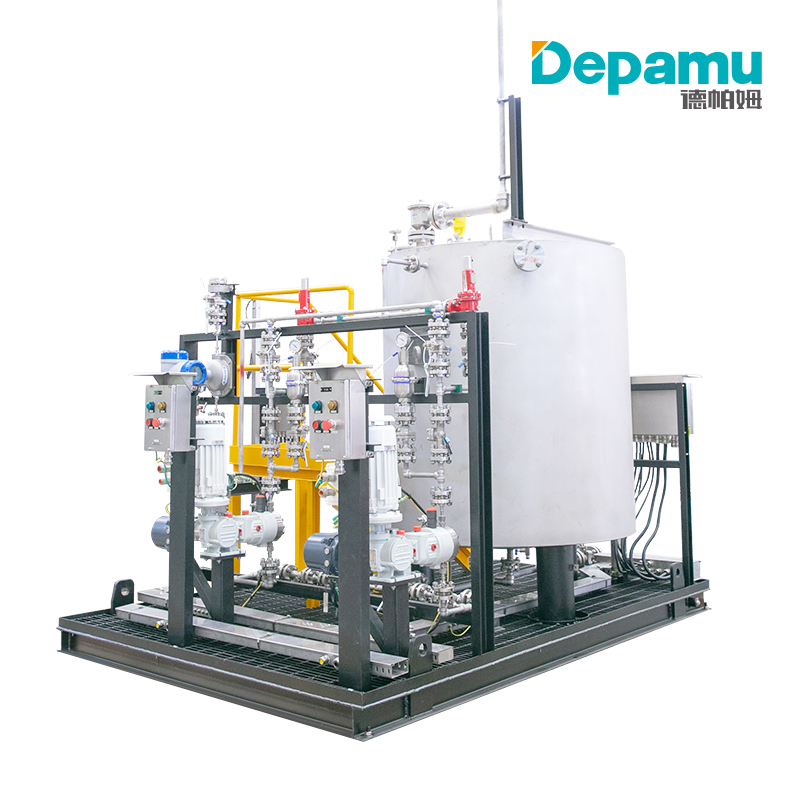
The Depamu Injection Package is a complete, factory-assembled unit that integrates chemical dissolution, preparation, metering, and injection into a single, compact structure. Its modular design facilitates easy transportation, installation, and integration into existing plant infrastructure.
2.1 Core Components
The system is composed of several key elements, all mounted on a common steel base:
-
Solution Tank: This vessel stores the prepared chemical solution. Depending on anti-corrosion requirements, tanks can be fabricated from 304 or 316 stainless steel, carbon steel (with or without rubber/plastic lining), FRP, PE, or PVC. Tank volumes typically range from 0.5 to 2.5 m³ for boiler water applications, though larger tanks are available for other uses. Level gauges provide continuous monitoring of solution inventory.
-
Metering Pump: The heart of the injection package, responsible for accurate, proportional chemical delivery. The system can be equipped with one or more pumps (working or standby configurations), with flow capacities ranging from 20 to 70 L/H and discharge pressures from 0.5 to 32 MPa depending on the specific application. Pump wetted parts are constructed from corrosion-resistant materials (316/304 stainless steel or UPVC).
-
Pulsation Damper and Safety Valve: The metering pump's reciprocating action creates flow pulsations. A pulsation damper smoothens these fluctuations, ensuring consistent injection and protecting downstream piping. A safety valve provides overpressure protection for the system.
-
Piping and Valve System: A comprehensive network of pipes, valves, and fittings connects all components, enabling flow control, isolation, and maintenance. The system allows for flexible operation, such as alternating between multiple tanks or using two pumps simultaneously.
-
Electrical Control Cabinet: The control system governs the operation of the package. It can support local manual control, semi-automatic operation, or fully automatic control integrated with a plant's Distributed Control System (DCS).
2.2 Configurations and Customization
Depamu packages are available in various configurations to match process requirements. Standard combinations include:
-
1 Tank + 2 Pumps: Typically used for single-chemical applications with one pump in operation and one on standby.
-
2 Tanks + 3 Pumps or 2 Tanks + 4 Pumps: Employed when multiple chemicals are required or when redundant capacity is necessary.
The physical footprint of these packages ranges from approximately 1,800 mm × 1,900 mm × 2,500 mm (length × width × height) to 3,000 mm × 1,900 mm × 2,500 mm, with weights between 1,600 kg and 4,200 kg depending on tank size and pump configuration. Custom designs are available to suit specific dosing room layouts.
3. Application-Specific Chemical Dosing Packages
The Depamu product line offers tailored injection packages for various boiler water treatment chemicals, each addressing a specific aspect of water chemistry control.
3.1 Hydrazine Injection Package (Oxygen Scavenging)
Dissolved oxygen is a primary cause of pitting and corrosion in boiler systems. Mechanical deaeration reduces oxygen to low levels, but residual oxygen (typically 7–10 ppb) remains and can cause significant damage. The hydrazine injection package serves as a chemical deoxidizer, removing these traces of oxygen through a redox reaction.
The hydrazine dosing rate must be precisely controlled: insufficient dosage compromises corrosion protection, while overdosing results in chemical waste and potential environmental concerns. The Depamu package's automatic control system adjusts injection volume based on real-time signals from flow meters, dissolved oxygen analyzers, and turbidimeters, maintaining optimal hydrazine residuals.
3.2 Ammonia Injection Package (pH Adjustment)
Ammonia is injected into feedwater to raise and stabilize pH levels, typically within the 8.5–9.5 range, to minimize acidic corrosion of the condensate return system. While deionized water has a neutral pH of 7, the presence of carbon dioxide (from atmospheric ingress) can form carbonic acid, reducing pH and accelerating corrosion. The ammonia injection package responds to pH and conductivity signals from inline sensors, modulating pump stroke or speed to maintain the target pH setpoint.
3.3 Phosphate Injection Package (Scale Control)
In high-pressure boilers, phosphate compounds are dosed to precipitate residual hardness ions (calcium and magnesium) as non-adherent sludge, which can be removed via blowdown. Phosphate also aids in maintaining a protective magnetite layer on boiler tube surfaces. This package typically delivers tri-sodium phosphate (TSP) at pressures ranging from 5 to 32 MPa, suitable for medium- to high-pressure steam systems.
4. Process Control and Automation Strategy
The effectiveness of any chemical dosing system hinges on its ability to respond dynamically to changing process conditions. The Depamu Injection Package offers a comprehensive automation framework.
4.1 Control Philosophy
Operation can be local (manual) or automatic. In automatic mode, a Programmable Logic Controller (PLC) or the plant's host computer/DCS receives input signals from various sensors: flow rate (feedwater demand), dissolved oxygen concentration, pH, electrical conductivity, turbidity, etc.. The control logic processes these signals and computes the required chemical flow rate.
4.2 Actuation and Adjustment
Control signals are sent to the metering pump via a frequency converter (Variable Frequency Drive - VFD), which adjusts the pump's motor speed. The standard input signal is 4–20 mA, with the same format used for feedback to the DCS. This arrangement allows for a pump flow adjustment range of 0–100%, providing turndown ratios sufficient for both startup/upset conditions and steady-state operation.
4.3 Remote Monitoring and Integration
All status signals—pump running, pump fault, mixer status, tank level alarms—can be transmitted to the DCS or host computer. Operators can remotely start or stop injection pumps as required, enabling efficient plant-wide management. This level of integration is particularly beneficial in large thermal power stations where multiple dosing points are distributed across the water-steam cycle.
5. Placement and Sizing Considerations
The performance of a chemical dosing system is influenced not only by the package itself but also by its placement within the feedwater system and the accurate sizing of chemical demand.
5.1 Dosing Point Location
The selection of the chemical injection point is critical. For oxygen scavengers, injection should occur close to the feedwater outlet of the feed tank, away from incoming make-up water agitation to ensure adequate mixing and reaction time before water enters the boiler. For pH adjusters (ammonia) and scale inhibitors, injection into the feed line is typically preferred, often using a multi-pump configuration (2 to 4 pumps) for simultaneous chemical addition. For deaerator applications, dosing at the deaerator outlet is standard practice.
5.2 Determining Chemical Demand
The chemical demand is determined by the feedwater flow rate and the condensate return ratio. Using mass balance equations (FW = MU + CR, where FW = feedwater, MU = makeup, CR = condensate return), the operator can calculate the amount of makeup requiring treatment and the corresponding chemical dosage. Accurate flow metering is essential: under-dosing leads to inadequate protection; over-dosing wastes chemicals and increases operating costs.
6. Conclusion
The Depamu Chemical Dosing System (Injection Package) represents a robust, integrated solution for the critical task of boiler feedwater treatment. By combining precision metering pumps, corrosion-resistant materials, and advanced automation capabilities, it addresses the primary challenges of oxygen removal, pH control, and scale inhibition. Its skid-mounted design simplifies installation, while its customizable configurations accommodate a wide range of plant sizes and chemical treatment programs.
The system's ability to interface with plant-wide DCS and respond to real-time water quality signals ensures optimal chemical consumption and effective equipment protection. As the demands on boiler plants increase—higher pressures, greater thermal efficiency, stricter environmental regulations—the importance of reliable, accurate chemical dosing systems like those offered by Depamu will only continue to grow. For plant operators and engineers, understanding the principles, capabilities, and application-specific features of these packages is essential to achieving operational excellence and ensuring the long-term reliability of steam generation assets.