

Depamu vs. Neptune Hydraulic Metering Pumps: A Comparative Analysis of Hydraulic Diaphragm Technologies
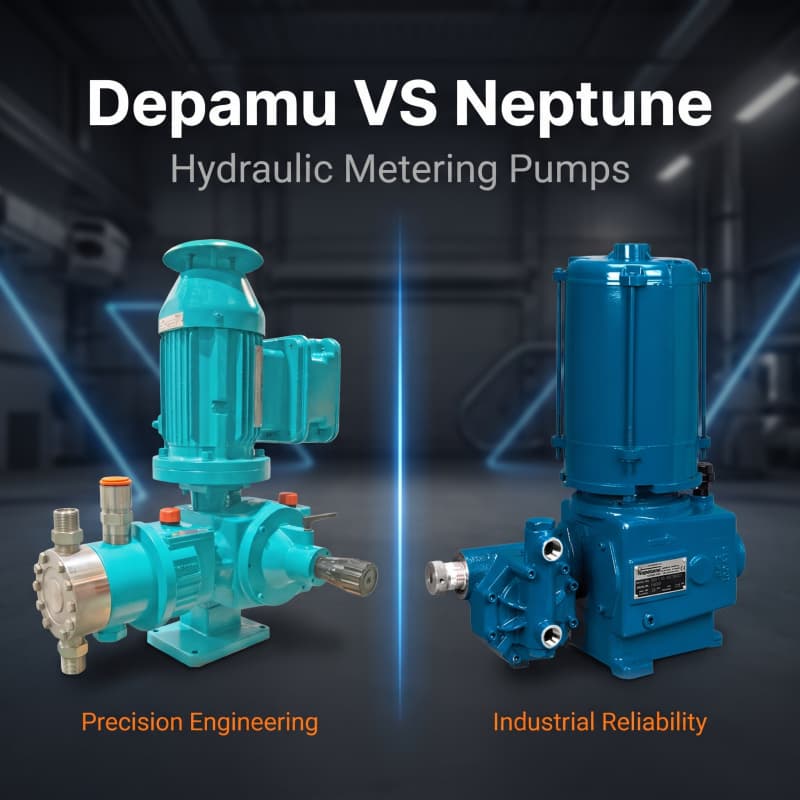
Hydraulic Diaphragm Metering Pumps occupy a critical niche in industrial fluid handling. By interposing a layer of hydraulic fluid between the mechanical drive and the process diaphragm, these pumps achieve a combination of high discharge pressure, exceptional metering accuracy, and robust containment of aggressive or hazardous chemicals. Within this specialized field, Depamu (Hangzhou) Pump Technology Co., Ltd. and Neptune Chemical Pump Company (a PSG Dover brand) represent two distinct engineering traditions. While both manufacture hydraulic diaphragm metering pumps, their design philosophies, performance envelopes, and application priorities differ in ways that matter to specifying engineers and plant operators. This article examines those differences across design architecture, performance range, control and safety systems, maintainability, and application focus.
Company Backgrounds and Design Philosophies
Depamu, established in 2003 and headquartered in Hangzhou, China, has positioned itself as a high-technology enterprise with an extensive catalog exceeding 4,000 specifications and models of metering and chemical pumps. The company holds more than 20 patents, including five invention patents, and has developed internationally leading Diaphragm Pump technologies. Depamu’s engineering approach emphasizes mechanical robustness and modular configurability. A defining characteristic of its hydraulic diaphragm platforms is the ability to reconfigure the pump head as a hydraulic diaphragm type, a plunger type, or a piston type, allowing a single drive family to serve radically different fluid-handling duties. This modularity reflects a design philosophy oriented toward adaptability across severe process environments, including oil and gas field exploitation, nuclear power, metallurgy, and petrochemical processing.
Neptune Chemical Pump Company, headquartered in North Wales, Pennsylvania, and a member of PSG Dover’s Fluid Solution Platform, traces its hydraulic metering heritage to 1961. Neptune’s market identity is tightly coupled to water treatment, chemical dosing, and power generation, with particular renown in boiler and cooling-tower chemical injection. Its design philosophy centers on hydraulic refinement and field-serviceability. Rather than pursuing modular head interchangeability across plunger and diaphragm types, Neptune has concentrated on perfecting the hydraulic diaphragm mechanism itself, introducing innovations such as the Variable Oil By-Pass™ stroke adjustment and EZE-CLEAN™ valve cartridges that define the operational character of its pumps.
Hydraulic System Architecture: Two Paths to Diaphragm Actuation
Both brands rely on the fundamental hydraulic diaphragm principle: a reciprocating piston displaces hydraulic oil, which in turn deflects a process-side diaphragm to induce suction and discharge through check valves. Depamu describes this sequence explicitly: the motor drives a crank connecting-rod mechanism that converts rotary motion into reciprocating piston motion; the piston pushes hydraulic oil within the hydraulic chamber, transmitting thrust and volumetric change to the diaphragm, which undergoes cyclical compression and relaxation to move process fluid through the inlet and outlet check valves. The hydraulic fluid acts as a cushion, absorbing shock loads and enabling smooth diaphragm movement while permitting high-pressure operation without sacrificing metering accuracy.
Where the architectures diverge is in stroke adjustment and hydraulic management. Depamu employs a patented integrated sleeve adjustable eccentric transmission mechanism. This mechanism allows stepless stroke adjustment across 0% to 100% and is described as simple and reliable, with the stroke mechanism integrated into the drive rather than relying on hydraulic bypass. Neptune, by contrast, utilizes its proprietary Variable Oil By-Pass™ stroke adjustment. In this design, capacity is varied by allowing a portion of the hydraulic oil to bypass the diaphragm actuation circuit, which introduces a controlled time delay between the end of the suction stroke and the beginning of the discharge stroke. The practical significance is that the check valves have additional time to seat fully before pumping resumes—an advantage that becomes particularly pronounced with viscous liquids, where valve closure is slower. Neptune contends that this approach provides better valve performance than variable-linkage designs and that the stroke mechanism itself moves only when an adjustment is made, eliminating wear, while the piston is powered through its complete stroke length at all capacity settings, avoiding the stress and shock associated with lost-motion designs.
Depamu’s eccentric adjustment and Neptune’s oil-bypass adjustment represent two legitimate solutions to the same problem. Depamu’s approach is mechanically direct and integrated into the transmission, consistent with its broader emphasis on robust mechanical design. Neptune’s approach is hydraulically mediated and explicitly optimized for valve seating dynamics, consistent with its focus on dosing repeatability in demanding chemical services.
Performance Envelope and Model Range
The performance specifications reveal the intended application territories of the two brands. Depamu’s hydraulic diaphragm and plunger platforms span an exceptionally wide pressure range. The DP(M)TA series is engineered for high-pressure duties, with limit-valve accuracy reaching ±0.002 mm, surface hardness of 60–70 HRC, and a diaphragm design rated for 80 million cycles across a temperature range of −80 °C to 160 °C. Depamu’s broader metering pump catalog lists maximum discharge pressures of 95 MPa and maximum flow rates of 12,100 L/h per pump head, with some oil-and-gas-oriented configurations extending pressure ratings to 228 MPa. The DP(M)WA series, a flagship hydraulic diaphragm line, delivers flow adjustment from 10% to 100% with ±0.5% metering accuracy and offers motor power options from 0.37 kW upward, with individual models such as the DP(M)WA75/2.7/4.0 providing 75 L/h at 2.7 and 4.0 MPa and the DP(M)WA212/1.0/1.4 providing 212 L/h at 1.0 and 1.4 MPa.
Neptune’s hydraulic diaphragm range is organized around application-specific series rather than a single broad platform. The 500 Series covers general chemical dosing with flows from 3.03 L/h to 355 L/h and pressures up to 206 bar, with the 500-A simplex models spanning 3.03 to 68 L/h at up to 75.8 bar. The 5003/5005 low-flow models deliver 1.3 to 1.9 L/h at pressures to 206 bar, targeting oil and gas corrosion-inhibitor dosing. The 600 Series addresses high-flow applications with capacities from 477 to 2,426 L/h at pressures to 41 bar, while the 6000 Series is optimized for low-flow, high-pressure service, spanning 16 to 131 L/h at pressures up to 276 bar. Neptune’s 600 and 6000 Series brochures confirm maximum capacities to 240 gph (908.5 L/h) and maximum pressures to 4,000 psi (275.8 bar) in 316SS, C-20, PVDF, and PVC constructions.
In broad terms, Depamu’s catalog extends to higher absolute pressures and larger single-head flows, reflecting its penetration into oil and gas, nuclear, and heavy chemical markets. Neptune’s range is more tightly curated around the flow-and-pressure combinations that dominate municipal and industrial water treatment, chemical processing, and agricultural chemical feed.
Metering Accuracy, Control, and Automation
Both manufacturers specify ±0.5% metering accuracy within the adjustable flow range—Depamu across 10%–100% of capacity, and Neptune across a comparable 10%–100% band achieved through its ten-turn micrometer dial calibrated in 1% increments. The difference lies less in the accuracy figure itself than in the control ecosystem surrounding each pump.
Depamu offers a notably broad array of capacity-control modes: manual, electrical, pneumatic, and frequency-conversion adjustment are all available across its hydraulic diaphragm lines. The company explicitly supports electric actuator installation for automatic remote control and can connect up to twelve pump heads in parallel, using multi-head configurations either to dampen pulsation when pumping a single fluid or to proportionally dose multiple fluids with independent flow adjustment per head. This multi-head architecture is particularly relevant in proportional chemical injection skids where several additives must be delivered in coordinated ratios.
Neptune’s control architecture is equally automation-ready but is oriented toward integration with process control systems in water and wastewater treatment. Electronic stroke-length adjustment and 4–20 mA signal control allow the pump to follow a process signal directly, and explosion-proof models are available for hazardous environments. Neptune also offers variable-speed drives as an alternative to stroke-length control. The company’s emphasis on “accuracy and repeatability” as a core value proposition reflects the dosing duties—disinfection, pH control, coagulation—where a pump must hold a setpoint reliably over long periods with minimal operator intervention.
Safety, Diaphragm Integrity, and Process Containment
Diaphragm rupture is the central safety concern in any diaphragm metering pump, particularly when the process fluid is toxic, flammable, or strongly corrosive. Depamu addresses this with a layered protection scheme built around the interaction of the diaphragm, a limit valve, a compensation valve, and an internal safety valve. This arrangement provides automatic air discharge and oil replenishment, maintaining hydraulic integrity over time. For hazardous fluids, Depamu offers double or multiple diaphragm configurations, and its diaphragm rupture alarm device prevents process fluid from contacting hydraulic oil in the event of a rupture, averting contamination and unsafe conditions. The DP(M)TA series further underscores Depamu’s safety engineering with a limit valve machined to ±0.002 mm accuracy and hardened to 60–70 HRC, ensuring precise hydraulic control under repeated cycling.
Neptune’s safety philosophy is embedded in its diaphragm and hydraulic circuit design. The company’s hydraulic diaphragm pumps utilize a hydraulically balanced PTFE diaphragm that eliminates the stress associated with mechanically flexed diaphragms, extending diaphragm life and reducing the likelihood of fatigue failure. Neptune also describes “dry” coupled diaphragm configurations in which the area between diaphragms is evacuated and pumping action is transmitted without intermediate fluids in certain designs, though its mainstream hydraulic diaphragm lines rely on the oil-coupled principle. The Variable Oil By-Pass™ mechanism contributes indirectly to safety by promoting complete valve seating and stable hydraulic behavior, reducing the hydraulic transients that can accelerate diaphragm wear.
Depamu’s safety narrative is more explicitly system-oriented, with dedicated alarm and monitoring devices for diaphragm rupture and multi-diaphragm redundancy. Neptune’s safety narrative is more component-oriented, emphasizing diaphragm stress elimination and hydraulic balance as the primary defenses against failure.
Maintainability and Field Serviceability
Neptune’s most visible maintainability innovation is the EZE-CLEAN™ valve system. Valve cartridges can be removed for cleaning or inspection without disturbing the piping connected to the pump, a significant advantage in chemical feed services where line breaks introduce safety risks and downtime. The ten-turn micrometer dial is protected by a clear PVC covering, and the stroke mechanism is designed to move only during adjustment, minimizing wear on the adjustment mechanism itself. Neptune’s power train operates submerged in oil for extended service, and the pumps accept standard 56C motors, simplifying motor replacement and regional sourcing.
Depamu’s maintainability approach emphasizes long-component life and lubrication reliability rather than quick-access valve cartridges. Oil-immersion lubrication ensures reliable long-term operation of the transmission mechanism, and high-performance plungers, special packing, diaphragms, and sealing components are specified for long service life and excellent sealing performance. The integrated worm gear used as a variable-speed transmission is designed for low noise and high efficiency. Depamu’s after-sales structure includes a 24-hour service hotline and a commitment to provide solutions within 24 hours of a request, with field service available when necessary. However, the public literature does not highlight a piping-independent valve removal feature comparable to EZE-CLEAN™, suggesting that Neptune retains a distinct field-service advantage for routine valve maintenance in packaged chemical feed systems.
Application Focus and Market Positioning
The application profiles of the two brands reflect their engineering choices. Depamu’s hydraulic diaphragm and plunger pumps are positioned for severe-service industrial processes: petrochemical and chemical processing, oil and gas field exploitation, electricity and nuclear power, new energy and new materials, metallurgy, environment protection, pulp and paper, pharmaceutical chemical, and green food and beverage production. The availability of pressures to 228 MPa and flows to 12,100 L/h per head makes Depamu a candidate for high-pressure chemical injection in deep-well and pipeline applications, where the pump must survive extreme pressure differentials and often harsh ambient conditions. The ability to configure the same drive with diaphragm, plunger, or piston heads gives Depamu a flexible platform for project-specific engineering.
Neptune’s hydraulic diaphragm pumps are positioned around precision chemical dosing in water and wastewater treatment, power generation, chemical processing, oil and gas production, agriculture, and air pollution control. The company’s historical strength in boiler and cooling-tower treatment, municipal water treatment, and irrigation chemical feed is supported by pump ranges that prioritize flows from a few liters per hour to several hundred liters per hour at pressures typically below 300 bar. Neptune’s low-flow 5003/5005 models and high-pressure 6000 Series extend its reach into oil and gas corrosion inhibition, but the center of gravity remains the water-treatment chemical feed market, where EZE-CLEAN™ valves, 4–20 mA control, and rugged 316SS/PVDF liquid ends are decisive selection criteria.
Conclusion: Choosing Between Two Competent Technologies
Depamu and Neptune both manufacture hydraulic diaphragm metering pumps that achieve ±0.5% accuracy and offer robust hydraulic actuation, but they optimize for different priorities. Depamu builds a broad, modular platform oriented toward high-pressure, high-flow, and severe industrial service, with particular strengths in diaphragm rupture monitoring, multi-head proportional dosing, and extreme-pressure capability. Its eccentric stroke adjustment is mechanically direct, and its catalog reaches pressure and flow envelopes that exceed Neptune’s standard hydraulic diaphragm range. Neptune builds a focused, hydraulically refined product family oriented toward precision chemical dosing in water treatment and process chemical feed, with distinctive advantages in valve serviceability through EZE-CLEAN™, valve seating reliability through Variable Oil By-Pass™ stroke adjustment, and a mature automation interface for process control integration.
For a specifying engineer, the decision hinges on the duty. If the application demands pressures approaching or exceeding 200 bar, large single-head flows, multi-head proportional injection, or explicit diaphragm-rupture alarming for highly hazardous fluids, Depamu’s platform is likely to offer a closer match. If the application is a chemical feed system for water treatment, boiler or cooling-tower dosing, or a moderate-pressure process where routine valve maintenance without piping disassembly and reliable valve seating in viscous service are paramount, Neptune’s hydraulic diaphragm lines remain a benchmark. Both companies demonstrate that the hydraulic diaphragm principle is far from monolithic; it is a design space in which distinct engineering cultures produce meaningfully different machines.