

Depamu Metal Rotor Pump for Crude Oil and Heavy Oil in the Petrochemical Industry
Abstract: The transfer of crude oil and heavy oil in the petrochemical industry presents a set of fluid-handling challenges that conventional centrifugal pumps are poorly equipped to meet. High viscosity, entrained solids, multiphase compositions, and fluctuating operating conditions push rotodynamic machines beyond their efficient and reliable envelope. This article examines the Depamu metal rotor pump—a positive displacement, API 676-compliant rotary lobe machine—as a targeted engineering response to these conditions. It sets out the working principle and design features of the pump, analyzes the performance envelope that makes it suited to crude and heavy oil service, and discusses its applications across upstream, midstream, and downstream petrochemical operations. The central argument is that the metal rotor pump's value in heavy hydrocarbon service lies not in any single specification, but in the way its positive-displacement architecture aligns with the physical realities of viscous, contaminated, and variable feedstocks.
1. The Fluid-Handling Problem
Crude oil is rarely a clean, homogeneous liquid. Even before it reaches a refinery gate, a barrel of crude may carry sand, formation fines, water, associated gas, and wax or asphaltene fractions that alter its flow behavior with temperature and shear history. Heavy and extra-heavy crudes intensify every one of these difficulties. Their viscosity at ambient conditions can run into the hundreds of thousands of centipoise, and at the low end of the API gravity scale the material behaves less like a liquid than a slow-moving slurry.
Centrifugal pumps, the default choice for bulk liquid transfer in most process plants, are fundamentally mismatched to this duty. Their performance depends on imparting kinetic energy to a fluid through an impeller, and that energy transfer becomes progressively less effective as viscosity rises. The efficiency of a centrifugal pump begins to decline noticeably once kinematic viscosity exceeds roughly 50 cSt, and the decline steepens as viscosity climbs further. In practice, centrifugal machines are generally restricted to fluids below approximately 500 cP, which places most heavy crude grades well outside their practical range without dilution or heating. Operators who insist on centrifugal equipment are forced into workarounds—injecting diluents, installing heaters, or accepting steep efficiency penalties—that add cost, complexity, and safety exposure to the transfer system.
Positive displacement pumps operate on a different logic. Instead of accelerating the fluid, they trap a fixed volume and force it from suction to discharge. Flow is therefore largely independent of viscosity and discharge pressure, and the energy is applied as static pressure rather than kinetic energy. This is the architectural premise on which the Depamu metal rotor pump is built.
2. Principle and Construction
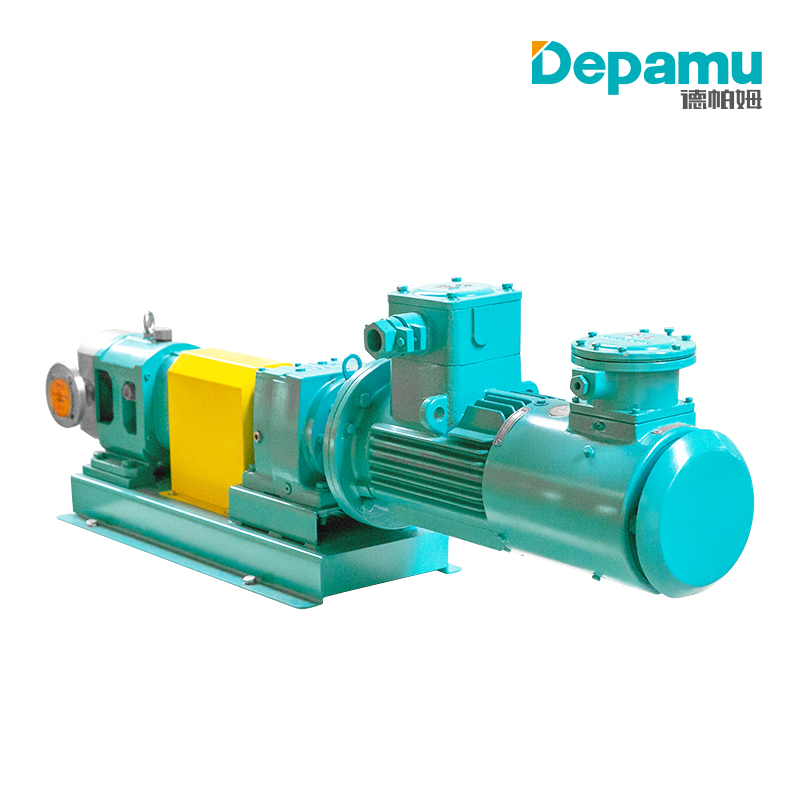
The Depamu metal rotor pump is a rotary lobe positive displacement machine. Two metal rotors, each with two or more lobes, rotate in synchronism within a close-clearance pump cavity. The rotors are driven by external timing gears and do not contact each other; a running clearance of 0.05 to 0.3 mm is maintained between the rotors and between each rotor and the casing, with the exact figure selected according to the viscosity and characteristics of the medium being handled. As the rotors turn, the working volume on the suction side expands, drawing fluid into the cavity; on the discharge side the volume contracts, and the fluid is expelled under pressure. The surface tension of the liquid assists in sealing the clearance, so that volumetric efficiency is maintained without metal-to-metal contact in the pumping chamber.
This construction has several consequences relevant to crude and heavy oil service. Because the rotors do not touch, the pump can run dry for short periods without seizing, and it can tolerate the fine abrasive solids that are routinely present in produced crude. Because the geometry is non-contacting and the speed is low—Depamu lobe pumps operate at speeds up to 720 r/min, with many models rated to 500 r/min or less—shear exposure is modest, which matters for emulsions and for crudes whose asphaltene stability can be disturbed by mechanical agitation. The pump is also reversible, a practical advantage in tanker unloading and pigging operations where flow direction may need to be reversed to clear a line.
Depamu manufactures the metal rotor pump through its subsidiary Keniluowa (Hangzhou) Industrial Equipment Co., Ltd., whose lobe pump range is designed in accordance with API 676, the American Petroleum Institute standard for positive displacement rotary pumps. The CLZ series spans displacements from 0.06 L/r to 50.4 L/r, with port sizes from 25 mm to 300 mm and capacity coverage from fractional flow rates up to 400 m³/h in the standard metal-lobe configuration. Casing and rotor materials are selectable from cast steel, 304 and 316L stainless steel, duplex 2205, titanium alloys, and Hastelloy C, with PTFE and other elastomeric options for sealing elements. This material flexibility is not incidental: crude service frequently involves chlorides, H₂S, naphthenic acids, and temperature excursions that rule out a single default metallurgy.
3. Performance Envelope Relevant to Heavy Hydrocarbon Service
The published performance envelope of the Depamu lobe pump line places its upper viscosity limit at approximately 1,500,000 cP for the metal-lobe CLZ range, with company literature for the broader rotor pump family citing capability up to 2,000,000 cP under appropriate configurations. Solid handling is rated at up to 60% solids content by volume, and the pump is designed for multiphase service—liquid, gas, and solid mixtures—without the flow instability that would be expected from a centrifugal machine under the same conditions. Self-priming capability extends to a suction lift of up to 8 to 9 meters, which simplifies tank and pit emptying operations and reduces the need for flooded suction arrangements.
Discharge pressure ratings vary by model and configuration. The standard CLZ metal-lobe range is tabulated to 12 bar, while the broader Depamu Rotor Pump family is quoted with discharge pressures up to 1.5 MPa in standard form and up to 3.0 MPa in multistage or double-support configurations. For petrochemical service, the more important point is that flow remains essentially constant as discharge pressure varies, because the positive-displacement action delivers a fixed volume per revolution. This characteristic allows flow to be controlled by speed adjustment—via variable-frequency drive or mechanical variator—rather than by throttling, which is both more energy-efficient and gentler on the fluid.
The low operating speed is a further reliability factor in abrasive service. Wear scales approximately with the square of sliding speed in clearance passages, so a lobe pump turning at 200 to 400 r/min will outlast a higher-speed rotary machine in the same solids-laden duty. Depamu addresses wear at the most exposed points through replaceable rotor tips and replaceable axial and radial bushings, allowing the wetted end to be refurbished without replacing the entire rotor set. An internal overflow valve is available to protect the pump against overpressure caused by downstream blockage or valve mis-operation, a more continuously effective safeguard than an external relief valve that may remain idle for long periods and fail when called upon.
4. Application in Crude Oil and Heavy Oil Operations
Depamu positions its rotor and Screw Pump lines explicitly for crude oil, thick oil, catalysts, polymers, oil sludge, and oily sewage in petroleum and petrochemical service. The metal rotor pump fits into this portfolio at the points where viscosity is high, solids are present, and flow must be predictable.
Crude receiving and tank farm transfer. Tanker and railcar unloading, tank-to-tank transfers, and tank emptying all involve fluids whose viscosity varies with temperature and whose solids load increases as a tank is drawn down toward the sludge layer. The self-priming capability and reversible rotation of the lobe pump simplify line stripping and direction changes, while the positive-displacement characteristic maintains flow rate as suction conditions degrade.
Heavy oil and residue transfer. Vacuum residuum, atmospheric bottoms, and heavy fuel oil streams are moved at elevated temperatures but still present viscosities that would overwhelm a centrifugal pump. The lobe pump's ability to handle high viscosity without dilution or excessive heating reduces the energy and diluent costs associated with centrifugal-based transfer schemes.
Sludge and oily waste handling. Refinery and terminal operations generate oily sludge, tank bottoms, and separator underflow that contain both high-viscosity hydrocarbon and abrasive particulate. The non-contacting rotor geometry and the 60% solids rating make the metal rotor pump a practical choice for these intermittent, heavily contaminated duties, where a centrifugal pump would suffer rapid erosion and clogging.
Catalyst and additive streams. The petrochemical industry also uses rotor pumps for catalyst slurries and polymer injection streams, where shear sensitivity and the need for a steady, pulsation-free flow argue against rotodynamic equipment. The lobe pump's low internal velocities and gentle volume displacement are compatible with fluids that would be degraded by the high shear of an impeller.
Multiphase and produced-fluid service. Depamu literature describes faultless delivery of liquid–gas–solid mixtures through the rotor pump family, and this capability is relevant to upstream and early midstream operations where crude is not yet fully degassed or separated. The ability to pump a three-phase mixture without gas locking is a direct advantage over centrifugal equipment in this setting.
5. A Note on Selection and System Integration
The metal rotor pump is not a universal replacement for every crude transfer duty. At low viscosity and high flow, a centrifugal pump remains the more economical and compact choice; the crossover point in most engineering practice lies somewhere between 50 and a few hundred centistokes, depending on system head and energy cost. The Depamu lobe pump earns its place where viscosity is high enough that centrifugal efficiency collapses, where solids or multiphase flow would cause a centrifugal impeller to clog or wear, or where flow must be held steady against a varying discharge pressure.
Proper integration also requires attention to NPSH, seal selection, and piping layout. Depamu offers mechanical seal options ranging from single to double and containerized arrangements, with flush plans configurable to the fluid and temperature. For high-temperature heavy oil service, seal flushing and cooling arrangements are not optional accessories but conditions of reliable operation. The pump's low speed helps here as well, reducing heat generation at the seal faces.
6. Conclusion
The Depamu metal rotor pump is best understood as a positive-displacement answer to a specific set of petrochemical fluid-handling problems: viscous crude that defeats centrifugal impellers, solids-laden heavy oil that erodes close-clearance rotodynamic machines, and multiphase streams that demand predictable volumetric delivery rather than pressure-dependent flow. Its API 676 design basis, viscosity capability in the millions of centipoise, 60% solids tolerance, self-priming behavior, and reversible low-shear operation are not isolated features but consequences of a single architectural choice—to move fluid by trapping and displacing a volume rather than by accelerating it. In an industry where feedstock quality is becoming heavier and more variable, that choice aligns the pump with the fluid rather than asking the fluid to accommodate the pump. For crude oil and heavy oil service in the petrochemical industry, this alignment is the measure of a pump's fitness for duty.