


The Depamu Chemical Dosing Pump for Ammonium Hydroxide (Liquid Ammonia): A Technical and Operational Analysis
Introduction
In the complex ecosystem of industrial fluid management, the accurate and safe handling of volatile chemicals remains one of the most significant engineering challenges. Among these challenging substances, ammonium hydroxide (NH₄OH)—commonly referred to in industrial settings as liquid ammonia or aqua ammonia—presents a particularly demanding application due to its corrosive nature, toxicity, and tendency to off-gas. DEPAMU (Hangzhou) Pumps Technology Co., Ltd. has positioned itself as a notable manufacturer in this niche, offering specialized dosing solutions designed to meet the rigorous demands of ammonia injection systems. This article provides a comprehensive examination of DEPAMU's chemical dosing pump systems for ammonium hydroxide, analyzing their technical specifications, operational principles, and critical safety features that make them suitable for this challenging application.
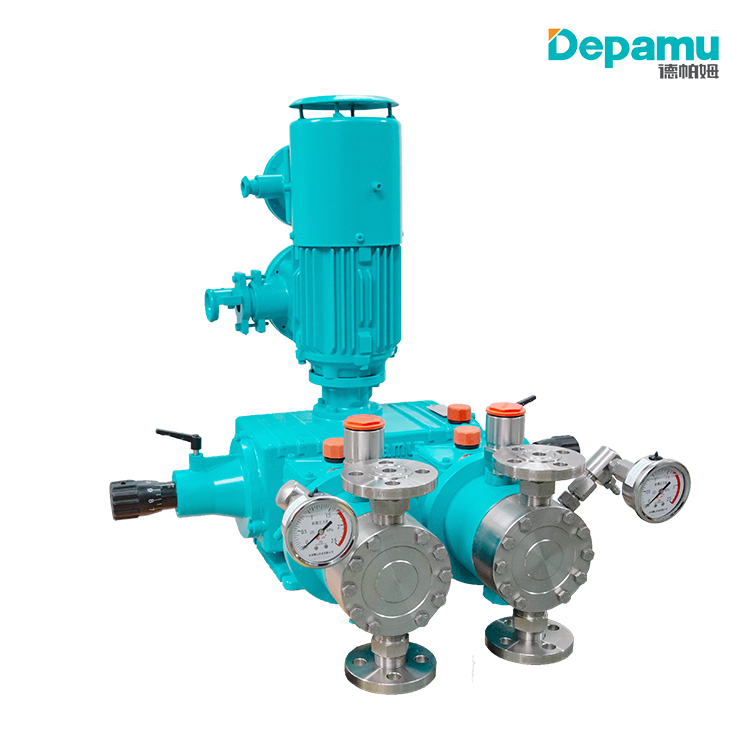
The Challenge of Ammonium Hydroxide Dosing
Ammonium hydroxide is a solution of ammonia gas in water, widely used in power generation, water treatment, and chemical processing for pH adjustment, particularly in boiler feed water systems. The thermal power industry, for instance, relies on ammonia Injection Packages to regulate the pH value of boiler water through automatic injection of ammonia solution, ensuring good quality of system water vapor and safe unit operation .
However, dosing ammonium hydroxide presents several formidable challenges. The chemical is corrosive to many common materials, has a high vapor pressure leading to off-gassing, and is toxic and volatile. These characteristics demand equipment that can maintain precise flow rates while preventing leakage and withstanding chemical attack. Standard Metering Pumps often fail in such applications due to seal degradation, material incompatibility, or inability to handle gas entrainment.
DEPAMU's Engineering Approach to Liquid Ammonia Applications
DEPAMU has developed a range of dosing solutions specifically addressing the unique requirements of liquid ammonia service. Their Reciprocating Pumps, designed according to the American Petroleum Institute standard API674, demonstrate the company's commitment to quality at a worldwide leading level . This standard is particularly significant for ammonia applications, as it ensures the pump can meet extremely severe working conditions and transport materials accurately and reliably.
The company's HD series—including models such as the HD3E(M), HD3H(M), and HD5J(M)—are specifically listed as suitable for liquid ammonia pump applications, along with other challenging media including ammonium carbamate, acetic acid cuprammonia, and liquid carbon dioxide . The breadth of this application list indicates that DEPAMU has designed these pumps with high-pressure, corrosive, and volatile media in mind.
Critical Design Features for Ammonia Service
Process Diaphragm Technology
The most critical design element in DEPAMU's ammonia Dosing Pumps is the process Diaphragm Pump configuration. This design ensures no leakage during transportation of toxic, flammable, or abrasive media with harsh requirements, without restriction from different fields . The diaphragm creates a hermetic seal between the hydraulic fluid and the process fluid, eliminating the dynamic seals that are the primary failure points in plunger-type pumps. This zero-leakage capability is non-negotiable when handling ammonia, where even minor fugitive emissions pose serious health and safety risks.
The diaphragm pump head can be configured with single or double diaphragm pump head structures, with a PTFE diaphragm driven mechanically without a protection plate at the feeding side, allowing smooth material transfer and safe operation . PTFE's exceptional chemical resistance makes it ideal for ammonia contact, while the mechanical drive system ensures reliable operation even under fluctuating process conditions.
Material Selection and Wetted Parts
Material compatibility is paramount in ammonia dosing. DEPAMU offers customization of wetted parts using materials including alloy steel, stainless steel, dual-phase steel, titanium, and Hastelloy . For less demanding ammonia applications, 304 or 316 stainless steel may be sufficient, but for higher concentrations or more aggressive conditions, the availability of duplex stainless steel and Hastelloy represents a significant advantage.
The solution tank, a critical component of the complete dosing package, can be manufactured from 316 stainless steel, 304 stainless steel, carbon steel, or carbon steel rubber liner (plastic), FRP, PE, or PVC according to different corrosion-resisting requirements . This range of options allows users to select the optimal material for their specific ammonia concentration and operating conditions.
Integration into Complete Dosing Systems
DEPAMU's ammonia dosing solution extends beyond the pump itself to encompass complete ammonia injection packages. These turnkey systems integrate the metering pump with solution tanks, level gauges, safety valves, pulsation dampers, valves, piping, and electrical control cabinets mounted on a single base frame . This modular approach offers several operational advantages: ease of installation, reduced footprint, and simplified maintenance.
The system can be configured with multiple pumps—typically one working pump and one standby pump—allowing for continuous operation during maintenance or in the event of pump failure. The ability to use solution tanks alternately or simultaneously through valve switching provides additional operational flexibility .
Control and Automation Capabilities
Intelligent Control Architecture
Modern ammonia dosing demands sophisticated control to respond to changing process conditions. DEPAMU's systems offer multiple control options, from local manual control to semi-automatic and fully automatic control . The fully automatic configuration represents the most advanced option, utilizing PLC, host computer, or DCS integration to adjust pump operation based on process signals.
Under automatic control, the system processes signals for flow rate, pH value, and electrical conductivity through PLC or DCS, automatically adjusting the rotation speed and stroke of the metering pump . The speed control input signal of the frequency converter is a standard 4~20mA signal, facilitating integration with existing control infrastructure. This closed-loop control ensures that the ammonia injection rate responds dynamically to process variations, maintaining optimal pH control.
Variable Frequency Drive Integration
The use of variable frequency drives (VFDs) provides a significant advantage for ammonia dosing applications. DEPAMU's pumps can be supplied with variable frequency speed control, allowing flow adjustment across a 0-100% range . This is particularly valuable in applications where the demand for ammonia varies significantly, such as in power plants during load changes, or in water treatment plants with variable influent characteristics.
The combination of VFD control with stroke adjustment offers exceptionally wide turndown ratios, allowing the pump to maintain accurate dosing even at very low flow rates. This precision is essential to prevent overfeeding or underfeeding of ammonia, both of which have negative consequences for process performance and regulatory compliance.
Operational Reliability and Maintenance Considerations
Extended Service Life
DEPAMU has designed their pumps for long service life in demanding applications. Bath lubrication of drive parts ensures extended longevity, while the maintenance intervals are specified as up to 4000 hours for pressures ≤1.0 MPa and up to 8000 hours for pressures ≤0.7 MPa . These intervals are significant in industrial settings where downtime is costly, and they reflect the durability of the mechanical design.
The use of industrial gear oil ISO VG 220 as the lubricant provides reliable performance across a wide temperature range (-35°C to +100°C), ensuring the pump remains operational in various ambient conditions .
Self-Cleaning Check Valve Design
One of the frequently overlooked aspects of ammonia dosing is the potential for crystallization or deposit formation. DEPAMU addresses this with check valves featuring a self-cleaning structure . This design helps prevent the accumulation of ammonium salts or other precipitates that can impair valve function and compromise dosing accuracy.
Pulsation Dampening
High-pressure ammonia dosing can generate significant pulsation in the discharge line, leading to piping vibration, measurement inaccuracies, and potential system fatigue. DEPAMU addresses this through the inclusion of pulsation dampers in the dosing package . The HD series pumps are noted for low pulsation, rendering stable transport of media . This is particularly important in ammonia injection applications where pulsation can affect the mixing of the ammonia into the water stream and compromise the pH control response.
Safety Considerations
Toxic and Volatile Media Handling
The use of DEPAMU's process diaphragm pumps for liquid ammonia underscores their safety-conscious design. The zero-leakage characteristic is the primary safety feature, eliminating the most common pathway for ammonia release to the atmosphere. Additionally, the compact modular structure reduces the number of potential leak points .
The inclusion of safety valves in the complete dosing package provides overpressure protection, a critical safeguard in ammonia systems where pressure excursions could lead to equipment failure and subsequent release . The ability to transmit all signals for metering pump and mixer state and fault to DCS or host computer allows for remote monitoring and alarm notification, enhancing operational safety through early detection of abnormal conditions .
Electrical and Instrumentation Safety
The electrical control cabinets can be designed for local and manual, semi-automatic, or fully automatic control, with remote start/stop capabilities allowing operators to shut down the system from a safe location if necessary . This remote operation capability is particularly valuable in ammonia applications, where operators should minimize exposure to the chemical.
Performance Specifications
DEPAMU's HD series reciprocating pumps demonstrate impressive performance parameters suitable for ammonia injection. The HD3E(M) model offers a flow range of 0.76-10.74 m³/h with pressure capabilities up to 50.9 MPa . The HD5J(M) model extends the flow range up to 78.99 m³/h with pressures reaching 83.5 MPa . This wide performance envelope allows DEPAMU to serve applications ranging from small water treatment plants to large-scale power generation facilities.
For applications requiring lower pressures and smaller flows, the DPMFX series solenoid dosing pumps provide flow rates up to 2300 L/h at pressures up to 1.2 MPa . These pumps offer a more economical solution while maintaining the material compatibility required for ammonia service.
Conclusion
DEPAMU's chemical dosing pumps for ammonium hydroxide represent a comprehensive engineering solution to a challenging industrial application. The combination of process diaphragm technology, corrosion-resistant materials, intelligent control systems, and complete package integration addresses the critical requirements of ammonia dosing: precision, reliability, and safety.
The design philosophy underlying these systems—adherence to API standards, modular construction, and flexible automation capabilities—positions DEPAMU as a credible supplier for industries requiring robust ammonia handling solutions. The provision of both High-Pressure Reciprocating Pumps and lower-pressure solenoid pumps ensures that appropriate solutions are available for diverse applications, from high-pressure boiler feed treatment in power plants to municipal water pH adjustment.
As industrial processes continue to demand higher levels of automation, accuracy, and safety, DEPAMU's ongoing development of ammonia dosing technology will likely remain relevant to the evolving needs of the thermal power, water treatment, and chemical processing industries