

A Technical Comparison of Depamu Mechanical Diaphragm Metering Pumps and PCM Lagoa Pumps
Introduction
In the industrial landscape, accurate fluid metering is critical across sectors ranging from water treatment and chemical processing to food and personal care. At the heart of these processes are metering pumps, which are designed to deliver a precise, adjustable flow of fluid against a certain pressure. Among the various types available, Mechanical Diaphragm Metering Pumps stand out for their ability to handle corrosive or hazardous fluids without leakage, thanks to the sealed diaphragm that separates the fluid from the mechanical drive.
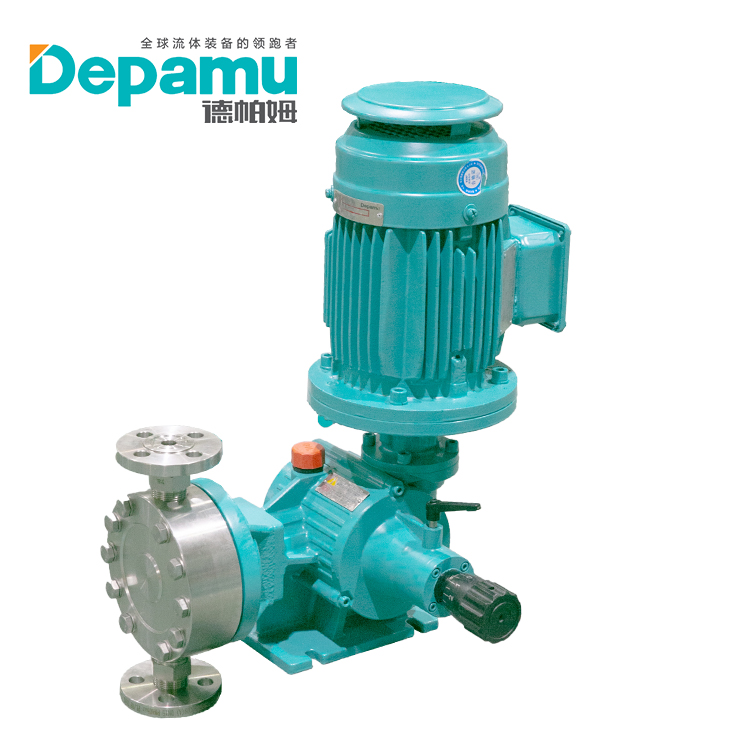
This report offers a detailed technical comparison between two prominent products in this category: the Depamu mechanical diaphragm metering pump and the PCM Lagoa pump. Both are robust, positive displacement Diaphragm Pumps, but as the analysis will show, they are engineered for different operational priorities. While Depamu's offering focuses on high-capacity fluid transfer and versatility at lower pressures, the PCM Lagoa pump is designed for high-precision metering with exceptional reliability and simplicity at higher pressures.
Pump Design and Working Principle
Both pumps operate on the same fundamental principle of a mechanical diaphragm driven by a motor, but their specific implementations differ.
Depamu Mechanical Diaphragm Metering Pump:
The Depamu pump utilizes a motor that drives a worm gear pair. This rotary motion is converted into a reciprocating movement of a slide rod through an eccentric mechanism. The slide rod then drives the mechanical diaphragm to perform periodic deformation, drawing in and then expelling the fluid . The design described for the DP-Series emphasizes a two-cylinder configuration, which contributes to a smooth and stable flow rate with reduced pulsation . This design is well-suited for applications involving very large flows.
PCM Lagoa Pump:
The PCM Lagoa pump employs a simpler and more direct mechanism. It is composed of a diaphragm connected to a piston. The alternating movement of this piston fills and empties the pumphead. Specifically, the backward movement of the diaphragm opens the bottom check valve, allowing fluid to enter and fill the chamber. The forward movement closes the bottom valve, opens the top valve, and expels the fluid . This is a classic, straightforward design that prioritizes reliability and ease of maintenance.
Performance and Specification Comparison
The most significant differences between the two pumps become apparent when comparing their performance specifications.
Flow Rate and Pressure:
The Depamu DP-Series is unequivocally a high-flow solution. It boasts a maximum flow rate per head of 3200 L/h . However, this high capacity is achieved at a moderate maximum discharge pressure of 0.6 MPa (6 bar) . It also features a turndown ratio of 10:1 . In contrast, the PCM Lagoa is designed for precision at a lower capacity but significantly higher pressure. Its maximum flow is 350 L/h , but it can achieve a maximum pressure of 12 bar . This makes the PCM Lagoa more suitable for injection applications where overcoming backpressure is crucial.
Accuracy:
Here, the PCM Lagoa demonstrates a clear advantage. It guarantees a metering accuracy of ±1% . The Depamu pump, while adequate for many transfer tasks, offers a steady-state accuracy of ±2% . For applications demanding highly repeatable and precise chemical dosing, the PCM Lagoa's performance is superior.
Other Specifications:
-
Stroke Adjustment: Both pumps offer an adjustment range of 0-100% . Depamu highlights options for manual, electric, and variable frequency stroke adjustment . PCM Lagoa uses a micrometer dial with vernier scale and offers an option for electric servo control .
-
Temperature: The PCM Lagoa can handle fluids up to 90°C , while the Depamu's limit is dependent on the pump head material, reaching up to 80°C with PTFE .
-
Temperature: The PCM Lagoa can handle fluids up to 90°C , while the Depamu's limit is dependent on the pump head material, reaching up to 80°C with PTFE .
Key Features and Application Focus
The Depamu Pump: Designed for High-Capacity Transfer and Flexibility
The primary strength of the Depamu mechanical diaphragm metering pump lies in its large flow capacity and flexibility. Its two-cylinder design and the ability to use different pump heads to transport various fluids make it a powerful tool for bulk transfer and large-scale metering . It is an ideal choice for applications requiring the movement of a high volume of fluid, such as in water treatment plants, chemical mixing, or any process where the focus is on moving significant quantities with moderate accuracy. The option for a double diaphragm pump head structure also points to applications where redundancy or safety is a priority .
The PCM Lagoa Pump: Engineered for Precision and Reliability
The PCM Lagoa pump is built for applications where precision and reliability are paramount. Its robust cast aluminum construction and IP55 motor ensure a long service life and low maintenance . Key features include a pre-formed PTFE diaphragm reinforced with elastomer, ensuring chemical inertness and long-term reliability . The ability to run dry without damage adds a layer of operational safety . Furthermore, the pumphead is designed for easy removal and changing, simplifying maintenance . The Lagoa's strength is its versatility in metering a wide variety of products across chemical engineering, environmental, food, and personal care industries . Its precise metering and ability to handle higher pressures make it ideal for injecting additives, disinfectants, acids, or polymers into a system.
Maintenance and Durability
Both manufacturers have addressed the need for reliable operation. Depamu's pump features bath lubrication for its drive parts, ensuring a long service life, with maintenance intervals up to 8000 hours depending on pressure . The PCM Lagoa is designed for simplicity, with the bearings "greased for life," making the motor virtually maintenance-free . The pumphead's easy removal also simplifies any necessary maintenance or replacement.
Conclusion
In summary, the choice between the Depamu mechanical diaphragm metering pump and the PCM Lagoa pump is not about which is "better," but which is more appropriate for the specific task.
Depamu is a high-capacity workhorse. Its value proposition is in its ability to move large volumes of fluid reliably with reasonable accuracy, making it suitable for transfer applications or processes that prioritize volume over pinpoint accuracy and pressure.
PCM Lagoa is a precision instrument. It is the superior choice for applications that demand accurate, repeatable dosing against higher system pressures. Its robust and simple design, combined with its ±1% accuracy, makes it the preferred pump for critical industrial, food, and chemical processes where the exact amount of additive or reagent must be introduced. The technical choice ultimately hinges on the specific requirements of the application: prioritize volume and lower pressure or precision and higher pressure.