

Depamu Hydraulic Diaphragm Metering Pumps: Precision Chemical Dosing Solutions for Water Treatment
Introduction
In the complex landscape of modern water treatment, precise chemical dosing is not merely an operational preference—it is an environmental and regulatory imperative. Whether adjusting pH in municipal drinking water, injecting coagulants in industrial wastewater treatment, or maintaining sanitizer levels in swimming pool water, the accuracy and reliability of chemical Dosing Pumps directly determine treatment efficacy, operational costs, and regulatory compliance. Among the various technologies available, Hydraulic Diaphragm Metering Pumps have emerged as the gold standard for demanding dosing applications. Depamu (Hangzhou) Pumps Technology Co., Ltd., a Chinese manufacturer with roots dating back to the early 1990s, has established itself as a prominent player in this field. This article provides a comprehensive examination of Depamu's hydraulic diaphragm metering pumps, exploring their design philosophy, technical specifications, operational advantages, and critical role in water treatment applications—with particular emphasis on their use as pool acid chemical dosing pumps.
Company Background and Technological Heritage
Depamu (Hangzhou) Pumps Technology Co., Ltd. is headquartered in the National High-tech Development Zone of Hangzhou, China, and specializes in the manufacture of metering pumps, dosing pumps, high-pressure Reciprocating Pumps, petrochemical pumps, and packaged chemical dosing devices. The company's technological trajectory took a significant leap at the beginning of the 1990s when it introduced hydraulic diaphragm metering pumps of the high-new series, along with advanced mixed-type dosing device technology and scientific management practices from Germany. This strategic technology transfer positioned Depamu to compete at an internationally advanced level.
The company's commitment to quality is evidenced by its adherence to rigorous international standards. Depamu's products conform to API 674 and API 675 standards of the American Petroleum Institute and have earned certifications from internationally recognized authorities including DNV, ISO 9001:2000 Quality Management System, and CE European Community Certification. These credentials underscore the company's dedication to manufacturing equipment that meets global expectations for safety, reliability, and performance.
Depamu's products have found application across a diverse range of industries, including oil and gas exploitation, petroleum refining, chemical processing, power generation, pharmaceuticals, food production, and—critically—water treatment. The company serves as a long-term strategic partner to major Chinese energy enterprises such as CNPC, Sinopec, and CNOOC, and exports to more than twenty countries and regions including Russia, Brazil, Germany, Australia, Iran, and Turkmenistan.
Fundamental Operating Principle of Hydraulic Diaphragm Metering Pumps
To appreciate the capabilities of Depamu's hydraulic diaphragm metering pumps, it is essential to understand their underlying operating principle. Unlike mechanical Diaphragm Pumps, which rely on direct mechanical linkage to drive the diaphragm, hydraulic diaphragm pumps employ a hydraulic fluid as an intermediate medium between the驱动 mechanism and the process diaphragm.
The motor drives a worm gear pair, converting rotary motion into reciprocating movement through an eccentric mechanism. This reciprocating motion actuates a plunger within a hydraulic chamber filled with oil. The hydraulic fluid, in turn, transmits this motion to the process diaphragm, which undergoes periodic deformation to alternately draw in and discharge the process fluid. This hydraulic amplification system offers several distinct advantages: it provides superior protection against overpressure conditions, enables higher discharge pressures than mechanical designs, and ensures exceptionally smooth, pulse-minimized flow.
Key Technical Specifications and Performance Parameters
Depamu offers an extensive portfolio of hydraulic diaphragm metering pump models, each engineered to address specific flow and pressure requirements across the water treatment spectrum. The company's product nomenclature typically follows a systematic pattern—for instance, the 3DP(M)DAA series, DP(M)TA series, DP(M)XAA series, and DP(M)WA series—each representing different flow capacities, pressure ratings, and configuration options.
Flow Rate and Pressure Capabilities
The flow rate capabilities of Depamu's hydraulic diaphragm metering pumps span an exceptionally wide range. The DP(M)WA series, for example, offers flow rates from as low as 75 L/h up to 212 L/h, with corresponding discharge pressures reaching up to 61.7 MPa depending on configuration. For higher-capacity requirements, the 3DP(M)DAA series delivers flow rates ranging from 360 L/h to 2,970 L/h, with discharge pressures from 7.5 MPa to 71.3 MPa. The DP(M)XAA series provides more modest flows from 8 L/h to 85 L/h but maintains pressures up to 51.3 MPa. The DP(M)TA series bridges the gap with flows from 200 L/h to 2,300 L/h and pressures reaching 72.2 MPa. For the largest applications, the multi-head 2DP(M)DAA series achieves flows up to 1,480 L/h per head with pressures up to 71.3 MPa.
Metering Accuracy and Flow Adjustment
Precision is the defining characteristic of any metering pump, and Depamu's hydraulic diaphragm units deliver industry-leading performance in this regard. The metering accuracy is specified at ±0.5%, ensuring that chemical doses are delivered with exceptional consistency. This level of precision is particularly critical in applications such as pool acid dosing, where even minor deviations in pH can affect water quality, equipment longevity, and bather comfort.
The flow rate adjustment range spans 10% to 100% of full capacity, providing operators with broad flexibility to respond to varying treatment demands. Importantly, the stroke can be adjusted steplessly from 0% to 100% through the patented integrated sleeve adjustable eccentric transmission mechanism. Depamu offers multiple flow rate adjustment modes to suit different operational requirements, including manual adjustment, electrical actuation, pneumatic control, and frequency conversion (variable frequency drive) adjustment. This versatility allows seamless integration into both simple manual systems and sophisticated automated treatment plants.
Temperature and Material Compatibility
Water treatment applications frequently involve aggressive chemicals, including strong acids, bases, and oxidants. Depamu addresses this challenge through careful material selection. The allowable maximum pumping temperature for fluid is PVC ≤ 40°C and PTFE ≤ 80°C. Wetted parts can be fabricated from a comprehensive range of materials including 304 stainless steel, 316 stainless steel, 316L stainless steel, PVC, PVDF, PP, and PTFE. This material flexibility ensures chemical compatibility with virtually any water treatment chemical, from sulfuric acid and sodium hypochlorite to polymer flocculants and phosphate-based corrosion inhibitors.
Design Features and Engineering Excellence
Depamu's hydraulic diaphragm metering pumps incorporate numerous design features that collectively contribute to their reliability, safety, and operational longevity.
Leak-Free Operation and Safety
Vertical motor installation ensures safety without leakage, a critical consideration when handling hazardous chemicals. The hydraulic diaphragm design inherently provides a hermetic seal between the process fluid and the atmosphere, eliminating the fugitive emissions and leakage risks associated with packed plunger pumps. This feature is particularly valuable in pool acid dosing applications, where hydrochloric acid or sodium bisulfate solutions pose significant corrosion and safety hazards.
Automatic Air Discharge and Oil Replenishment
Each hydraulic diaphragm pump contains internal safety valves and compensation valves that realize automatic air discharge and oil replenishment. This self-maintaining hydraulic system ensures consistent performance over extended operating periods without manual intervention. The automatic air venting feature prevents hydraulic lock and ensures stable diaphragm movement, while the oil replenishment system maintains proper hydraulic fluid levels to compensate for normal losses.
Integrated Worm Gear Transmission
The integrated worm gear serves as a variable speed transmission mechanism, featuring low noise and high efficiency. This design choice contributes to the pump's overall energy efficiency while minimizing acoustic emissions—an important consideration in urban water treatment facilities and pool equipment rooms where noise constraints may apply.
Patented Eccentric Transmission Mechanism
The adoption of a patented integrated sleeve adjustable eccentric transmission mechanism provides simple, reliable operation. This mechanism enables stepless stroke adjustment across the full 0-100% range, delivering precise flow control without the complexity and maintenance requirements of more elaborate transmission designs.
High-Precision Check Valves
Inlet and outlet high-precision check valves effectively guarantee metering accuracy and fluidity. These valves ensure positive displacement characteristics, preventing backflow and maintaining dosing consistency even under varying suction and discharge pressure conditions.
Durable Sealing Components
High-performance plungers, special packing, diaphragms, and sealing components provide long service life and excellent sealing performance. Depamu's diaphragm design is particularly noteworthy—the PTFE diaphragm is driven mechanically without a protection plate at the feeding side, allowing smooth material transfer and safe operation. The elimination of a protection plate reduces potential failure points and simplifies maintenance.
Oil-Immersion Lubrication
Oil-immersion lubrication ensures reliable use of the transmission mechanism for the long term. This lubrication system reduces wear on moving parts, extends component life, and minimizes maintenance frequency. For mechanical diaphragm variants, grease lubrication is employed with maintenance intervals specified at ≤1.0 MPa for 4,000 hours and ≤0.7 MPa for 8,000 hours.
Multi-Head Configurations
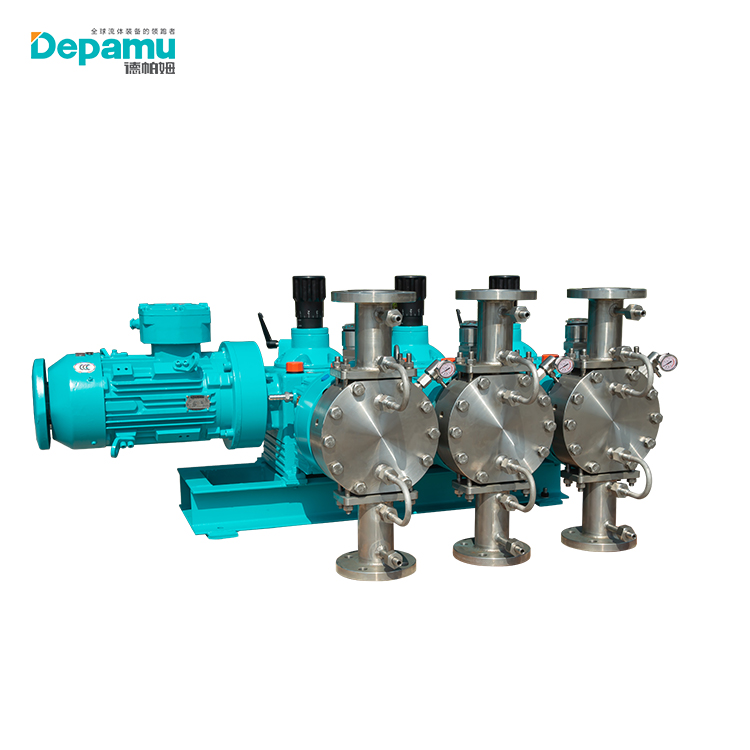
Depamu's hydraulic diaphragm pumps can be configured with multiple pump heads, allowing them to transport the same medium to reduce pulsation or transport different media as a proportioning pump with independent flow adjustment of each pump head. This multi-head capability is particularly valuable in complex water treatment processes requiring simultaneous dosing of multiple chemicals—for example, simultaneous addition of acid for pH adjustment, coagulant for solids removal, and disinfectant for pathogen control.
Applications in Water Treatment
Depamu's hydraulic diaphragm metering pumps serve a wide array of water treatment applications, each with unique demands and performance requirements.
Municipal Drinking Water Treatment
In municipal water treatment plants, precise chemical dosing is essential for producing safe, palatable drinking water. Depamu pumps are employed for the addition of coagulants (such as aluminum sulfate or ferric chloride) to remove suspended solids, flocculants (polymers) to enhance particle aggregation, disinfectants (chlorine, chloramines, or ozone) for pathogen inactivation, and corrosion inhibitors (phosphates or silicates) to protect distribution system infrastructure. The ±0.5% metering accuracy ensures that chemical doses remain within optimal ranges—sufficient to achieve treatment objectives without wasteful overdosing that increases costs and may create disinfection byproducts.
Industrial Water and Wastewater Treatment
Industrial facilities generate wastewater streams that require sophisticated treatment prior to discharge or reuse. Depamu pumps are used to dose pH adjustment chemicals (acids and bases), precipitation agents for heavy metal removal, oxidizing agents for organic destruction, and nutrient sources for biological treatment processes. The pumps' ability to handle aggressive chemicals and their wide material compatibility make them well-suited to the challenging chemical environments encountered in industrial wastewater treatment.
Swimming Pool Water Treatment
Swimming pool water treatment represents a particularly demanding application for chemical dosing pumps. Pool water must maintain specific pH levels (typically 7.2-7.8) to ensure bather comfort, optimize disinfectant efficacy, and prevent equipment corrosion and scale formation. The primary chemicals dosed in pool applications include:
-
Acid (typically hydrochloric acid or sodium bisulfate) for pH reduction when water becomes too alkaline
-
Chlorine (sodium hypochlorite or calcium hypochlorite) for disinfection
-
Algaecides for prevention of algal growth
-
Clarifiers for improved water clarity
Depamu's hydraulic diaphragm pumps are ideally suited for pool acid dosing due to their leak-free operation, corrosion-resistant wetted materials, and precise flow control. The ability to adjust flow rates from 10% to 100% of capacity allows pool operators to respond to varying bather loads, temperature changes, and source water quality fluctuations. The pump's ±0.5% metering accuracy ensures that acid additions are precisely metered, preventing the costly and potentially hazardous consequences of over-acidification or under-acidification.
Packaged Dosing Systems
In addition to individual pumps, Depamu offers integrated dosing skids that combine pumps, tanks, piping, and controls into complete, ready-to-install systems. These packaged solutions simplify installation, reduce engineering costs, and ensure system compatibility. The DPJY series dosing skids, for example, can incorporate hydraulic diaphragm pumps with solution tanks, mixers, and control systems tailored to specific water treatment requirements.
Advantages of Hydraulic Diaphragm Technology for Water Treatment
When compared to alternative metering pump technologies—including mechanical diaphragm pumps, plunger pumps, and peristaltic pumps—Depamu's hydraulic diaphragm design offers several distinct advantages for water treatment applications.
Superior Accuracy and Stability
The hydraulic transmission system provides exceptionally smooth diaphragm movement, minimizing flow pulsation and ensuring consistent dosing. The ±0.5% metering accuracy exceeds that of mechanical diaphragm pumps (typically ±2%), making hydraulic diaphragm pumps the preferred choice for applications requiring the highest precision.
Higher Pressure Capability
Hydraulic diaphragm pumps can achieve significantly higher discharge pressures than mechanical diaphragm designs. While Depamu's mechanical diaphragm pumps reach maximum pressures of 1.2 MPa, their hydraulic diaphragm counterparts achieve pressures exceeding 70 MPa. This high-pressure capability is essential for injection into pressurized pipelines and for overcoming backpressure from downstream equipment.
Enhanced Safety and Environmental Protection
The hermetic seal provided by the hydraulic diaphragm design eliminates leakage paths, protecting operators from chemical exposure and preventing environmental contamination. This is particularly important when handling hazardous chemicals such as acids, chlorine compounds, and toxic coagulants.
Extended Maintenance Intervals
The robust hydraulic design, combined with oil-immersion lubrication and durable sealing components, results in extended maintenance intervals and reduced total cost of ownership. The self-maintaining hydraulic system—with automatic air discharge and oil replenishment—further reduces the need for routine operator intervention.
Versatility and Adaptability
The availability of multiple pump head configurations, extensive material options, and diverse flow adjustment modes makes Depamu's hydraulic diaphragm pumps adaptable to virtually any water treatment application. Whether dosing a few liters per hour of acid to a small swimming pool or thousands of liters per hour of coagulant to a large municipal treatment plant, Depamu offers a model suited to the task.
Conclusion
Depamu's hydraulic diaphragm metering pumps represent a sophisticated, reliable, and precise solution for chemical dosing in water treatment applications. With roots in German technology transfer and a commitment to international quality standards, Depamu has developed a product portfolio that meets the demanding requirements of municipal water treatment, industrial wastewater management, and swimming pool chemical dosing—including the critical application of pool acid dosing.
The pumps' key attributes—±0.5% metering accuracy, 10%-100% flow adjustment range, leak-free hydraulic diaphragm design, wide material compatibility, and multi-head configurability—position them as a versatile and cost-effective choice for water treatment professionals. As water quality regulations become increasingly stringent and treatment processes more sophisticated, the demand for precision dosing equipment will continue to grow. Depamu, with its proven technology and global presence, is well-positioned to meet this demand, delivering pumps that combine accuracy, reliability, and safety in a single integrated package.
For water treatment facilities seeking to optimize chemical dosing performance, reduce operational costs, and enhance process reliability, Depamu's hydraulic diaphragm metering pumps offer a compelling solution—one that has been validated through decades of service in some of the world's most demanding industrial and municipal applications