

Depamu Plunger Pumps for Moving 5 mm Solids in Mining Slurries
1. Introduction
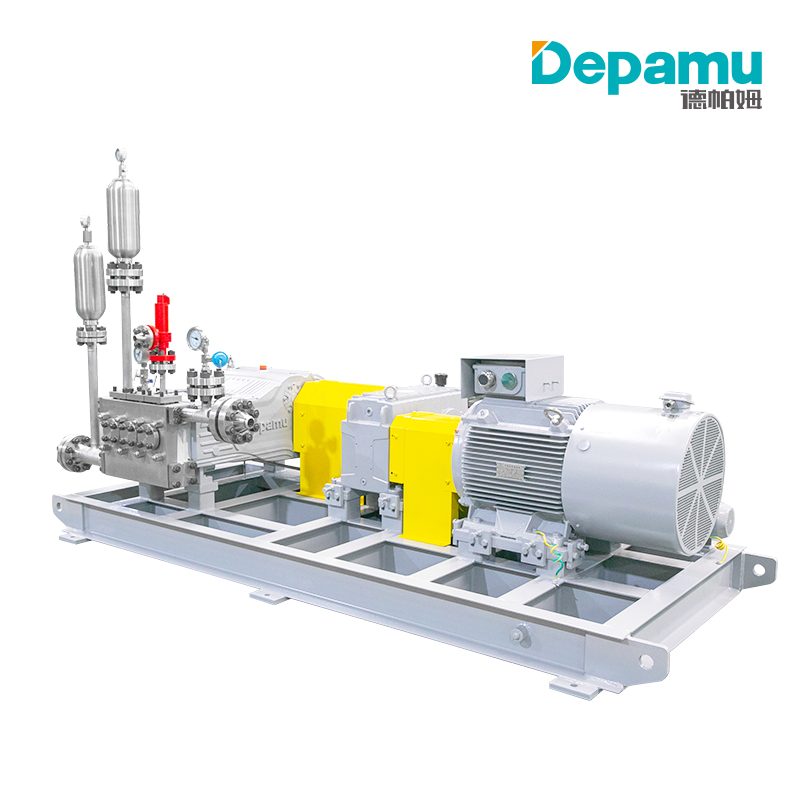
The mining industry relies on efficient and reliable slurry transportation systems to move ore, tailings, and process water across vast distances and challenging terrains. Among the most demanding applications is the pumping of slurries containing solid particles in the 5 mm range—a particle size that sits at the critical boundary between fine and coarse solids classification in mineral processing. At this threshold, conventional centrifugal pumps begin to show significant limitations in terms of wear, efficiency loss, and valve blockage, making positive displacement solutions increasingly attractive. Depamu, a pump manufacturer specializing in high-pressure reciprocating and Diaphragm Pump technologies, has developed plunger and hose diaphragm pump configurations that are particularly well-suited to handling highly viscous fluids with entrained particles. This article examines the technical principles, operational characteristics, and practical advantages of Depamu plunger pumps when applied to the transportation of mining slurries containing 5 mm solid particles, drawing on available product specifications, industry standards, and slurry pump selection guidelines.
2. The Challenge of 5 mm Solids in Mining Slurries
2.1 Particle Size Classification and Pump Selection
In mineral processing, particle size is a primary determinant of pump type selection. Industry guidelines classify everything larger than 5 mm as coarse particles, and this threshold carries significant engineering implications. For slurries with particles above 5 mm, metal pump components are generally recommended over rubber, because the impact forces exerted by coarser particles accelerate the degradation of elastomeric materials. Conversely, for sharp abrasive particles below 5 mm, rubber-lined components are preferred, as they offer better resistance to the sliding wear mechanisms that dominate in this size range. A 5 mm particle therefore occupies an ambiguous position: it is at the upper limit for rubber-lined centrifugal pump applications and at the lower boundary where positive displacement pumps begin to encounter valve-related challenges.
2.2 Limitations of Centrifugal Pumps at 5 mm
Centrifugal slurry pumps are typically the first choice for mining applications due to their lower initial cost and simpler maintenance. However, their performance degrades substantially when handling slurries with high solid concentrations and larger particles. When particle size increases from 5 mm to 20 mm, studies have shown reductions in pump head of over 10 metres and efficiency losses approaching 19%. More critically, centrifugal pumps struggle with slurries where solids exceed 50% by volume; above this concentration, the slurry becomes effectively impossible to handle with centrifugal technology, and only specialized positive displacement or vertical tank pumps remain viable. At 5 mm, the settling velocity of particles also becomes a significant concern, particularly in horizontal pipeline sections, where solids can accumulate and cause blockages that interrupt production.
2.3 Why Positive Displacement Pumps Are Preferred
Positive displacement pumps, including plunger and piston diaphragm designs, offer distinct advantages for slurries that require high pressure combined with high efficiency and elevated viscosity. Unlike centrifugal pumps, whose performance is highly sensitive to changes in slurry rheology, positive displacement pumps deliver a nearly constant volume of slurry per stroke, maintaining volumetric efficiency even as viscosity increases. This characteristic makes them particularly suitable for long-distance slurry transportation, mine backfilling, and tailings disposal operations. Positive displacement pumps typically achieve operating efficiencies in the 90% range, compared with a maximum of approximately 85% for centrifugal pumps at their optimal design point.
3. Depamu Plunger Pump Technology
3.1 Operating Principle
Depamu's high-pressure process hose diaphragm pumps operate through a crank-connecting rod mechanism that converts the rotary motion of a crankshaft into the reciprocating motion of a piston. This piston displaces hydraulic oil within a hydraulic chamber, which in turn transmits force and volumetric change to a hose diaphragm. The hose diaphragm undergoes cyclical squeezing, causing the internal fluid chamber to compress and relax, thereby creating the volumetric changes necessary for continuous fluid delivery through inlet and outlet check valve assemblies. This indirect displacement mechanism—where hydraulic oil serves as the force transmission medium—is a critical design feature that separates the abrasive slurry from the mechanical drive components, substantially reducing wear on the plunger and cylinder.
3.2 Technical Specifications Relevant to Mining Slurries
Depamu's plunger pump range offers specifications that are directly relevant to mining slurry applications. The pumps are designed for capacities ranging from 1 to 450 m³/h, with pressure ratings up to 34.5 MPa and a maximum fluid solid content of 80%. These parameters position the pumps well within the operational envelope required for typical mining slurry transportation, where solid concentrations of 40–70% by weight are common and discharge pressures frequently exceed 10 MPa for long-distance pipeline transport. The low-speed operation of the pumps—rated speed below 60 r/min—further contributes to reduced wear on internal components, as lower linear speeds of the piston and diaphragm reduce both abrasive and erosive damage.
3.3 Design Features for Solids Handling
Several design features make Depamu pumps particularly suitable for slurries containing 5 mm solids. The direct-through wheel and end pump head cavity without threaded parts minimize opportunities for particle accumulation and subsequent blockage. The inlet and outlet check valve jacket design facilitates maintenance and cleaning, which is essential when handling slurries that can precipitate or settle during operational pauses. The use of a hose diaphragm to separate the pumped fluid from the pump head eliminates direct contact between abrasive particles and the mechanical drive components, resulting in no wearing and no leaking in the fluid end. This separation is particularly important for 5 mm particles, which possess sufficient mass and momentum to cause significant impact damage if allowed to contact moving mechanical surfaces directly.
4. Key Advantages for 5 mm Solids Applications
4.1 Hydraulic Separation and Wear Reduction
The most significant advantage of Depamu's hose diaphragm configuration for 5 mm solids handling is the hydraulic separation between the abrasive slurry and the pump's mechanical components. In conventional direct-acting plunger pumps, the plunger contacts the slurry directly, and 5 mm particles can become trapped between the plunger and packing, causing scoring of the plunger surface and accelerated packing wear. By interposing a hose diaphragm between the hydraulic oil and the slurry, Depamu pumps eliminate this failure mode entirely. The diaphragm acts as a flexible barrier that transmits pressure while isolating the abrasive medium, and the absence of fluid contact with the pump head under this separation means that neither the plunger nor the cylinder liner is exposed to particle impingement.
4.2 High Solid Content Capability
Depamu's pump range is specifically designed to handle fluids with solid content up to 80%, making it suitable for the high-density slurries encountered in mining operations such as coal water slurry transfer, ore pulp transportation, and tailings management. At 5 mm particle size, achieving stable flow at high solid concentrations requires a pump that can generate sufficient suction pressure to overcome the settling tendency of the particles while maintaining discharge pressure to move the slurry through the pipeline system. The positive displacement principle ensures that each stroke delivers a fixed volume, regardless of variations in slurry density or viscosity, providing predictable and reliable transportation performance.
4.3 Low Pulsation and Stable Flow
The modular design of Depamu pumps, which allows multiple pump heads (up to 12) to be connected in parallel, enables the reduction of flow pulsation to levels comparable with centrifugal pumps while retaining the pressure and solids-handling advantages of positive displacement technology. This is particularly valuable in mining applications where downstream processes—such as hydrocyclones, thickeners, or flotation circuits—require stable feed rates for optimal separation performance. The low-pulsation characteristic also reduces fatigue loading on pipeline supports and joints, extending the service life of the entire transportation system.
5. Comparison with Alternative Pump Technologies
5.1 Centrifugal vs. Plunger Pumps for 5 mm Solids
The selection between centrifugal and positive displacement pumps for 5 mm solids transportation involves trade-offs between capital cost, operating efficiency, and maintenance requirements. Centrifugal pumps have lower initial and maintenance costs, and where possible, they are used instead of positive displacement pumps. However, centrifugal pumps are best suited for high-volume, low-to-moderate head applications, and their efficiency drops significantly when handling viscous slurries or slurries with high solid concentrations. For slurries containing particles in the 6–8 mm range, centrifugal pumps may not be suitable because large particles can cause valve sticking in positive displacement alternatives, but this same particle size also causes impeller wear and efficiency loss in centrifugal designs. At exactly 5 mm, the choice depends heavily on the specific slurry characteristics: solid concentration, particle shape and hardness, and required discharge pressure all influence the optimal selection.
5.2 Plunger Pumps vs. Piston Diaphragm Pumps
Within the positive displacement category, Depamu's hose diaphragm plunger pumps offer advantages over conventional piston diaphragm pumps. While both technologies use a diaphragm to separate the slurry from the drive mechanism, the hose diaphragm design provides a larger flow area with fewer obstructions, reducing the risk of blockage by 5 mm particles. The absence of threaded parts in the fluid chamber and the self-cleaning check valve structure further enhance the pump's ability to handle slurries that might otherwise cause operational interruptions. Additionally, the hydraulic oil cushion between the piston and the hose diaphragm provides a dampening effect that reduces the impact forces transmitted to the diaphragm during each stroke, extending diaphragm life in abrasive service.
6. Operational Considerations and Maintenance
6.1 Suction and Discharge Line Design
Effective transportation of 5 mm solids requires careful attention to suction and discharge line design. Suction lines should be kept as short and direct as possible to minimize the opportunity for particle settling before the slurry enters the pump. The settling velocity of 5 mm particles is significantly higher than that of finer particles, making adequate line velocity critical to preventing solids deposition in horizontal runs. Depamu pumps offer maximum suction lift of up to 8 metres of water column, providing flexibility in pump placement relative to the slurry source. The pumps can operate in both directions of rotation and accommodate flexible installation orientations, which is advantageous in the confined spaces typical of underground mining operations.
6.2 Maintenance Intervals and Wear Parts
Depamu pumps are designed with maintenance accessibility as a priority. The modular design and inlet/outlet valve jacket arrangement facilitate rapid inspection and replacement of wear components. Maintenance intervals vary with operating pressure: at pressures up to 1.0 MPa, the recommended interval is 4,000 hours, while at pressures up to 0.7 MPa, the interval extends to 8,000 hours. For mining applications where continuous operation is essential, this predictable maintenance schedule allows planned shutdowns rather than unplanned failures. The hose diaphragm rupture alarm system provides real-time monitoring of diaphragm integrity, enabling operators to detect and address potential failures before they result in slurry leakage or pump damage.
6.3 Control and Automation
Depamu's plunger pumps can be equipped with various flow control systems, including manual, electric, pneumatic, and variable-frequency drive options. Metering accuracy of ±0.5% is achievable across a 10–100% adjustment range, and remote automatic control can be implemented through electric actuators. This level of control precision is valuable in mining operations where reagent dosing, backfill slurry preparation, or tailings thickening processes require accurate volumetric control. The integration of pump control with plant-wide SCADA systems enables real-time monitoring of flow rates, pressures, and pump status, supporting predictive maintenance and process optimization.
7. Conclusion
The transportation of mining slurries containing 5 mm solid particles represents a demanding application that sits at the intersection of centrifugal and positive displacement pump capabilities. While centrifugal pumps can handle such slurries under favourable conditions of low solid concentration and moderate discharge pressure, their efficiency and reliability deteriorate rapidly as particle size, solid content, and viscosity increase. Depamu plunger pumps, with their hydraulic separation design, high solid content capability, and low-speed operation, offer a technically robust solution for these challenging conditions. The hose diaphragm configuration eliminates direct contact between abrasive particles and mechanical components, extending component life and reducing maintenance frequency. With pressure ratings up to 34.5 MPa, solid handling capability up to 80%, and capacity ranges suitable for both small-scale and large-scale mining operations, Depamu pumps provide a reliable and efficient means of transporting slurries that would cause unacceptable wear or operational instability in conventional centrifugal equipment. As mining operations continue to push toward higher solid concentrations and longer transportation distances to reduce water consumption and tailings surface area, the role of positive displacement pump technology in slurry management is likely to expand, and pumps specifically engineered for solids handling will become increasingly central to achieving operational efficiency and environmental objectives.