

In the landscape of modern industrial processing, corrosion represents a persistent threat to capital-intensive assets, particularly in sectors such as oil and gas production, petrochemical refining, thermal power generation, and water treatment. The introduction of corrosion inhibitors is a critical mitigation strategy, yet the efficacy of these chemicals is entirely dependent on the precision and reliability of the delivery system. The Depamu Corrosion Inhibitor Injection Skid addresses this challenge by providing a factory-engineered, modular solution that integrates storage, metering, control, and injection into a single, pre-assembled unit. This article provides a comprehensive technical analysis of the Depamu skid, exploring its mechanical design, operational mechanisms, adherence to international standards, material selection criteria, and diverse applications across heavy industry.
1. Introduction: The Necessity of Chemical Injection
Industrial process streams—whether crude oil, natural gas, boiler feedwater, or cooling water—are inherently corrosive. Dissolved oxygen, hydrogen sulfide, carbon dioxide, and various ionic species create electrochemical conditions that rapidly degrade carbon steel and other common construction materials . Left unchecked, this degradation leads to pinhole leaks, catastrophic pipe ruptures, maintenance downtime, and product contamination.
Corrosion inhibitors function by forming a protective molecular film on metal surfaces or by neutralizing aggressive species. However, these chemicals are only effective when introduced at a precise concentration. Under-dosing leaves assets vulnerable; over-dosing wastes expensive chemicals and can foul downstream equipment or violate environmental permits. Consequently, the engineering industry has moved away from makeshift injection setups toward standardized Chemical Injection Skids (CIS) .
The Depamu Corrosion Inhibitor Injection Skid represents the culmination of this engineering evolution. It is designed as a "plug-and-play" solution—self-contained, pre-piped, pre-wired, and factory-tested—designed to deliver inhibitor with Metering Pump accuracy and full system redundancy .
2. System Architecture and Mechanical Design
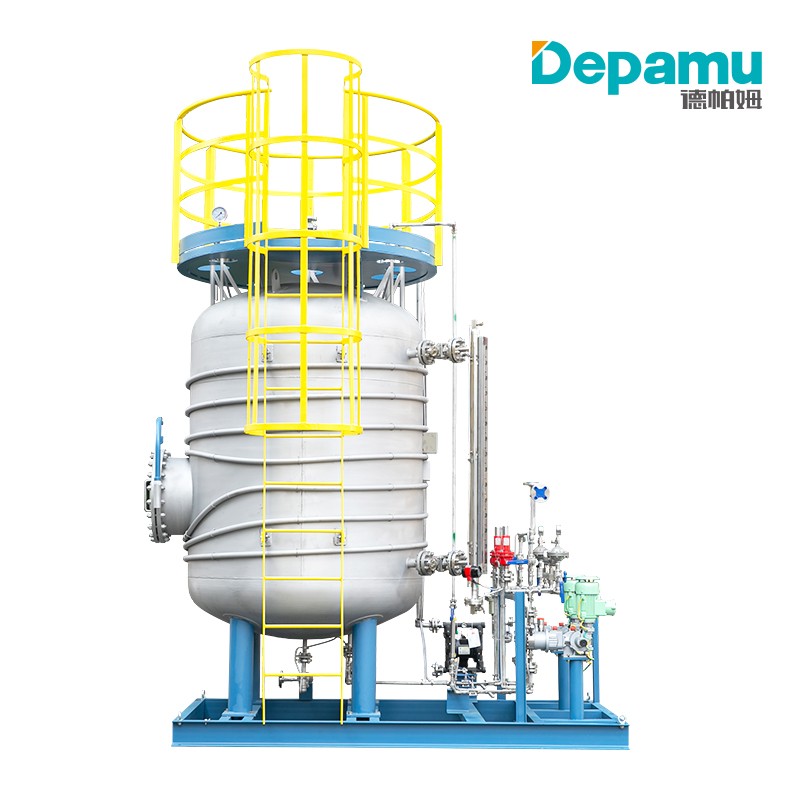
The philosophy behind the Depamu skid is modular integration. Unlike field-erected systems that require separate procurement and assembly of tanks, pumps, and piping, Depamu mounts all critical components onto a single structural steel base.
2.1 The Skid Frame
The base structure is typically fabricated from heavy-gauge steel beams (e.g., I-beams or channel iron), designed to withstand vibration, seismic activity, and the stress of lifting during transport. The frame features integrated forklift pockets and lifting lugs, complying with international rigging standards. A critical feature of the design is the inclusion of a full-perimeter drip tray or spill containment basin beneath the pump and tank area. This secondary containment is essential for environmental compliance, preventing chemical spills from reaching the plant floor .
2.2 Solution Tank (Chemical Storage)
At the heart of the skid is the solution tank. For corrosion inhibitor applications, Depamu offers tanks ranging from 0.5 m³ to 20 m³ depending on the application (small scale for power plants, large scale for oil gathering lines) .
-
Material Construction: Tanks are constructed from corrosion-resistant materials such as SS316L (stainless steel) or high-density polyethylene (HDPE). For particularly aggressive inhibitor formulations (e.g., high-acid scavengers), the tank may feature duplex steel (2205) or PTFE linings .
-
Features:
-
Magnetic Level Indicators (LG): For local, at-a-glance volume monitoring.
-
Level Transmitters (LSLL/LSL): Connected to the control system to trigger low-level alarms or auto-refill mechanisms.
-
Manways and Mixers: For powdered or viscous inhibitors, the tank is fitted with an electric mixer (agitator) to ensure solution homogeneity.
-
Heating/Cooling Jackets: Optional for viscous inhibitors that require temperature management to maintain fluid viscosity .
-
2.3 The Metering Pump (The Precision Engine)
The accuracy of the Depamu skid is defined by its metering pump. Unlike standard centrifugal pumps, metering pumps (usually reciprocating, diaphragm-type) offer precise displacement regardless of discharge pressure fluctuations.
Depamu typically configures these skids with API 675 compliant metering pumps . Specifications range from 10 L/H to 1000 L/H at pressures from 0.3 MPa to 4.0 MPa .
-
Duty/Standby Redundancy: A hallmark of industrial skid design is the "1 Tank + 2 Pumps" configuration. One pump serves as the primary "Duty" unit, while the second acts as a "Standby" unit. Pressure switches monitor the discharge line; if the duty pump fails, the standby unit automatically starts, ensuring uninterrupted chemical injection .
-
Pulsation Dampeners: Because Reciprocating Pumps create fluid pulsation, Depamu integrates pulsation dampeners (usually bladder-type) on the discharge side. This ensures a smooth, laminar flow into the process line, preventing "hammering" and extending the life of downstream piping .
3. Operational Mechanism: How the Skid Works
The Depamu Corrosion Inhibitor Injection Skid operates on a closed-loop feedback principle. The goal is to maintain a specific concentration (ppm) of inhibitor in the main process stream, typically measured by a corrosion rate monitor or redox potential.
Step 1: Chemical Preparation
The operator fills the solution tank with concentrated inhibitor, which is automatically diluted with water (or solvent) to the required working concentration. The mixer homogenizes the solution.
Step 2: Dosing Control
The control system (PLC) receives a 4-20 mA signal from the main process line—typically a flow meter measuring the parent fluid (oil, gas, or water flow rate) .
-
Calculation: The PLC calculates the required pump speed (stroke length and frequency).
-
Pacing: If the main process flow increases, the PLC tells the metering pump to stroke faster. If flow decreases, the pump slows down.
Step 3: Injection
The chemical is drawn from the tank through a strainer (to protect the pump from debris) and into the pump head. The pump pressurizes the fluid to slightly higher than the process line pressure. The chemical travels through a calibration pot (a transparent cylinder allowing operators to verify the actual flow rate via the "drop test" method) and a relief valve (set to protect the pump if the injection nozzle is blocked). Finally, the chemical passes through an injection quill—a special nozzle that extends into the center of the pipeline to ensure the chemical does not simply run along the pipe wall but is sheared into the turbulent core for immediate mixing .
Step 4: Safety Interlock
If the main process line pressure spikes above the pump’s rating, or if the tank runs dry, the system automatically shuts down the pump and triggers an alarm to the Distributed Control System (DCS).
4. Material Selection and Compliance
The selection of materials for a Depamu Corrosion Inhibitor Injection Skid is not arbitrary. It follows strict metallurgical and polymer guidelines based on the "inhibitor compatibility."
4.1 Wetted Materials
All components that touch the chemical (pump heads, valves, seals, and piping) must resist the specific chemistry of the inhibitor. Corrosion inhibitors are often alkaline (amines) or acidic. Consequently, Depamu utilizes Hastelloy C276, Titanium, or PVDF (Kynar) for the pump heads when handling aggressive sour service inhibitors . For standard applications, SS316L is the default standard .
4.2 Compliance and Standards
Depamu equipment is typically manufactured to meet or exceed:
-
ASME B31.3: Process Piping (ensures the piping on the skid is safe for the rated pressure) .
-
API 675: Positive Displacement Pumps (controls the manufacturing quality of the metering pump) .
-
NACE MR0175/ISO 15156: For sour service (H2S environments), ensuring materials are resistant to Sulfide Stress Cracking (SSC) .
-
ATEX/IECEx: For the electrical enclosures (motors, junction boxes) when the skid is located in Zone 1 or Zone 2 hazardous areas (gas and dust) .
5. Application Case Studies
The versatility of the Depamu Corrosion Inhibitor Injection Skid allows it to serve distinct industrial verticals:
5.1 Upstream Oil & Gas (Wellhead and Flowlines)
Challenge: Crude oil extracted from wells contains formation water (brine) and H2S/CO2 gases. As pressure drops along the flowline, corrosive conditions peak.
Solution: Depamu injects a film-forming corrosion inhibitor directly into the well annulus or the flowline header.
Configuration: High-pressure skids (up to 30,000 PSI) with small-volume, high-pressure Diaphragm Pumps . Often integrated with solar-powered control systems for remote wells.
5.2 Downstream & Refining (Overhead Condensers)
Challenge: In crude distillation units, the overhead system condenses HCl and H2S, creating a highly corrosive "sour water" zone.
Solution: Injection of neutralizing amines and filming inhibitors.
Configuration: Depamu utilizes low-flow, high-turndown ratio pumps to maintain a precise pH range of 5.5 to 6.5 in the overhead receiver, preventing tray and condenser tube failure.
5.3 Thermal Power Generation (Boiler Feedwater)
Challenge: Dissolved oxygen in boiler feedwater causes oxygen pitting in boiler tubes, leading to catastrophic rupture.
Solution: Injection of Oxygen Scavengers (often Hydrazine derivatives or carbohydrate-based chemicals) .
Configuration: Depamu integrates these skids with the deaerator level controls. The skid injects the oxygen scavenger downstream of the deaerator, reacting with residual ppb levels of oxygen to form harmless oxides. The control system utilizes a Redox (ORP) analyzer to close the loop.
5.4 Circulating Cooling Water
Challenge: Cooling towers expose metal surfaces to oxygen, biological growth, and scaling ions.
Solution:* Injection of scale inhibitors and corrosion inhibitors (e.g., zinc phosphate, molybdate, or organic azoles).
Configuration:* Skids often feature "2 Tank + 3 Pump" configurations where one tank holds corrosion inhibitor and another holds biocide, alternating injection cycles .
6. Control and Automation Philosophy
Modern Depamu skids are shifting from manual "stroke-length adjustment" to Intelligent Instrumentation.
6.1 The Control Panel
The skid includes a NEMA 4X (IP66) rated local control panel, often featuring an HMI (Human-Machine Interface) touchscreen. This panel houses the PLC (Programmable Logic Controller).
-
Local Mode: Operators use the HMI to prime pumps or run manual batch injections.
-
Remote Mode: The PLC receives commands (start/stop, setpoint) via Modbus TCP/IP or Profibus from the central plant DCS.
6.2 Advanced Diagnostics
Modern skids include vibration sensors on the pump motors and pressure transducers before and after the pump. The Depamu control logic can detect a "broken diaphragm" (if the pump loses prime) or a clogged injection quill (if backpressure spikes) and will switch to the standby pump while alerting maintenance via SMS or email.
7. Operational Advantages
The decision to purchase a Depamu skid over a field-erected system yields specific economic and operational benefits:
-
Reduced Installation Cost (Brownfield vs. Greenfield): While a skid has a higher upfront material cost than a loose pump and tank, the installation cost is drastically lower. A field-erected system requires weeks of scaffolding, welding, and electrical routing. A skid requires one crane lift and connecting "four points": Power in, Chemical suction (if bulk storage is remote), Injection line out, and Signal cable to the DCS .
-
Factory Acceptance Testing (FAT): Before the skid even leaves the Depamu factory, it is filled with water and run. All leaks are fixed, and all logic is verified. This "risk transfer" means the client does not discover fabrication errors during the plant outage window.
-
Footprint Optimization: In offshore Oil & Gas (FPSOs and platforms), space is the most expensive commodity. The vertical integration of the Depamu design minimizes the footprint compared to spreading components across the grating.
8. Maintenance Considerations
Despite its sophistication, the Depamu skid is designed for maintainability.
-
Calibration Pots: As mentioned, these are standard. Operators close the valve to the tank, open the valve to the pot, and measure how many milliliters are pumped in 1 minute. This mechanical verification is an ISO standard requirement for chemical injection .
-
Valve Access: The pump heads are arranged so that the suction and discharge check valves (the most common wear points in a reciprocating pump) are accessible without disassembling the entire piping manifold.
-
Flushing Ports: The skid includes water flushing ports to allow the operator to flush the entire system with clean water before working on the pump, preventing exposure to toxic inhibitors.
9. Future Trends: Industry 4.0 Integration
The Depamu Corrosion Inhibitor Injection Skid is evolving with the digital transformation of industry.
-
Cloud Connectivity: The PLC transmits real-time flow rates and tank levels to a cloud server. A plant manager in a central office can see exactly how much chemical was used at a remote wellhead in the last 24 hours via a cell phone app.
-
AI Predictive Maintenance: The system learns the normal vibration signature and power draw of the metering pump. If it detects a deviation (e.g., a 5% drop in flow at the same stroke rate), it predicts a valve leak before production is affected.
10. Conclusion
The Depamu Corrosion Inhibitor Injection Skid is far more than a pump on a frame; it is a mission-critical asset integrity module. By masterfully integrating precise hydraulics, rugged structural design, and intelligent control logic, Depamu provides industries with the confidence that their pipelines, vessels, and heat exchangers are receiving exactly the right dose of protection at exactly the right time.
For engineering managers facing the twin pressures of maximizing production uptime and minimizing environmental risk, the Depamu skid offers a standardized, proven, and highly reliable solution. Whether it is keeping a deep-water subsea Christmas tree free from hydrate blockages or ensuring a power station's boiler runs for another decade without tube failure, the Depamu Corrosion Inhibitor Injection Skid stands as the silent guardian of industrial infrastructure.