

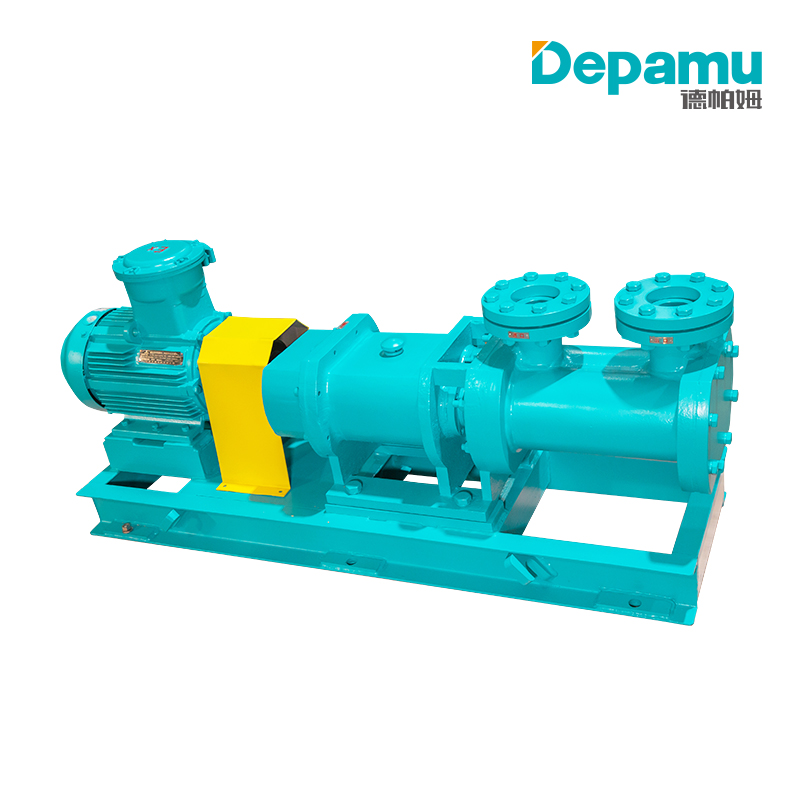
Depamu High-Efficiency Twin Screw Multiphase Pumps for Oil & Gas
Abstract
The global oil and gas industry faces persistent challenges in economically transporting unprocessed well streams, particularly from mature assets, offshore fields, and remote locations where conventional separation and single-phase pumping systems prove technically impractical or prohibitively expensive. Multiphase pumping technology has emerged as a transformative solution, enabling operators to boost commingled production directly from wellheads without separation. Among available technologies, twin-screw multiphase pumps (MPPs) have demonstrated superior reliability, operational flexibility, and cost-effectiveness across diverse applications. This article examines the technology, operational principles, performance characteristics, and economic benefits of twin-screw MPPs, with particular focus on Depamu (Hangzhou) Pumps Technology Co., Ltd., a leading Chinese manufacturer that has positioned itself as a competitive global supplier in this specialized segment.
1. Introduction
Since the beginning of the 21st century, energy security has driven intensified development of offshore and unconventional oil and gas resources. Produced well fluids—mixtures of crude oil, natural gas, water, and sometimes solids—must be transported from wellheads to processing facilities. Traditionally, this required phase separation at each wellsite, with separate pipelines for each phase—an approach that entails significant capital expenditure, operational complexity, and environmental footprint.
Multiphase pumping eliminates the need for upfront separation. A single multiphase pump can handle gas volume fractions (GVF) ranging from 0% to 100%, boosting the entire well stream through a single pipeline. This technology is particularly valuable for subsea tie-backs, marginal field development, and mature fields with declining reservoir pressure.
Twin-screw multiphase pumps, in particular, have proven their reliability in some of the most demanding operating conditions globally. With over 30 years of field experience and more than 600 installed references worldwide, twin-screw MPP technology has become an industry standard.
2. Depamu: A Rising Global Player
Depamu (Hangzhou) Pumps Technology Co., Ltd., established in 2003 and headquartered in Hangzhou Qiantang Area, is a high-tech enterprise specializing in R&D, production, and sales of fluid transfer equipment. The company has successfully applied for over 100 technical patents and holds API, CE, ISO 9001, ISO 14001, and ISO 45001 certifications. It also serves as a drafter of pump industry standards in China.
Depamu's product portfolio spans Metering Pumps, high-pressure process Reciprocating Pumps, Diaphragm Pumps, centrifugal pumps, cryogenic pumps, and—critically for the oil and gas sector—Screw Pumps including single-screw, twin-screw, and triplex-screw configurations. The company has established long-term strategic partnerships with China's national oil companies—CNPC, SINOPEC, and CNOOC—and exports to over 50 countries including the United States, the United Kingdom, France, and beyond.
The company's twin-screw multiphase pumps are engineered to meet the demanding requirements of upstream oil and gas production, offering capabilities comparable to established European and North American manufacturers at competitive price points.
3. Operating Principle of Twin-Screw Multiphase Pumps
Twin-screw multiphase pumps are positive displacement rotary pumps operating with two intermeshing, counter-rotating screws within a cylindrical housing. The screws feature flights of similar pitch but opposite direction. As the screws rotate in opposite directions, a series of enclosed chambers is generated between the screw flights and the pump housing.
3.1 Sealing and Compression Mechanism
The critical feature enabling multiphase operation is the internal leakage flow—a liquid slipstream that travels through the clearances between rotors and liner. This liquid provides the necessary sealing for gas compression and removes the heat generated during compression. The pump requires a minimum of 3% to 5% liquid at inlet conditions to maintain effective sealing and prevent gas locking.
The intermeshing screws are designed with gaps—between flights and between flights and the housing—as narrow as possible to minimize leakage flows during operation. However, these clearances are precisely controlled to accommodate thermal expansion, wear, and variations in fluid properties.
3.2 Handling Capabilities
Twin-screw MPPs can handle:
Low internal velocities and the absence of pulsations result in low stress to shear-sensitive liquids, making Twin-Screw Pumps suitable for emulsions and polymers.
4. Technical Challenges and Design Considerations
4.1 Gas Solubility Effects
A significant technical challenge in multiphase pumping is the solubility of gas in crude oil, which affects the gas fraction and pressure profile along the conveying process. Experimental investigations at Leibniz University Hannover have demonstrated that high solubility negatively affects delivery performance by reducing the gas fraction in the outlet pipe.
The research showed that for oil-CO₂ mixtures—where CO₂ is highly soluble—the two-phase volume flow was considerably lower and more volatile than for oil-air mixtures, particularly at high pressure differences and high gas fractions. These conditions must be regarded as critical operating points for twin-screw MPPs.
The absorbed shaft power is hardly affected by solubility; however, isothermal efficiency is negatively impacted, with the optimal pressure difference shifting to lower values as gas fraction increases.
4.2 Gap and Clearance Management
In multiphase reciprocating pumps, excessive clearance volume has been identified as a critical factor causing gas locking and efficiency reduction. As clearance volume increases, pressure and fluid velocity decrease, vortex flow intensifies, and the lag angle of discharge valve opening becomes larger. For twin-screw pumps, the internal clearances similarly must be optimized for the specific gas-liquid ratio and operating conditions.
4.3 Flow Regime Management
Experimental studies on multiphase pumps have revealed that as gas fraction increases, the flow regime inside the pump gradually transitions from bubbly flow to slug flow and gas cavity structures, leading to increased flow resistance and instability. Under low flow rates and sudden GVF surges, both pressure and torque can drop nearly to zero, resulting in a stall. Increasing rotational speed improves performance at low GVF but is insufficient to overcome instantaneous blockage and backflow caused by large gas cavities.
5. Operational Benefits and Economic Impact
5.1 Production Enhancement
Twin-screw MPPs enhance crude oil production by lowering backpressure on wells, reviving marginal wells, and increasing production by several hundred percent. Field trials at Saudi Aramco demonstrated that twin-screw MPPs custom-designed for low-flowing wellhead pressure wells achieved high operating efficiency and realized measurable oil gain.
5.2 System Simplification
The use of multiphase pumping eliminates the need for wellhead separators, compressors, and separate gas and liquid pipelines. The MPP unit acts as both a compressor and a pump, reducing equipment count, footprint, and capital expenditure. A simplified system layout results in:
-
Reduced capital costs (simpler facilities)
-
Reduced operating costs (less equipment to maintain)
-
Reduced space and weight (critical for offshore platforms)
5.3 Environmental Benefits
By eliminating flaring at wellheads, multiphase pumping systems help oil operators comply with environmental regulations and government mandates. The associated gas that would otherwise be flared becomes available for productive use as fuel or as an injection medium for enhanced oil recovery. Centralized processing away from producing fields also enables better control of fugitive emissions and involuntary flaring.
5.4 Extended Field Life
Multiphase pumps support natural reservoir pressure to increase and extend oil and gas production, particularly from mature fields where reservoir pressure has declined. By enabling longer production cycles from existing fields, operators can generate sizeable profit from assets that might otherwise be abandoned.
6. Midstream and Pipeline Applications
Beyond upstream production, twin-screw MPPs are increasingly applied in midstream pipeline operations for commingled transportation. In heavy crude oil and bitumen trunk lines, these pumps handle gas slugs that occur when diluent, condensate, or light hydrocarbons are injected—preventing upsets from gas breakout in suction lines with inadequate NPSHa.
A notable example is a 2,800 horsepower twin-screw pump serving a Canadian 24-inch, 60-mile long heated and diluent-injected heavy oil trunk line. The pump's gas handling capability and variable speed control enable it to start up a shut-in line slowly while maintaining full discharge pressure—a challenging requirement for centrifugal pumps.
As more centralized processing is adopted, multiphase pipelines are likely to expand, driven by economies of scale, lower facility costs, and environmental considerations.
7. Market Outlook
The global multiphase twin-screw pump market was valued at US$121 million in 2024 and is projected to reach US$143 million by 2031, growing at a compound annual growth rate (CAGR) of 2.5%. Key drivers include:
-
Deepwater and unconventional resource development requiring multiphase transport solutions
-
Smart oilfield initiatives driving demand for efficient, stable, and monitorable equipment
-
Environmental pressures to reduce flaring and fugitive emissions
-
Marginal field economics where system simplification is critical
Challenges include high technical barriers to manufacturing and integration, performance degradation from fluctuating gas-liquid ratios, and supply chain risks.
8. Conclusion
Twin-screw multiphase pumps represent a mature, proven technology that transforms the economics of oil and gas production and transportation. By eliminating separation, reducing equipment count, enabling production from marginal and mature assets, and minimizing environmental impact, these systems deliver compelling value across the upstream and midstream value chain.
Depamu (Hangzhou) Pumps Technology Co., Ltd., with over two decades of experience, more than 100 patents, and international certifications, has emerged as a credible global supplier in this specialized field. Backed by its strategic partnerships with China's national oil companies and an expanding international presence, Depamu is well-positioned to serve the growing demand for multiphase pumping solutions.
As the industry continues to push into deeper waters, more remote regions, and more challenging reservoir conditions, the role of twin-screw multiphase pumps—and the companies that manufacture them—will only become more critical. With the combination of advanced engineering, rigorous quality standards, and competitive cost structures, Chinese manufacturers like Depamu are poised to play an increasingly significant role in powering global energy production for decades to come.