

Depamu High-Pressure Reciprocating Pumps: Engineering Solutions for Coal-Water Slurry and Mineral Slurry Applications
Introduction
In the demanding landscape of industrial fluid handling, few challenges rival the complexity of pumping abrasive slurries under high-pressure conditions. Coal-water slurry (CWS) and mineral slurry represent two of the most punishing media that industrial pumps must contend with, combining high solids content, severe abrasion, and often corrosive chemical environments. DEPAMU, a manufacturer recognized for compliance with the American Petroleum Institute standard API 674, has developed High-Pressure Reciprocating Pumps specifically engineered to address these extreme operating conditions. This essay examines the technical characteristics, engineering principles, and application suitability of DEPAMU reciprocating pumps for coal-water slurry and mineral slurry transport.
The Challenge of Slurry Pumping
The fundamental difficulty in pumping coal-water slurry and mineral slurry lies in the physical properties of these media. Coal-water slurry consists of finely ground coal particles suspended in water, typically with solids concentrations exceeding 50% by weight. Mineral slurries present similar challenges, often containing abrasive particles such as alumina, ore concentrates, or tailings with particle sizes up to 2 millimeters and temperatures reaching 120 degrees Celsius.
These characteristics create several operational hazards for pumping equipment. Abrasive particles cause rapid wear on plungers, seals, and valve components. The settling tendency of high-density slurries demands consistent flow patterns to prevent blockages. Additionally, many slurry applications involve corrosive chemical environments, particularly in coal liquefaction processes where temperatures can range from 121 to 371 degrees Celsius. Conventional centrifugal pumps often prove inadequate for these applications due to efficiency losses and accelerated wear.
Reciprocating Pump Design Principles
DEPAMU's reciprocating pumps operate on the positive displacement principle, where a plunger or piston moves back and forth within a cylinder to displace fluid. This design offers distinct advantages for slurry applications. Unlike centrifugal pumps, which rely on impeller rotation and can suffer from erosion and efficiency degradation when handling abrasive media, reciprocating pumps maintain consistent volumetric output regardless of pressure variations.
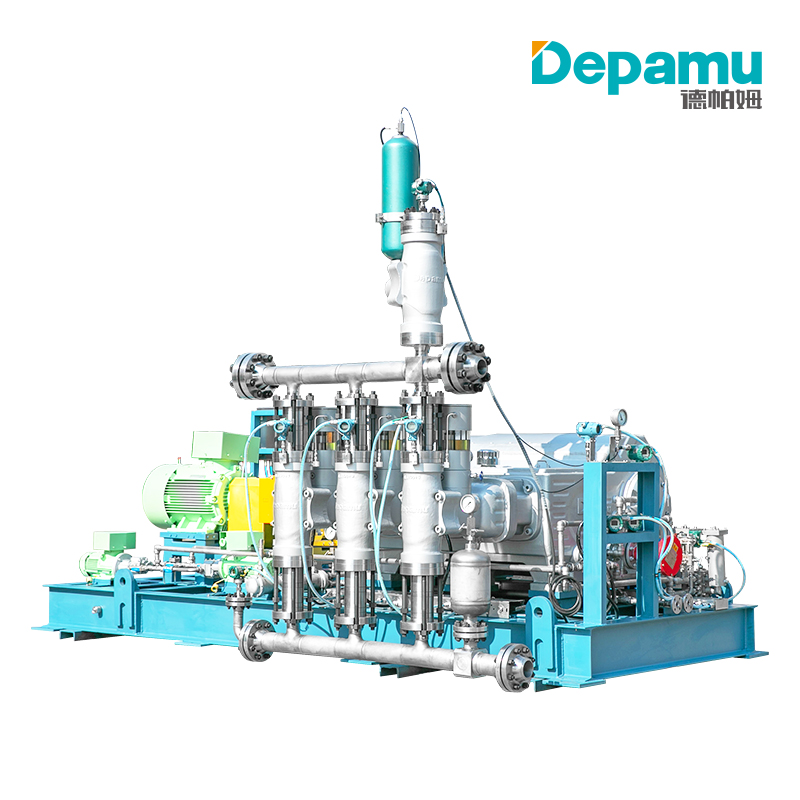
The compact modular structure of DEPAMU pumps contributes to their suitability for demanding installations. Available in horizontal, vertical, stationary, and mobile configurations, these pumps can be integrated into existing processing facilities with minimal spatial constraints. The drive end incorporates double helical gear mechanisms, reducers, or belt pulley systems, with power supplied by motors, diesel engines, or even solar energy sources.
Material Selection and Wear Resistance
Perhaps the most critical aspect of slurry pump design is material selection for wetted components. DEPAMU addresses this through offering multiple material options including alloy steel, stainless steel, duplex steel, titanium, and Hastelloy. This material versatility enables customization based on specific slurry characteristics—whether the primary concern is abrasion resistance, corrosion resistance, or both.
The wetted parts in reciprocating pumps must withstand continuous exposure to abrasive particles moving at high velocities. DEPAMU's engineering addresses this through robust plunger seal structures and wear-corrosion resistant valve configurations. For extreme applications, process Diaphragm Pump designs eliminate leakage entirely, making them suitable for toxic or volatile media transport.
API 674 Compliance and Quality Standards
DEPAMU's adherence to API 674 standards signifies a commitment to quality that meets worldwide leading levels. API 674 establishes rigorous requirements for reciprocating positive displacement pumps used in petroleum, chemical, and gas industry services. Compliance ensures that DEPAMU pumps meet international benchmarks for reliability, performance, and safety.
The company's patent portfolio further validates its technological capabilities. These patents cover innovations in pump architecture, sealing technology, and fluid dynamics that enhance performance in severe service conditions. For industries where pump failure can result in costly downtime and safety hazards, such certification provides essential confidence.
Performance Parameters for Slurry Applications
DEPAMU offers a range of pump models with performance characteristics suited to different slurry processing requirements. The HD3E(M) series, for instance, delivers flow rates from 0.76 to 10.74 cubic meters per hour with pressure capabilities extending to 50.9 MPa. The HD5P(M) series offers expanded flow ranges up to 96.89 cubic meters per hour and pressures reaching 104 MPa.
These pressure capabilities are particularly relevant for coal-water slurry applications in coal liquefaction processes. As described in technical literature on coal slurry pumping, such processes require elevating slurry pressure to enable chemical reactions under high-temperature, high-pressure conditions. DEPAMU pumps are explicitly listed as suitable for coal water slurry diaphragm pump applications, indicating their proven performance in this demanding field.
Diaphragm Technology for Leak-Free Operation
For applications involving toxic, corrosive, or volatile slurry components, DEPAMU's process diaphragm pumps offer an important solution. The diaphragm design isolates the pumped fluid from the reciprocating mechanism using a flexible membrane, preventing leakage while maintaining positive displacement characteristics.
This technology proves particularly valuable in coal liquefaction, where the slurry contains coal-derived liquids that may be water-immiscible and chemically aggressive. The diaphragm system ensures that abrasive solids remain contained within the fluid end, protecting the power end components from wear and contamination. Additionally, diaphragm pumps with alarm technology for damage detection provide early warning of potential failures, enabling preventive maintenance before catastrophic breakdowns occur.
Applications in Mineral Processing
Beyond coal-water slurry, DEPAMU pumps demonstrate versatility across mineral processing applications. The mining industry requires reliable pumping of pulp, mortar, and slurry containing particulate abrasive materials. DEPAMU's reciprocating pumps serve in thermal power plants, metallurgy, transportation, construction, and tailings backfilling operations.
The ability to handle high-concentration slurry at over 75% concentrate ratio, with particle dimensions under 2 millimeters, positions these pumps for challenging mineral processing duties. The combination of high pressure capability and abrasive media handling makes them suitable for dephosphorization applications in metallurgy and high-pressure cleaning operations.
Operational Considerations and Maintenance
Effective slurry pumping requires attention to operational parameters beyond pump selection. The erosive nature of slurries demands appropriate flow velocities to prevent settling while minimizing wear. DEPAMU's low pulsation design contributes to stable transport, reducing the cyclic stress on piping systems and downstream equipment.
For coal-water slurry specifically, temperature management presents additional considerations. Slurries containing coal-derived liquids may be processed at temperatures up to 371 degrees Celsius. At these temperatures, conventional aqueous motive fluids would boil, causing cavitation and foaming. DEPAMU's engineering supports the use of compatible motive fluids that remain stable at elevated temperatures, maintaining pump performance and reliability.
Conclusion
DEPAMU high-pressure reciprocating pumps represent a sophisticated engineering response to the demanding requirements of coal-water slurry and mineral slurry applications. Through compliance with API 674 standards, versatile material selection, and robust design incorporating diaphragm technology, these pumps address the key challenges of abrasive media handling: wear resistance, leak prevention, and reliable high-pressure operation.
The specific designation of DEPAMU pumps for coal water slurry diaphragm pump applications confirms their suitability for one of the most challenging industrial pumping duties. As coal liquefaction and mineral processing continue to demand higher pressures and more challenging operating conditions, reciprocating pump technology from manufacturers like DEPAMU provides essential enabling capability for these critical industrial processes.
The combination of compact modular construction, multiple configuration options, and performance ranges spanning from modest flows to over 700 cubic meters per hour at pressures exceeding 100 MPa ensures that DEPAMU pumps can be tailored to specific application requirements. For industries where pump reliability directly impacts production continuity and safety, this engineering approach offers a proven solution to the perennial challenge of abrasive slurry handling.