

Abstract
The maintenance of urban sewage infrastructure presents a formidable challenge to municipalities and industrial facilities worldwide. Traditional pumping solutions often struggle with the heterogeneous nature of wastewater—a complex mixture of solids, fibrous materials, chemical sludge, and abrasive grit. This paper examines the Depamu rubber Rotor Pump (lobe pump) as a specialized solution for sewage pipe cleaning operations. By analyzing its mechanical design, operational advantages over centrifugal and progressive cavity pumps, and specific application methodologies, this article argues that the Depamu Rotor Pump represents a paradigm shift in positive displacement pumping for the sanitation sector. With features such as dry-run capability, high solid content tolerance, and exceptional self-priming lift, this technology offers a robust answer to the age-old problem of pipeline clogging and inefficient sewage transfer.
1. Introduction
Sewage pipe cleaning is not merely a matter of urban hygiene; it is a critical component of public health and environmental protection. Blockages in sewage systems can lead to sanitary sewer overflows (SSOs), flooding of residential areas, and severe ecological damage to water bodies. The primary mechanical challenge in this sector is the transfer of "difficult" fluids—media that are high in viscosity, laden with solids, and chemically aggressive.
Centrifugal pumps, the industry standard for clean water, fail catastrophically when faced with sewage. Their impellers become clogged with rags and plastics, leading to cavitation and seal failure. While effective for high-viscosity sludge, progressive cavity pumps (PC pumps) cannot handle large, incompressible solids and are expensive to repair when damaged by debris.
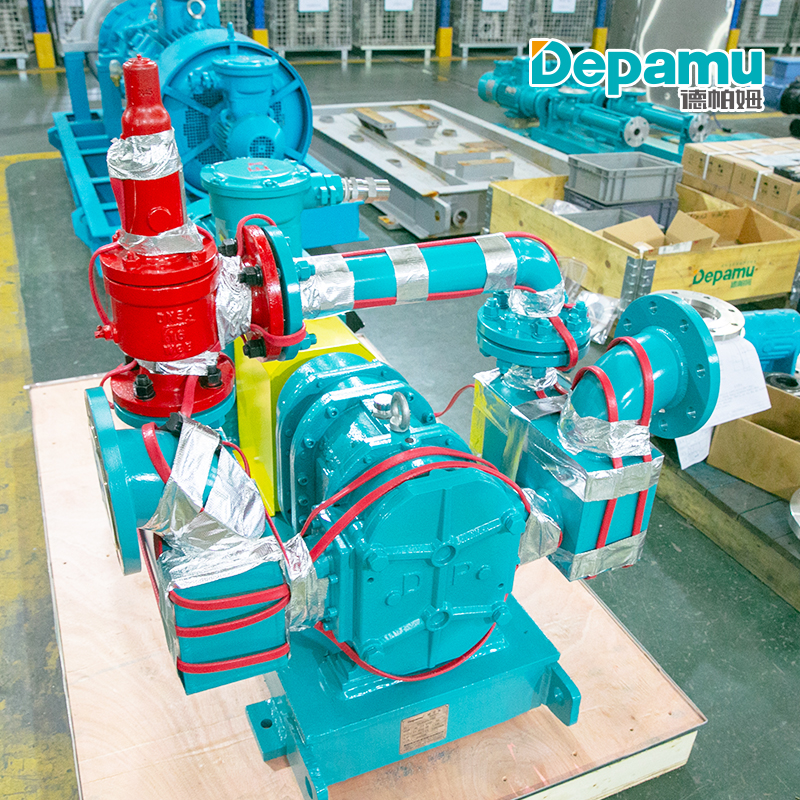
Enter the Depamu rubber rotor pump. Engineered following API 676 standards, this positive displacement pump utilizes elastomeric rotors to create a powerful, gentle, and highly tolerant pumping mechanism specifically suited for the rigors of sewage pipe cleaning. This article explores how the specific technical specifications of the Depamu pump translate into real-world efficacy in unclogging and maintaining sewage networks.
2. The Anatomy of a Solution: Design and Engineering
To understand why the Depamu pump excels in sewage applications, one must first understand its construction. Unlike a centrifugal pump that spins water at high speeds, the Depamu rotor pump operates on the principle of volumetric displacement.
2.1 The Rubber Rotor Advantage
The defining feature of the Depamu model is its use of rubber (elastomer) rotors. In the context of sewage, this material choice is critical. Unlike metal rotors, rubber rotors offer high elasticity and flexibility. When encountering a small, incompressible solid (e.g., a pebble or a piece of hard plastic), the rubber rotor deforms slightly to let the particle pass without shattering or stalling the pump, then immediately returns to its shape. This allows the pump to achieve a "maximum passing diameter" of up to 80 mm for incompressible materials.
2.2 The Self-Priming Capacity
Sewage lines rarely present a flooded suction. Often, cleaning operations involve "lift stations" or portable bypass systems where the pump sits above the water level. The Depamu pump boasts a vertical self-priming lift of up to 9 meters (approximately 30 feet). This dry suction capability allows operators to empty clogged manholes or wet wells without requiring a complex priming system or foot valves, drastically reducing setup time.
2.3 Triple-Shaft and Double Support Structure
In heavy-duty sewage cleaning, pressure fluctuations are common as the pump alternates between pushing liquid and pushing gas pockets. The Depamu pump utilizes a double support structure (tri-lobe shaft design) that ensures rotor stability. This design maintains alignment even when the pump is subjected to back-pressure as high as 1.5 to 3.0 MPa. Consequently, the pump maintains a constant flow rate regardless of the discharge pressure—a phenomenon known as "positive slippage" control, which is vital for jetting and cleaning operations.
3. Operational Superiority in Cleaning Scenarios
The theoretical design of the Depamu pump is impressive, but its true value emerges in specific sewage pipe cleaning workflows. These workflows generally fall into two categories: Line Bypass (Cesspool Emptying) and High-Pressure Combination (Sewer Jetting Support) .
3.1 Handling High Solid Content
Sewage is not water; it is a slurry. Typical sewage sludge can contain up to 60% solid content. Standard pumps lose efficiency rapidly as the percentage of solids rises because the water no longer provides lubrication for the impeller.
The Depamu rotor pump thrives in this environment. Because it is a positive displacement pump, the flow rate is directly proportional to the rotational speed (RPM), not the fluid's density. Even when the sewage turns into thick sludge, the pump maintains a steady flow. Furthermore, the pump can handle viscosities exceeding 1 to 2 million centipoise (CP). This means it can pump the thick, settled sludge at the bottom of a pipe that has been static for months—the "elephant's foot" of debris that often causes complete blockages.
3.2 The "Liquid Bomb" Safety Feature
Sewage pipes often contain hazardous environments. Decomposition of organic matter releases methane, hydrogen sulfide, and other flammable or explosive gases. Additionally, sewage mixed with industrial runoff can create volatile chemical mixtures.
Depamu specifically notes that their rotor pumps are suitable for transporting "so-called liquid bombs"—sensitive media that are flammable or chemically unstable. The pump operates at a low speed (10–650 RPM). Unlike high-speed centrifugal pumps that can generate heat spikes or sparks through cavitation, the gentle, low-shear action of the rubber rotor minimizes the risk of igniting these volatile mixtures. This makes the Depamu pump intrinsically safer for confined space sewage operations.
3.3 Cavitation Resistance and Dry Running
One of the most common failure modes in sewage cleaning is "running dry." If a sewer line is emptied faster than it refills, the pump loses its prime. A standard centrifugal pump would overheat, melt its mechanical seal, and warp the impeller within minutes.
The Depamu pump features a unique capacity: it can run dry for up to 15 minutes without damage. This "dry-run tolerance" is a safety net that protects expensive equipment during the intermittent flows of sewage cleaning. Furthermore, the pump can handle three-phase mixtures (solid, liquid, and gas) simultaneously. As the pump clears a blockage, air rushing into the line does not break the pump's prime; it simply continues to push the mixed media forward.
4. Comparative Analysis: Depamu vs. Traditional Technologies
To fully appreciate the Depamu rubber rotor pump, it is instructive to compare it against the two incumbent technologies in the sewage market: the Centrifugal Pump and the Progressive Cavity (PC) Pump.
4.1 Depamu vs. Centrifugal Pumps
-
Clogging: Centrifugal pumps are prone to "ragging" (fabric wrapping around the impeller). Depamu rotors have a wide, swept profile that prevents fiber accumulation.
-
Efficiency: Centrifugal pumps drop efficiency significantly as viscosity rises. Rotor pumps maintain efficiency up to 70-85% regardless of viscosity.
-
Priming: Centrifugal pumps are non-self-priming. Depamu offers a 9m suction lift.
4.2 Depamu vs. Progressive Cavity Pumps
-
Cost of Ownership: PC pumps rely on a long metal rotor and rubber stator. When solids enter the cavity, the stator can be destroyed instantly. Depamu pumps have shorter, replaceable rubber rotors and replaceable liners, reducing replacement costs.
-
Maintenance: PC pumps often require disassembly of the entire drive train to replace the stator. The Depamu pump features an "online repair" design—all wear parts are accessible by simply removing the pump's front cover, without disconnecting the piping or motor.
-
Solid Handling: PC pumps require strainers to prevent hard solids from entering. Depamu pumps can pass 80mm solids without a strainer.
5. Practical Application: The Sewer Jetting Workflow
In practical terms, how does a Depamu rubber rotor pump operate during a pipe cleaning operation?
Scenario: A 24-inch concrete sewer main is 70% blocked by a mixture of wet wipes, grease, and settled grit.
Setup: A mobile Depamu pump unit is positioned at a manhole upstream of the blockage. The pump is equipped with a 15 kW motor and uses rubber rotors designed for abrasive wear.
Phase 1 – Dewatering:
The operator opens the suction valve. The pump, utilizing its 9m suction lift, pulls the standing water and floating debris out of the line, depositing it into a holding tanker or bypass line. The pump runs at low RPM (approx. 300 RPM) to manage the high head of the manhole depth.
Phase 2 – Agitation (The Cleaning):
Once the water level is lowered, the solids are exposed. The Depamu pump continues to run, but now it is sucking heavy sludge. Because it handles up to 60% solids, it vacuums the "rags" directly from the pipe floor. The positive displacement nature of the pump creates a high vacuum pressure on the suction side, collapsing air pockets and pulling the blockage toward the pump.
Phase 3 – Bypass & Flushing:
The collected sewage is pumped into a treatment truck. If the pipe is fully blocked, a high-pressure water jetter is inserted. Here, the low-pulse characteristic of the Depamu pump is vital. Low pulsation means the pump does not vibrate violently, reducing wear on the discharge hose connections and allowing for stable pumping of the fluid used to back-flush the line.
Phase 4 – Maintenance:
After the job, the pump has ingested sand, gravel, and plastic wipes. An operator opens the front cover of the pump. They inspect the rubber rotors. If the rotor tips are worn down, they are replaced in minutes. The pump does not need to be pulled off the trailer or unbolted from the engine. Within 30 minutes, the pump is ready for the next job.
6. Longevity and Economic Impact
The initial capital expenditure for a Depamu pump is generally higher than that of a trash pump. However, the Total Cost of Ownership (TCO) for sewage cleaning operations favors the rotor pump heavily.
Reduced Downtime:
The most expensive cost in sewage cleaning is downtime. If a pump breaks down inside a lift station during a flood warning, the financial consequences are catastrophic. The robustness of the Depamu design—specifically the "three-dimensional flow finishing die and five-axis linkage technique" used to manufacture the rotors—ensures high efficiency and low noise, correlating directly to longer Mean Time Between Failures (MTBF).
Consumables:
Unlike centrifugal pumps that require expensive, heavy-duty mechanical seals that fail when run dry, the Depamu pump's design places low stress on the seals. The low speed (10-650r/min) results in low wear on bushings and bearings. Furthermore, because the pump features replaceable rubber rotors and liners, the user does not throw away the entire pump housing when it wears out; they simply refurbish the internals at 30% of the cost of a new pump.
7. Conclusion
The cleaning of sewage pipes is a dirty, difficult, and demanding job. It requires machinery that acts less like a precision instrument and more like a hardy workhorse, yet one that cannot compromise on the safety or environmental regulations of modern urban management.
The Depamu rubber rotor pump transcends the limitations of traditional sewage pumps. By combining the high-pressure capabilities of positive displacement pumps (up to 3.0 Mpa) with the solid handling capacity of a trash pump (80mm solids), it fills a unique niche in the market.
For engineers and municipal maintenance crews, the decision to utilize a Depamu pump is a strategic shift from reactive blockage removal to proactive, efficient fluid transfer. The ability to run dry, self-prime from 9 meters, and pass fibrous solids without clogging makes the Depamu rubber rotor pump arguably the most technologically appropriate solution for modern sewage pipe cleaning challenges.
As cities grow and sewage networks age, the stress on infrastructure increases. Adopting resilient technologies like the Depamu rubber rotor pump is not merely an operational upgrade; it is a necessity for sustainable sanitation management. The pump does not just move water; it conquers the sludge.