

Depamu: The Customizable Chemical Injection Skid Manufacturer Redefining Effluent Treatment
Effluent treatment is, at its core, a chemistry problem wrapped in an engineering problem. Whether the target is phosphorus removal, pH neutralization, pathogen inactivation, or sludge conditioning, the outcome depends on delivering the right chemical, in the right concentration, at the right moment—consistently, and often across widely variable flow and load conditions. A chemical injection skid that is merely “adequate” at design point will drift into overdosing, underdosing, or premature component failure long before its service life is over. This is where the distinction between a catalogue product and a genuinely customizable engineered system becomes decisive. Depamu (Hangzhou) Pumps Technology Co., Ltd. has built its position in the global chemical injection market on precisely that distinction: not simply manufacturing skids, but engineering them around the specific hydraulic, chemical, and control realities of each effluent treatment duty.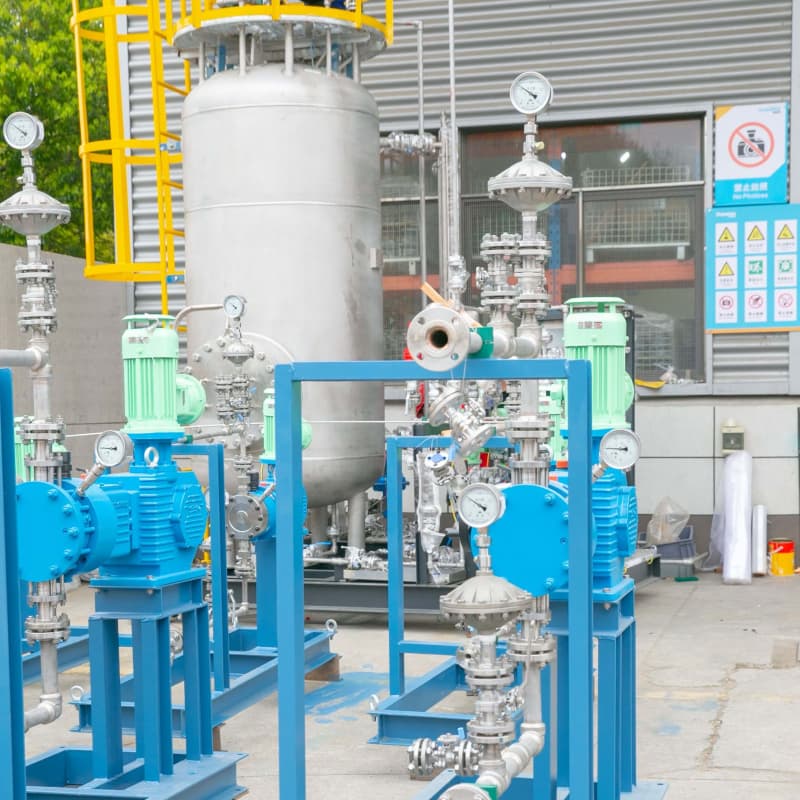
From pump maker to integrated skid architect. Depamu’s trajectory explains why its approach to customization is more than a marketing claim. Founded in 2003 in Hangzhou’s Qiantang District, the company began by absorbing hydraulic diaphragm Metering Pump technology and scientific management systems from Germany in the early 1990s, then adapted that foundation to the practical demands of Chinese and export markets rather than simply replicating European designs. That synthesis—international precision engineering filtered through a culture of application-driven problem solving—produced a manufacturer that now occupies a 35,000-square-meter facility, employs over 200 people, and dedicates no less than six percent of annual sales revenue to research and development. The patent portfolio tells a similar story: more than 100 technical patents, including 38 invention patents, and recognition as a National Key Specialized and Sophisticated “Little Giant” enterprise—a designation reserved for China’s most innovation-intensive small and medium manufacturers.
What matters for effluent treatment buyers, however, is not the scale of the factory but the vertical integration behind the skid. Depamu manufactures metering pumps, high-pressure Reciprocating Pumps, Diaphragm Pumps, and the packaged dosing systems that integrate them. When a wastewater plant needs a skid that handles a viscous polymer, a corrosive ferric chloride solution, or a sodium hypochlorite stream with a short shelf life, the pump, the wetted materials, the tank, and the control logic are all designed under one engineering system. That eliminates the compatibility gaps and performance disputes that arise when a skid is assembled from disparate suppliers.
The DPJY platform: customization as system architecture. Depamu’s DPJY-series chemical Injection Packages are the clearest expression of its customizable manufacturing model. Each unit integrates chemical dissolving and preparation, metering and injection, safety instrumentation, and control into a single skid-mounted assembly, with all components—solution tanks, pumps, piping, valves, level gauges, pulsation dampers, and electrical cabinets—mounted on a common structural base. The design philosophy rests on three principles: integration, modularity, and flexibility.
Integration delivers immediate practical value in effluent treatment, where footprint is often constrained by existing civil works. A pre-piped, pre-wired skid reduces field installation to connection of utilities and injection points, shortening commissioning time and eliminating the on-site fabrication that introduces contamination risk and schedule uncertainty.
Modularity is where customization begins in earnest. The DPJY platform offers combination forms from “1 Tank + 2 Pumps” through “2 Tanks + 3 Pumps” and “2 Tanks + 4 Pumps,” allowing the buyer to match capacity, redundancy, and available space without accepting a one-size-fits-all enclosure. For a municipal plant with diurnal flow swings, a duty/standby arrangement with two pumps and a single tank may be sufficient; for an industrial effluent stream with high solids and a need for continuous polymer make-down, a two-tank, four-pump configuration with independent mixing and aging capacity is the more defensible specification. The modular architecture also means that capacity can be expanded later by adding pump trains or tanks rather than replacing the entire skid.
Flexibility extends to materials and control—the two dimensions where effluent treatment applications diverge most sharply. Solution tanks can be fabricated in 304 or 316 stainless steel, carbon steel, rubber-lined carbon steel, FRP, PE, PP, or PVC, depending on the corrosivity of the chemical stored. Wetted flow-path components can be supplied in alloy steel, stainless steel, duplex stainless steel, titanium, or Hastelloy, so that a skid handling acidic ferric chloride is not compromised by the same material specification used for a caustic or polymer duty. On the control side, DPJY packages can be configured for local manual operation, semi-automatic control, or full automatic mode with a DCS output signal, allowing the skid to integrate with the plant’s existing SCADA or PLC architecture rather than forcing a control-system retrofit.
Where customization meets effluent treatment chemistry. The value of this configurability becomes concrete when mapped onto the unit operations of an effluent treatment plant. Depamu’s wastewater treatment injection packages are organized around functional chemical duties: acid–base regulation, flocculant injection, disinfectant injection, and additive injection. Each duty imposes a different set of requirements on the skid.
For coagulation and flocculation, the challenge is not simply pumping a liquid. Many plants receive coagulants and polymers as dry powders that must be dissolved, aged, and diluted to the correct working concentration before injection. Depamu’s automatic dissolving and dosing devices address this by integrating a PLC control system, dry-powder storage and precise feeding, an anti-humidity heater, and the dissolution and aging tank into the skid envelope. For liquid polymer duties, the skid can be specified with the dilution water supply, low-shear mixing, and residence time needed to avoid chain scission before the polymer reaches the clarifier. Flow ranges for flocculant injection packages span 100–850 L/h at discharge pressures of 0.3–2.5 MPa, with tank volumes from 0.5 to 2.5 m³ and configurations from one tank with two pumps to two tanks with four pumps.
Disinfection and pH adjustment impose different constraints. Sodium hypochlorite is corrosive and degrades over time; the skid must be specified with compatible wetted materials, minimized dead legs, and—where necessary—a duty/standby pump arrangement that allows rotation without interrupting dosing. Acid and alkali injection require materials resistant to concentrated solutions and a control strategy that can follow pH feedback without overshooting. Depamu’s acid and alkali injection packages operate in the 50–1000 L/h range at 0.3–2.5 MPa, with the same modular tank-and-pump architecture, allowing the plant to standardize on a common skid footprint while varying materials and control logic by chemical duty. For smaller or more distributed dosing points, Depamu’s DPMFWSA-series units extend the same metering philosophy to pressures up to 1.2 MPa, suitable for polishing or backup chemical feed applications.
Sludge conditioning—often the most unforgiving chemical duty in a wastewater plant—demands tight control over polymer dilution, aging, and dose rate. The customizable skid approach allows the polymer preparation and dosing functions to be integrated on a single frame, with the aging tank sized to the plant’s sludge throughput and the metering pump selected for the low-flow, high-accuracy regime that sludge dewatering requires. Because the skid is engineered as a system, the dilution water quality, mixer energy input, and pump suction conditions are treated as design variables rather than afterthoughts.
The engineering discipline behind the customization. A manufacturer can offer options without being genuinely customizable; the difference lies in whether those options are supported by engineering analysis. Depamu’s skid designs are developed against the same standards that govern high-consequence chemical injection: metering pumps conform to API 675 performance requirements, including ±1% accuracy over a 10:1 turndown ratio, and reciprocating pump designs follow API 674 where high-pressure service demands it. The company holds certifications including API, DNV, ISO 9001, ISO 14001, and ISO 45001, and participates as a drafter of pump industry standards—an indicator that its customization is anchored in documented engineering practice rather than ad hoc fabrication.
This discipline has been tested in applications far more demanding than most effluent treatment plants. Depamu delivered multiple sets of offshore platform chemical injection skids to CNOOC for service in the South China Sea and Bohai Sea, where a three-tier vertical skid layout reduced footprint by 40–50% and full-penetration welding plus duplex stainless steel and titanium wetted materials addressed the corrosive marine environment. For Uganda’s Kingfisher oil field, the company designed and delivered 29 custom chemical injection skids, managing complex crude chemistry and local-content requirements across design, manufacturing, factory testing, and shipment. These projects demonstrate that Depamu’s customization capability is not limited to selecting a tank material and a pump model; it extends to re-engineering layout, structural detailing, and material systems when the duty requires it.
Why customization is a total-cost argument, not a premium. The conventional procurement logic treats a “custom” skid as a cost premium to be avoided in favor of a standard unit. In effluent treatment, that logic frequently inverts. A standard skid that is oversized for the actual chemical demand wastes chemical and accelerates pump wear through excessive turndown. A standard skid that is undersized becomes a bottleneck during peak load and may require a second unit or field modification within the first year of operation. A skid built with materials that are adequate for the design chemical but marginal for the real chemical—ferric chloride with elevated free acid, hypochlorite with varying decay, polymer with abrasive fillers—will generate maintenance and replacement costs that dwarf any initial saving.
Depamu’s customizable model addresses these risks at the specification stage. The buyer defines the chemical, the concentration range, the flow and pressure envelope, the turndown requirement, the control interface, the available footprint, and the redundancy philosophy. The skid is then configured from a validated modular platform, with materials and instrumentation selected against those inputs. The result is a system that is neither over-engineered nor under-engineered—the two failure modes that dominate chemical dosing skid life-cycle cost. In a sector where chemical cost, maintenance labor, and compliance risk are all under scrutiny, that alignment between specification and reality is the most durable economic argument for customization.
A manufacturer positioned for the next phase of effluent treatment. Effluent treatment is becoming more chemically intensive, not less. Nutrient removal limits are tightening, emerging contaminants are pushing plants toward advanced oxidation and specialized coagulants, and the variability of industrial influent is making fixed-dose strategies obsolete. The skids that serve these duties will need to be more sensor-integrated, more responsive to feedback control, and more adaptable to chemical changes over the asset life. Depamu’s DPJY platform—with its modular pump-and-tank combinations, broad material options, and configurable control modes—provides a structural foundation for that evolution. The company’s manufacturing scale, patent portfolio, and export track record suggest that its customization capability is not a niche offering but a core operating model. For effluent treatment engineers and plant owners, the practical implication is straightforward: the chemical injection skid should be specified as an engineered subsystem, and the manufacturer should be selected on the ability to engineer it—not merely to assemble it. Depamu’s proposition is that those two activities are inseparable, and that a skid built around the specific chemistry of the effluent is the only skid that performs as promised over the long run.