

Depamu High-Pressure Diaphragm Pump for Liquid Ammonia: An Engineered Solution for a Hazardous Medium
1. Introduction: The Challenge of Liquid Ammonia Transfer
Liquid ammonia (NH₃) is a cornerstone of modern industry, serving as a vital feedstock for fertilizers, a precursor for numerous chemical syntheses, and an emerging carbon-free energy carrier for maritime propulsion . However, its widespread utility is matched by its formidable hazards. At atmospheric pressure, anhydrous ammonia boils at a chilling -33°C (-28°F), requiring pressurization to remain in a liquid state at ambient temperatures . It is acutely toxic, corrosive to human tissue, and poses significant risks of severe chemical burns and respiratory damage upon exposure .
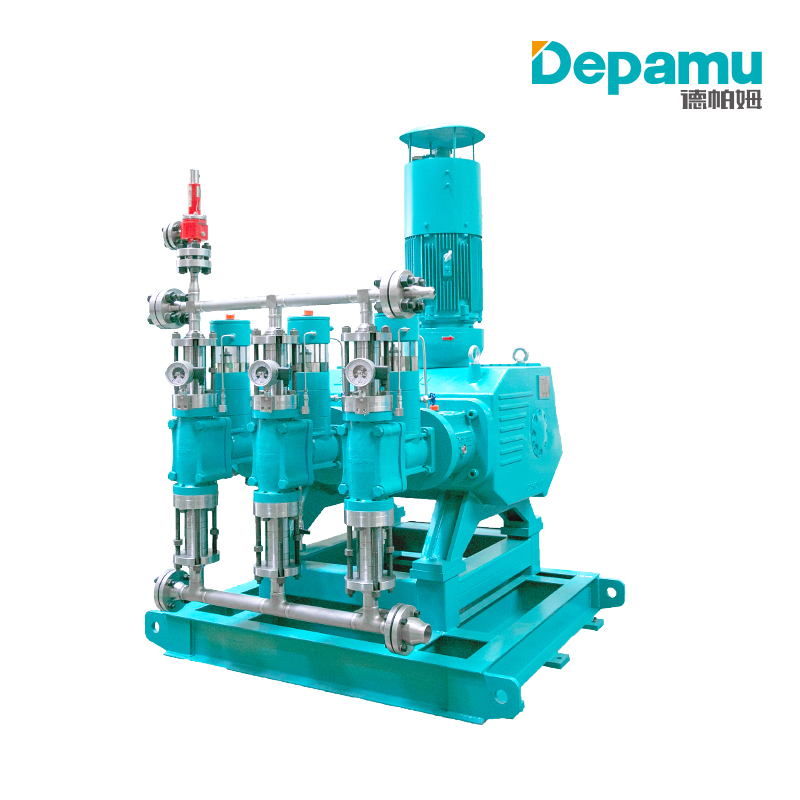
These very properties—toxicity, volatility, and corrosivity—demand that any equipment handling this fluid be engineered with an uncompromising focus on safety, reliability, and leak-tight operation. Traditional centrifugal pumps or packed-plunger pumps present an unacceptable risk of leakage through shaft seals, potentially leading to catastrophic releases. It is within this critical and demanding niche that the Depamu high-pressure diaphragm pump finds its essential purpose. Designed and manufactured in accordance with the rigorous American Petroleum Institute standard API 674, Depamu's process diaphragm pumps are engineered to deliver a zero-leakage solution for the transfer and metering of liquid ammonia, providing a robust barrier between the hazardous fluid and the environment .
2. The Depamu Pump: Design Philosophy and Operating Principles
The Depamu high-pressure diaphragm pump for liquid ammonia is a reciprocating, positive-displacement pump engineered for precision and absolute containment . Its fundamental operating principle relies on a hydraulically actuated diaphragm that precisely separates the pumped medium from the mechanical drive components.
2.1. The Hydraulic Diaphragm System
At the heart of the pump lies a process diaphragm, a flexible membrane typically manufactured from a highly corrosion-resistant material such as PTFE or a metallic alloy . This diaphragm forms a complete seal between the process fluid chamber and the hydraulic fluid chamber. The reciprocating motion of a plunger within the hydraulic system displaces oil, which in turn flexes the diaphragm. This flexing motion creates a controlled, periodic change in the volume of the process chamber, drawing in liquid ammonia on the suction stroke and forcibly discharging it at high pressure on the discharge stroke.
2.2. The "Absolute No Leakage" Advantage
The key differentiator of this design is that the process fluid—in this case, aggressive and toxic liquid ammonia—never comes into contact with dynamic mechanical seals, such as those found on a plunger rod. This configuration is often described as providing "absolute no leakage" . By isolating the ammonia within a static, hermetically sealed chamber, the Depamu pump eliminates the primary source of fugitive emissions and environmental release, making it uniquely suited for the most hazardous services.
2.3. Compliance with API 674
Depamu's Reciprocating Pumps are designed to meet the stringent requirements of API 674, the international standard for positive-displacement pumps used in the petroleum, chemical, and gas industries . This standard mandates strict criteria for design, materials, fabrication, and testing, ensuring that the pump can withstand extreme process conditions, maintain long-term reliability, and meet the highest performance expectations. This commitment to an industry-leading standard provides end-users with confidence in the pump's durability and operational safety, even under the severe service conditions associated with high-pressure liquid ammonia transfer.
3. Technical Specifications and Performance Capabilities
The Depamu pump series, including models such as the HD3E(M) and HD3H(M), offers a broad range of performance parameters designed to accommodate diverse industrial applications. The pump's modular architecture allows for customization to specific flow and pressure requirements.
3.1. Performance Envelope
Depamu diaphragm pumps are capable of achieving high discharge pressures and substantial flow rates. According to manufacturer specifications, certain models can deliver pressures up to 160.3 MPa (approximately 23,250 psi) and flow rates up to 94.61 m³/h (approx. 1,576 L/min) . Other variants, such as the HD3H(M), are optimized for slightly lower pressure ranges (up to 41.6 MPa) while maintaining a robust flow capacity . This wide performance envelope ensures that the pump can be tailored to applications ranging from high-pressure chemical injection to large-scale process transfer.
Figure 1: Simplified Performance Matrix for Depamu HD Series Liquid Ammonia Pumps (Illustrative)
3.2. Materials of Construction
The selection of wetted parts is critical for handling liquid ammonia. Depamu offers a wide array of materials for the fluid end, including alloy steel, stainless steel, dual-phase steel, titanium, and Hastelloy . This flexibility allows the pump to be optimized for resistance to corrosion, stress cracking, and erosion, ensuring a long service life and safe containment of the pumped media. This is a crucial aspect of the pump's design, as ammonia’s corrosive nature requires careful material selection to prevent premature failure.
3.3. Drive and Configuration Options
To provide versatility in installation, the Depamu pump is available in horizontal, vertical, stationary, and mobile configurations . It can be driven by a variety of power sources, including electric motors, diesel engines, and solar energy . The drive end utilizes robust components such as internal-meshing double helical gears, external reducers, or belt pulleys, ensuring stable and reliable transmission with low noise output . This modularity allows for seamless integration into both new and existing plant infrastructure.
4. Application: Liquid Ammonia in the Chemical and Fertilizer Industry
The primary application for this class of pump is within the chemical and fertilizer sectors, where liquid ammonia is a principal feedstock. The Depamu pump is explicitly listed as being suitable for use as a "liquid ammonia pump" and an "ammonium carbamate pump" .
In the production of urea—one of the most important nitrogen-based fertilizers—ammonia and carbon dioxide react at extremely high pressures (often exceeding 15 MPa) to form ammonium carbamate, which then dehydrates to urea. The synthesis loop operates under severe conditions, involving high temperatures and highly corrosive carbamate solutions. The absolute sealing capability of the Depamu diaphragm pump makes it an ideal choice for injecting liquid ammonia into this high-pressure loop. Any leak in such a system is not only a safety hazard but also a significant process inefficiency.
Similarly, in "boiler water Injection Packages" for thermal power plants, ammonia is used to regulate the pH of boiler feedwater, preventing corrosion of critical and costly infrastructure . Depamu's Metering Pump technology can be integrated into these systems to deliver a precise, controlled flow of ammonia, ensuring the water chemistry remains within the stringent limits required for safe and efficient plant operation.
5. Safety Considerations and Operational Integrity
The use of a Depamu high-pressure diaphragm pump is inherently a part of a larger, comprehensive approach to liquid ammonia system safety. The pump's leak-free design is the first and most critical line of defense. However, a holistic safety strategy must also encompass other engineering controls, safety devices, and rigorous operational procedures.
5.1. Engineering Controls and System Integration
Engineers specify the pump to be part of a "closed system" designed to prevent any release of ammonia . The system must be equipped with a full complement of safety devices, including:
-
Pressure Safety Valves (PSV): Essential for preventing over-pressurization of the pump and associated piping. These valves must be routinely inspected and maintained, as over-pressurization due to a blocked discharge is a common cause of system failure .
-
Leak Detection and Gas Monitors: Continuous ammonia gas detection is mandatory in areas where liquid ammonia is handled. These detectors provide an immediate alert in the event of a leak, allowing for a rapid emergency response .
-
Emergency Shut-off Systems: Air-operated emergency shut-off valves, spring-loaded to close upon a loss of air pressure or a signal from a gas detector, can isolate the flow of ammonia .
5.2. Maintenance and Personal Protective Equipment (PPE)
Scheduled maintenance on the pump, its piping, and safety equipment is non-negotiable. Hoses and fittings must be inspected regularly for cuts, bulges, or wear, as deteriorated components are a common source of leaks . Any maintenance work must follow strict lock-out/tag-out (LOTO) procedures and line-break permits to prevent accidental exposure .
Furthermore, all personnel involved in the operation or maintenance of the liquid ammonia system must wear appropriate Personal Protective Equipment (PPE) . This includes non-vented chemical splash goggles, a face shield, chemical-resistant gloves (e.g., butyl rubber or chloroprene), and a full-body impervious suit . In the event of an exposure, immediate and continuous flushing of the affected area with copious amounts of water for at least 15 minutes is required, followed by immediate medical attention . Respiratory protection, such as a full-face mask with an ammonia filter (Type K) or a self-contained breathing apparatus (SCBA), must be readily available for emergency use .
6. The Future: Liquid Ammonia as a Fuel and the Depamu Pump
The role of the high-pressure diaphragm pump is poised to expand significantly with the growing interest in "green ammonia" as a carbon-free marine fuel . For dual-fuel marine engines, ammonia must be injected into the combustion chamber at very high pressures with absolute precision and safety.
LEWA, a manufacturer of similar process diaphragm pumps, highlights the suitability of this pump technology for this exact purpose . The Depamu pump, with its proven API 674 design and extreme pressure capabilities, is well-positioned to serve this emerging market. Its ability to provide "absolute no leakage" while handling the ultra-toxic ammonia at high pressures aligns perfectly with the stringent requirements of maritime applications, offering a robust, reliable, and flex-fuel-ready solution for the next generation of clean shipping.
7. Conclusion
The Depamu high-pressure diaphragm pump represents a pinnacle of engineering designed to address the profound challenges of handling liquid ammonia. By combining a hydraulically actuated, hermetically sealed diaphragm design with rigorous adherence to API 674 standards, it provides a dependable and virtually leak-free solution for one of the most hazardous industrial fluids. Its robust construction, flexible material options, and wide performance envelope ensure its applicability across a diverse range of critical services, from traditional fertilizer production to the nascent "green" energy economy. In an era where operational safety, environmental stewardship, and process integrity are paramount, the Depamu diaphragm pump stands as an essential tool for the safe and efficient handling of liquid ammonia