

x
Send Your Inquiry Today
Quick Quote

Depamu chemical injection package for boiler feedwater treatment

Abstract

Boiler feedwater treatment is a critical process in thermal power plants and industrial boiler systems, directly impacting operational safety, thermal efficiency, and equipment longevity. The Depamu chemical Injection Package represents a comprehensive, skid-mounted solution designed to precisely meter and inject treatment chemicals into boiler feedwater systems. This article examines the design principles, component configuration, operational mechanisms, and application-specific functionalities of Depamu's Chemical Injection Packages, with particular emphasis on phosphate, hydrazine, and ammonia injection systems for boiler water treatment.
Abstract Boiler feedwater treatment is a critical process in thermal power plants and industrial boiler systems, directly impacting operational safety, thermal efficiency, and equipment longevity. The Depamu chemical injection package represents a comprehensive, skid-mounted solution designed to precisely meter and inject treatment chemicals into boiler feedwater systems. This article examines the design principles, component configuration, operational mechanisms, and application-specific functionalities of Depamu's chemical injection packages, with particular emphasis on phosphate, hydrazine, and ammonia injection systems for boiler water treatment. 1. Introduction The quality of boiler feedwater fundamentally determines the reliability and efficiency of steam-generating systems. Impurities present in feedwater—particularly dissolved oxygen, hardness ions (calcium and magnesium), and pH imbalances—can precipitate scale formation, accelerate corrosion, and ultimately lead to catastrophic equipment failure. Modern boiler operations therefore rely on sophisticated chemical treatment programs to mitigate these risks. Depamu, a manufacturer of chemical dosing systems, offers a range of injection packages specifically engineered for boiler feedwater treatment applications. These systems integrate multiple components into a unified, pre-assembled skid that performs the functions of chemical dissolution, preparation, metering, and injection into the boiler water circuit. 2. System Architecture and Components The Depamu chemical injection package is designed as a complete, self-contained unit mounted on a single steel base. This modular approach facilitates transportation, installation, and maintenance while ensuring system integrity. 2.1 Core Components The package integrates several essential components: Solution Tank: Available in volumes ranging from 0.5 to 2.5 cubic meters, the solution tank serves as the chemical storage and mixing vessel. Material selection depends on corrosion resistance requirements, with options including 304 stainless steel, 316 stainless steel, carbon steel (with rubber or plastic lining), FRP, PE, and PVC. <a href=https://www.depamu-pumps.com/Metering-pump.html target='_blank'>Metering Pump</a>: The heart of the injection system, metering pumps provide precise chemical delivery. For boiler water applications, pumps typically offer capacities of 20–70 L/H with discharge pressures up to 2.5 MPa for ammonia and hydrazine, or 5–32 MPa for phosphate injection. The flow rate can be adjusted from 0 to 100% of rated capacity. Piping and Valves: A comprehensive network of pipes, safety valves, pulsation dampers, and pressure gauges ensures safe and stable chemical delivery. Electrical Control Cabinet: Provides manual, semi-automatic, or fully automatic control options, with the ability to interface with plant-wide DCS or host computer systems. 2.2 Configuration Options Depamu offers flexible configuration arrangements to suit different operational requirements: 1 Tank + 2 Pumps: Basic configuration with one working pump and one standby 2 Tanks + 3 Pumps: Allows alternate or simultaneous use through valve switching 2 Tanks + 4 Pumps: Maximum redundancy and capacity 3. Application-Specific Injection Systems Depamu's boiler water injection packages are categorized according to the specific treatment chemical and purpose: 3.1 Phosphate Injection Package Phosphate injection is the most widely adopted method for controlling scale formation in boiler water. Despite rigorous softening and demineralization pretreatment, trace amounts of calcium and magnesium ions inevitably enter the boiler system. In high-temperature environments, these ions can precipitate as hard scale that adheres to heat transfer surfaces. The phosphate injection approach addresses this through a precipitation reaction. When trisodium phosphate is injected into boiler water, it reacts with calcium ions to form basic calcium phosphate: 10Ca²⁺ + 6PO₄³⁻ + 2OH⁻ → Ca₁₀(OH)₂(PO₄)₆ This reaction product—basic calcium phosphate—forms a loose, non-adherent sludge that can be readily removed through routine boiler blowdown, rather than hard scale that would compromise heat transfer and potentially cause tube failure. Automatic control of phosphate injection is achieved through continuous monitoring of feedwater flow rate, pH value, and phosphate radical concentration. The control system processes these signals via PLC or DCS to adjust pump speed and stroke, maintaining optimal phosphate levels. 3.2 Hydrazine Injection Package Dissolved oxygen in boiler feedwater represents a primary cause of corrosion in thermal systems. While mechanical deaeration removes the bulk of dissolved oxygen, chemical scavenging is required to eliminate residual oxygen and provide a corrosion-inhibiting environment. Hydrazine (N₂H₄) serves as an effective oxygen scavenger, reacting with dissolved oxygen to form nitrogen and water: N₂H₄ + O₂ → N₂ + 2H₂O The Depamu hydrazine injection package continuously monitors oxygen content and feedwater flow rate, automatically adjusting hydrazine dosage to maintain optimal concentration. Precise dosing is critical—under-dosing fails to provide adequate corrosion protection, while over-dosing wastes chemical and creates environmental concerns. 3.3 Ammonia Injection Package pH control is essential for minimizing corrosion throughout the steam-water cycle. Ammonia injection raises boiler water pH to the optimal range, reducing the solubility of corrosion products and maintaining protective magnetite films on metal surfaces. The ammonia injection package automatically adjusts ammonia feed rate based on pH and conductivity measurements, responding to changes in feedwater quality and system operating conditions. 4. Control System Architecture 4.1 Automation Philosophy Depamu injection packages employ a sophisticated control architecture that enables fully automated operation with minimal operator intervention. Under automatic control, the system receives input signals from process instrumentation—flow meters, pH analyzers, conductivity meters, dissolved oxygen sensors, and phosphate analyzers. These signals are processed by a PLC, host computer, or DCS to generate control outputs that adjust metering pump speed (via frequency converter) and stroke length. This closed-loop control ensures chemical feed rates precisely match process demands. 4.2 Signal Interface The control system communicates using standard 4-20 mA analog signals for both setpoint input and feedback. All status and fault signals for pumps and mixers can be transmitted to the plant control room, enabling remote start/stop functionality and comprehensive system monitoring. 4.3 Control Modes Users can select from multiple control modes based on operational requirements: Manual: Local control with operator adjustment Semi-automatic: Local control with automatic adjustment based on selected parameters Full automatic: Remote control with complete DCS integration 5. Engineering Considerations 5.1 Material Selection The choice of wetted materials must consider both the chemical being injected and the operating environment. Depamu offers multiple material options: Stainless Steel (304/316): For general corrosion resistance and high-purity applications Carbon Steel with Linings: For cost-effective corrosion protection FRP and PE: For chemical resistance in specific applications 5.2 Safety Features Each package incorporates multiple safety features including: Safety valves to prevent overpressure Level gauges for solution tank monitoring Pulsation dampers to stabilize flow Pressure gauges for real-time pressure indication 5.3 Space Optimization Depamu packages are available in various configurations to accommodate different equipment room layouts. The skid-mounted design minimizes footprint while providing complete functionality, with typical dimensions for boiler water applications ranging from 1800×1900×2500 mm to 3000×1900×2500 mm. 6. Conclusion The Depamu chemical injection package for boiler feedwater treatment represents a comprehensive, engineered solution to the critical challenges of scale control, corrosion prevention, and pH management in steam-generating systems. By integrating precise metering pumps, corrosion-resistant tanks, and sophisticated automation capabilities into a compact skid-mounted assembly, these systems enable power plants and industrial facilities to maintain optimal water chemistry with minimal operator intervention. The availability of dedicated packages for phosphate, hydrazine, and ammonia injection allows facilities to implement complete treatment programs tailored to their specific water quality challenges. The flexible configuration options and material selections ensure compatibility with a wide range of operating conditions and chemical requirements. As boiler operating pressures continue to rise and environmental regulations tighten, the precision and reliability offered by these automated chemical injection systems become increasingly essential. Depamu's focus on skid-mounted, pre-engineered packages delivers the dual benefits of reduced installation complexity and consistent treatment performance, ultimately contributing to safer, more efficient, and more reliable boiler operations.

1. Introduction

The quality of boiler feedwater fundamentally determines the reliability and efficiency of steam-generating systems. Impurities present in feedwater—particularly dissolved oxygen, hardness ions (calcium and magnesium), and pH imbalances—can precipitate scale formation, accelerate corrosion, and ultimately lead to catastrophic equipment failure. Modern boiler operations therefore rely on sophisticated chemical treatment programs to mitigate these risks.

Depamu, a manufacturer of chemical dosing systems, offers a range of injection packages specifically engineered for boiler feedwater treatment applications. These systems integrate multiple components into a unified, pre-assembled skid that performs the functions of chemical dissolution, preparation, metering, and injection into the boiler water circuit.

2. System Architecture and Components

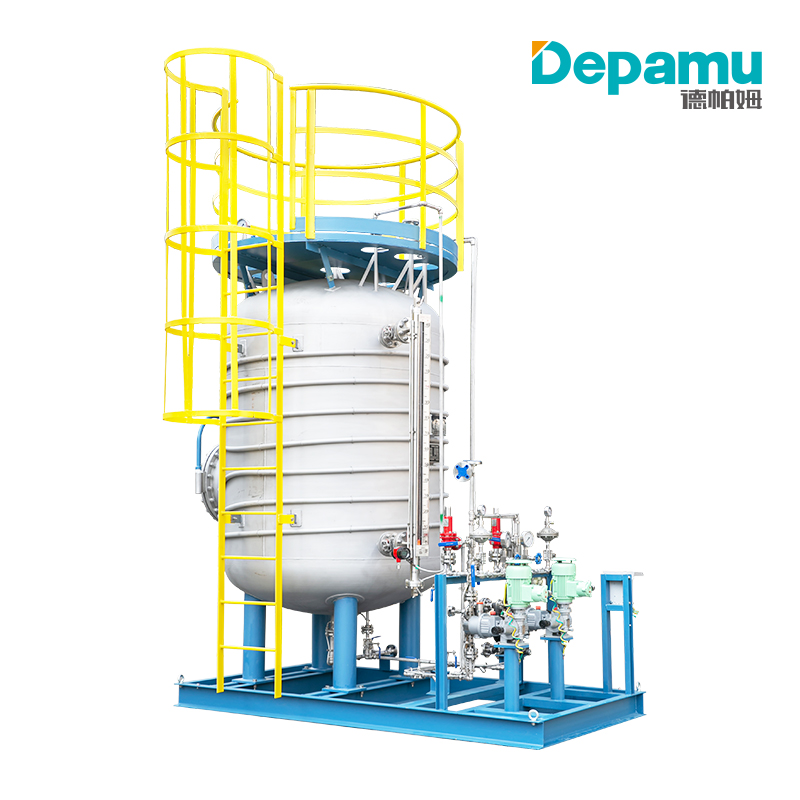
The Depamu chemical injection package is designed as a complete, self-contained unit mounted on a single steel base. This modular approach facilitates transportation, installation, and maintenance while ensuring system integrity.

2.1 Core Components

The package integrates several essential components:

Solution Tank: Available in volumes ranging from 0.5 to 2.5 cubic meters, the solution tank serves as the chemical storage and mixing vessel. Material selection depends on corrosion resistance requirements, with options including 304 stainless steel, 316 stainless steel, carbon steel (with rubber or plastic lining), FRP, PE, and PVC.

Metering Pump: The heart of the injection system, metering pumps provide precise chemical delivery. For boiler water applications, pumps typically offer capacities of 20–70 L/H with discharge pressures up to 2.5 MPa for ammonia and hydrazine, or 5–32 MPa for phosphate injection. The flow rate can be adjusted from 0 to 100% of rated capacity.

Piping and Valves: A comprehensive network of pipes, safety valves, pulsation dampers, and pressure gauges ensures safe and stable chemical delivery.

Electrical Control Cabinet: Provides manual, semi-automatic, or fully automatic control options, with the ability to interface with plant-wide DCS or host computer systems.

2.2 Configuration Options

Depamu offers flexible configuration arrangements to suit different operational requirements:

  • 1 Tank + 2 Pumps: Basic configuration with one working pump and one standby

  • 2 Tanks + 3 Pumps: Allows alternate or simultaneous use through valve switching

  • 2 Tanks + 4 Pumps: Maximum redundancy and capacity

3. Application-Specific Injection Systems

Depamu's boiler water injection packages are categorized according to the specific treatment chemical and purpose:

3.1 Phosphate Injection Package

Phosphate injection is the most widely adopted method for controlling scale formation in boiler water. Despite rigorous softening and demineralization pretreatment, trace amounts of calcium and magnesium ions inevitably enter the boiler system. In high-temperature environments, these ions can precipitate as hard scale that adheres to heat transfer surfaces.

The phosphate injection approach addresses this through a precipitation reaction. When trisodium phosphate is injected into boiler water, it reacts with calcium ions to form basic calcium phosphate:

10Ca²⁺ + 6PO₄³⁻ + 2OH⁻ → Ca₁₀(OH)₂(PO₄)₆

This reaction product—basic calcium phosphate—forms a loose, non-adherent sludge that can be readily removed through routine boiler blowdown, rather than hard scale that would compromise heat transfer and potentially cause tube failure.

Automatic control of phosphate injection is achieved through continuous monitoring of feedwater flow rate, pH value, and phosphate radical concentration. The control system processes these signals via PLC or DCS to adjust pump speed and stroke, maintaining optimal phosphate levels.

3.2 Hydrazine Injection Package

Dissolved oxygen in boiler feedwater represents a primary cause of corrosion in thermal systems. While mechanical deaeration removes the bulk of dissolved oxygen, chemical scavenging is required to eliminate residual oxygen and provide a corrosion-inhibiting environment.

Hydrazine (N₂H₄) serves as an effective oxygen scavenger, reacting with dissolved oxygen to form nitrogen and water:

N₂H₄ + O₂ → N₂ + 2H₂O

The Depamu hydrazine injection package continuously monitors oxygen content and feedwater flow rate, automatically adjusting hydrazine dosage to maintain optimal concentration. Precise dosing is critical—under-dosing fails to provide adequate corrosion protection, while over-dosing wastes chemical and creates environmental concerns.

3.3 Ammonia Injection Package

pH control is essential for minimizing corrosion throughout the steam-water cycle. Ammonia injection raises boiler water pH to the optimal range, reducing the solubility of corrosion products and maintaining protective magnetite films on metal surfaces.

The ammonia injection package automatically adjusts ammonia feed rate based on pH and conductivity measurements, responding to changes in feedwater quality and system operating conditions.

4. Control System Architecture

4.1 Automation Philosophy

Depamu injection packages employ a sophisticated control architecture that enables fully automated operation with minimal operator intervention. Under automatic control, the system receives input signals from process instrumentation—flow meters, pH analyzers, conductivity meters, dissolved oxygen sensors, and phosphate analyzers.

These signals are processed by a PLC, host computer, or DCS to generate control outputs that adjust metering pump speed (via frequency converter) and stroke length. This closed-loop control ensures chemical feed rates precisely match process demands.

4.2 Signal Interface

The control system communicates using standard 4-20 mA analog signals for both setpoint input and feedback. All status and fault signals for pumps and mixers can be transmitted to the plant control room, enabling remote start/stop functionality and comprehensive system monitoring.

4.3 Control Modes

Users can select from multiple control modes based on operational requirements:

  • Manual: Local control with operator adjustment

  • Semi-automatic: Local control with automatic adjustment based on selected parameters

  • Full automatic: Remote control with complete DCS integration

5. Engineering Considerations

5.1 Material Selection

The choice of wetted materials must consider both the chemical being injected and the operating environment. Depamu offers multiple material options:

  • Stainless Steel (304/316): For general corrosion resistance and high-purity applications

  • Carbon Steel with Linings: For cost-effective corrosion protection

  • FRP and PE: For chemical resistance in specific applications

5.2 Safety Features

Each package incorporates multiple safety features including:

  • Safety valves to prevent overpressure

  • Level gauges for solution tank monitoring

  • Pulsation dampers to stabilize flow

  • Pressure gauges for real-time pressure indication

5.3 Space Optimization

Depamu packages are available in various configurations to accommodate different equipment room layouts. The skid-mounted design minimizes footprint while providing complete functionality, with typical dimensions for boiler water applications ranging from 1800×1900×2500 mm to 3000×1900×2500 mm.

6. Conclusion

The Depamu chemical injection package for boiler feedwater treatment represents a comprehensive, engineered solution to the critical challenges of scale control, corrosion prevention, and pH management in steam-generating systems. By integrating precise metering pumps, corrosion-resistant tanks, and sophisticated automation capabilities into a compact skid-mounted assembly, these systems enable power plants and industrial facilities to maintain optimal water chemistry with minimal operator intervention.

The availability of dedicated packages for phosphate, hydrazine, and ammonia injection allows facilities to implement complete treatment programs tailored to their specific water quality challenges. The flexible configuration options and material selections ensure compatibility with a wide range of operating conditions and chemical requirements.

As boiler operating pressures continue to rise and environmental regulations tighten, the precision and reliability offered by these automated chemical injection systems become increasingly essential. Depamu's focus on skid-mounted, pre-engineered packages delivers the dual benefits of reduced installation complexity and consistent treatment performance, ultimately contributing to safer, more efficient, and more reliable boiler operations.