

Precision in Pollution Control: Depamu Chemical Dosing Systems (Injection Pumps) for Wastewater Treatment
Abstract
In the intricate choreography of modern wastewater treatment, precision is not merely a luxury but an environmental and economic necessity. As industrial effluents become more complex and discharge regulations grow increasingly stringent, the role of Chemical Injection Pumps—often referred to as Dosing Pumps or Metering Pumps—has evolved from auxiliary support to core operational criticality. Depamu, a prominent manufacturer in the fluid handling sector, offers a range of dosing systems that address the specific mechanical and chemical challenges of wastewater treatment. This article provides a comprehensive technical analysis of Depamu Mechanical Diaphragm Metering Pumps and their integrated dosing packages, exploring their working principles, construction materials, automation capabilities, and specific applications in flocculation, pH adjustment, and sludge conditioning.
1. Introduction: The Challenge of Wastewater Chemistry
Wastewater treatment is fundamentally a process of accelerated separation. Whether dealing with municipal sewage or industrial effluent, the goal remains consistent: separate clean water from suspended solids, dissolved organics, and harmful pathogens. To achieve this separation efficiently, plant operators rely on chemistry. Coagulants neutralize the electrostatic charges that keep particles suspended; flocculants bridge these neutralized particles into settleable flocs; acids and alkalis adjust pH to optimal biological reaction zones; and disinfectants eliminate pathogens.
However, the introduction of these chemicals presents a mechanical paradox. The operator must inject a highly corrosive or viscous fluid at a precise, often variable rate, against significant backpressure from the main water line, without leaking or losing calibration. This is where the precision of the Depamu injection pump becomes indispensable.
2. The Heart of the System: Mechanical Diaphragm Technology
Unlike centrifugal pumps, which move fluid through high-speed rotation, dosing pumps are positive displacement devices. They trap a fixed volume of fluid and force it into the discharge pipe. Depamu’s flagship technology for wastewater utilizes a mechanical diaphragm mechanism, which strikes the ideal balance between power, precision, and containment.
2.1. Working Principle
The operational cycle of a Depamu DPMFWSA series pump is driven by a robust motor and gear reduction system. The process can be broken down into three distinct mechanical stages:
-
Power Conversion: The electric motor drives a worm gear pair. This converts the high-speed rotary motion of the motor into a slower, controlled rotational force.
-
Motion Conversion: An eccentric mechanism mounted on the gear shaft transforms this rotary motion into a precise reciprocating (back-and-forth) movement of a slide rod.
-
Fluid Displacement: The slide rod connects directly to a PTFE (Polytetrafluoroethylene) diaphragm. As the rod pulls back, the diaphragm flexes inward, creating a vacuum that opens the suction valve and draws chemical into the pump head. As the rod pushes forward, the diaphragm flexes outward, increasing pressure, closing the suction valve, and forcing the chemical out through the discharge valve.
2.2. Why Mechanical Diaphragm for Wastewater?
Depamu’s choice of the mechanically actuated diaphragm offers specific advantages over piston pumps or solenoid-driven Diaphragm Pumps in wastewater environments:
-
Leak-Free Containment: Wastewater chemicals like sodium hypochlorite (bleach) and ferric chloride are hazardous. A mechanical diaphragm acts as a hermetic seal, eliminating the dynamic shaft seals (gland packings) found in piston pumps that are prone to leaking toxic fluids into the atmosphere.
-
High Pressure Capability: The DPMFWSA series can handle discharge pressures up to 1.2 MPa (approximately 174 psi), which is sufficient for injecting into deep well injection lines or pressurized filter presses.
-
Handling Viscous Media: Polymer flocculants (polyelectrolytes) are notoriously viscous and shear-sensitive. The gentle, low-pulsation action of the mechanical diaphragm minimizes polymer shearing, preserving the long molecular chains required for effective flocculation.
3. System Architecture: The Dosing Skid Solution
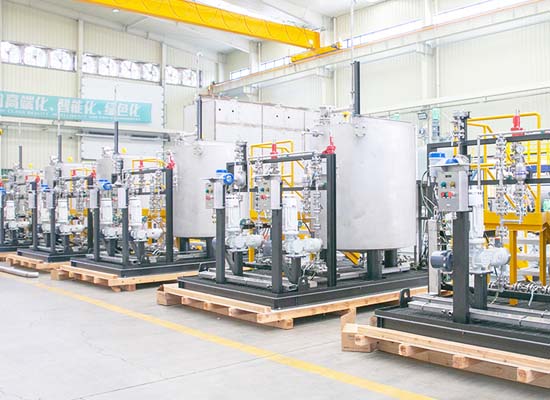
While a standalone pump is effective for simple applications, modern wastewater plants require a systems approach. Depamu addresses this through its Automatic Dissolving and Injection Packages (often referred to as "Skids" or "Package Systems"). These pre-assembled units integrate the pump with the necessary auxiliary equipment to ensure reliability.
3.1. Component Integration
A typical Depamu wastewater injection package for a chemical like polyelectrolyte (PAM) includes:
-
The PLC Control Cabinet: The brains of the operation. It allows for local or remote (SCADA/DCS) control, self-diagnosis, and alarm output.
-
The Solution Tank: Ranging from 0.5 to 2.5 cubic meters, manufactured from 304/316 stainless steel or engineering plastics like PE/PVC to resist corrosion.
-
The Dry Powder Feeder (for polymers): A unique servo-driven mechanism that prevents "fishing rod" effect (caking/bridging) and ensures precise concentration of the mother solution before it ever reaches the pump.
-
The Metering Pump: The Depamu injection pump itself, delivering flow rates from 100 to 850 L/h at pressures up to 2.5 MPa.
-
Pulsation Dampeners & Safety Valves: To smooth flow spikes and protect the system from over-pressure events.
3.2. Built-in Redundancy
Recognizing that wastewater treatment cannot stop, many Depamu skids are configured with duplex (2 pumps) or triplex (3 pumps) arrangements. A common configuration for critical applications is "1 Tank + 2 Pumps," allowing for duty/standby operation. If the primary pump fails or requires maintenance, the secondary pump activates automatically, ensuring continuous compliance.
4. Material Science: Surviving the "Chemical Cocktail"
The longevity of a dosing system in wastewater is determined almost entirely by the materials used in the "wetted end" (the parts that touch the chemical). Depamu offers a high degree of customization in this area.
4.1. Pump Head Materials
-
PVC (Polyvinyl Chloride): Standard for low-temperature (≤40°C), low-corrosion applications (e.g., sodium hypochlorite at low concentrations).
-
PVDF (Polyvinylidene Fluoride): Preferred for aggressive chemicals like strong acids and oxidizing agents, with a higher temperature tolerance.
-
SS 304/316/316L Stainless Steel: Used for high-pressure injection or fluids that are incompatible with plastics, such as oil-based defoamers or specific solvents.
-
PTFE: The diaphragm material itself is almost chemically inert, resistant to nearly all chemicals used in wastewater treatment.
4.2. Valve Technology
Depamu check valves feature a "self-cleaning" structure. In dirty water applications, particulate matter is the enemy. Standard ball valves can become stuck in an open or closed position if grit enters the seat. Depamu’s self-cleaning design allows small particulates to be flushed through during the discharge cycle, reducing the risk of "stiction" and maintaining volumetric efficiency.
5. Operational Efficiency: Precision Under Pressure
A pump is only as good as its turndown ratio and accuracy. Wastewater flow varies throughout the day (diurnal flow variation). A dosing system must match chemical feed to this variable flow. "Constant rate, variable concentration" leads to overdosing (costly and chemically wasteful) or underdosing (regulatory fines).
5.1. Flow Adjustment Mechanisms
Depamu pumps utilize a manual stroke adjustment mechanism. The operator (or automated control system) can adjust the effective length of the piston stroke from 0% to 100%, even while the pump is running (dynamic state).
-
Turndown Ratio: 10:1. This means the pump can accurately dose at 10% of its maximum flow rate while maintaining steady-state accuracy.
5.2. Automation Integration
In advanced configurations, the Depamu system integrates with Variable Frequency Drives (VFDs). A flow meter on the main influent line sends a 4-20 mA signal to the PLC. The PLC processes this signal and adjusts the pump's motor speed or stroke length accordingly. This creates a closed-loop control system where chemical feed is linearly proportional to flow, maintaining an exact parts-per-million (PPM) ratio regardless of hydraulic loading.
6. Application Matrix: Wastewater Scenarios
Depamu dosing systems are tailored for specific stages of the wastewater treatment process.
6.1. Flocculant (Polymer) Injection
-
Challenge: Producing a strong, dense floc without wasting expensive polymer.
-
Depamu Solution: The specific "Automatic Dissolving and Injection Package" for dry powder polymers. It pre-wets and ages the polymer before the injection pump sends it to the mixing flume. This prevents "fish eyes" (undissolved gel balls) which ruin sludge dewatering efficiency.
6.2. pH Neutralization (Acid/Alkali Injection)
-
Challenge: Industrial wastewater often arrives with a pH of 2 (highly acidic) or 12 (highly caustic). Introducing neutralizing agents too quickly causes localized pH shock.
-
Depamu Solution: Using the DPMFWSA series with PVDF heads and PTFE diaphragms. The precise metering prevents overshoot (using too much H2SO4 or NaOH), saving significant chemical costs.
6.3. Sludge Dewatering (Conditioning)
-
Challenge: Prior to a belt filter press or centrifuge, sludge must be conditioned to release bound water.
-
Depamu Solution: High-pressure units inject specific polymers directly into the sludge line. The reliability of the mechanical diaphragm ensures consistent cake dryness, reducing haul-off costs.
7. Maintenance and Reliability
Operational expenditure (OPEX) is heavily influenced by maintenance downtime. Depamu has engineered its pumps with serviceability in mind.
-
Maintenance Intervals: Depamu specifies maintenance periods of up to 4,000 hours at 1.0 MPa pressure, extending to 8,000 hours at lower pressures (≤0.7 MPa). This suggests a robust design life for the diaphragm and valve components.
-
Online Repairability: As noted in their Rotor Pump literature (which shares design philosophies with their metering pumps), Depamu designs allow for online repairing. In many configurations, the pump head can be serviced without draining the main pipeline or dismantling the entire suction/discharge piping.
8. Performance Specifications Overview
For the procurement engineer or plant manager, the following specifications define the capability of the Depamu wastewater dosing range:
| Parameter | Typical Range / Value |
|---|---|
| Flow Rate (per head) | 10 L/h to 150 L/h (Standard DPMFWSA) / Up to 1000 L/h (Skid systems) |
| Discharge Pressure | Up to 1.2 MPa (174 PSI) standard / 2.5 MPa for specific skids |
| Temperature Range | PVC: ≤ 40°C / PTFE & Metal: ≤ 80°C |
| Turndown Ratio | 10:1 |
| Steady State Accuracy | ± 2% |
| Power End | Cast Aluminum (Heat dissipation) / WORM gear drive |
| Diaphragm Material | PTFE (Mechanically actuated - no oil hydraulic fluid required) |
9. Conclusion
In the landscape of wastewater treatment, the chemical dosing pump is the instrument of control. It is the valve through which solutions flow to solve problems of turbidity, toxicity, and biological oxygen demand. Depamu’s offerings, particularly the DPMFWSA series mechanical diaphragm pumps and their integrated dosing packages, provide a robust answer to the industry's needs.
The combination of PTFE diaphragm leak protection, ±2% dosing accuracy, automation-ready PLC integration, and aggressive material compatibility positions Depamu as a competitive solution for both municipal and industrial applications.
For the plant operator, the value lies in the reduction of chemical waste and the assurance of regulatory compliance. For the maintenance manager, the value is in the extended service intervals and the self-cleaning valve architecture that reduces clogging risks. As water scarcity increases and discharge permits tighten globally, the precision offered by systems like those from Depamu will transition from being "recommended" to "absolutely mandatory."
Key Takeaway: When selecting a dosing system for wastewater, do not merely look at the flow rate. Look at the linearity of the turndown, the chemical resistance of the wetted path, and the redundancy of the skid design. Depamu addresses all three pillars of reliable chemical feed.