

Depamu Chemical Dosing Pump for Acetone (Dimethyl Ketone): Engineering Precision for Volatile Solvents
Abstract
Acetone (dimethyl ketone, CH₃COCH₃) is one of the most widely used industrial solvents, finding application across pharmaceutical manufacturing, chemical processing, plastics production, and laboratory settings. However, its low flash point (-20°C), high volatility, and aggressive solvency present unique challenges for fluid handling equipment. Depamu (Hangzhou) Pump Technology Co., Ltd., a manufacturer certified to ISO9001, ISO14001, and API675 standards, offers a range of chemical Dosing Pumps specifically engineered to address these challenges. This paper examines the technical requirements for pumping acetone, analyzes Depamu's pump technologies suitable for this application, and provides comprehensive guidance on material selection, safety considerations, and system integration.
1. Introduction: The Acetone Pumping Challenge
Acetone, the simplest ketone, serves as a critical industrial chemical with global production exceeding 6 million tonnes annually. Its applications span from solvent in pharmaceuticals and paints to intermediate in methyl methacrylate and bisphenol-A production. Despite its ubiquity, acetone presents significant handling difficulties that must be addressed at the pump selection stage.
1.1 Physical and Chemical Properties of Acetone
| Property | Value | Significance for Pumping |
|---|---|---|
| Molecular Weight | 58.08 g/mol | Low viscosity fluid |
| Boiling Point | 56°C | High vapor pressure |
| Flash Point | -20°C | High flammability risk |
| Vapor Pressure | 24.6 kPa at 20°C | Cavitation potential |
| Viscosity | 0.316 cP at 25°C | Very low viscosity |
| Surface Tension | 23.7 mN/m at 20°C | Leakage propensity |
1.2 Critical Handling Risks
Flammability and Explosion Hazard: With a flash point of -20°C, acetone generates flammable vapors at room temperature. The lower explosive limit (LEL) is 2.5% by volume in air. Static electricity accumulation during pumping—particularly in non-conductive pipework—can provide ignition energy, leading to fires or explosions .
Material Compatibility: Acetone aggressively attacks many elastomers and thermoplastics. PVC, Buna-N, natural rubber, and Tygon are rapidly degraded or dissolved upon contact. The fundamental chemistry rule applies: "like dissolves like"—acetone dissolves many polymers, requiring strict material selection .
Cavitation Risk: Acetone's high vapor pressure and low viscosity increase cavitation potential at pump inlets, particularly when handling at elevated temperatures or under suction lift conditions.
2. Depamu Pump Technologies for Acetone Service
Depamu offers multiple pump technologies applicable to acetone dosing, each suited to specific flow rate, pressure, and duty requirements.
2.1 DP-Series Solenoid Diaphragm Dosing Pump
The DP-Series electromagnetic diaphragm dosing pump represents Depamu's most versatile offering for precision chemical injection .
Operating Principle: An electromagnet drives a PTFE diaphragm through reciprocating motion, creating controlled suction and discharge cycles. The stroke length and frequency are adjustable, enabling turndown ratios of 10:1 with steady-state accuracy of ±2% .
Key Specifications:
| Parameter | Value |
|---|---|
| Maximum Flow per Head | 2300 L/h |
| Maximum Discharge Pressure | 1.2 MPa |
| Temperature Range | PVC ≤40°C; PTFE ≤80°C |
| Turndown Ratio | 10:1 |
| Accuracy | ±2% steady-state |
Acetone Suitability: The DP-Series is suitable for acetone dosing when equipped with PTFE (polytetrafluoroethylene) wetted parts. PTFE exhibits excellent resistance to acetone, with no swelling or degradation . The Diaphragm Pump's positive displacement design ensures consistent dosing independent of system backpressure variations.
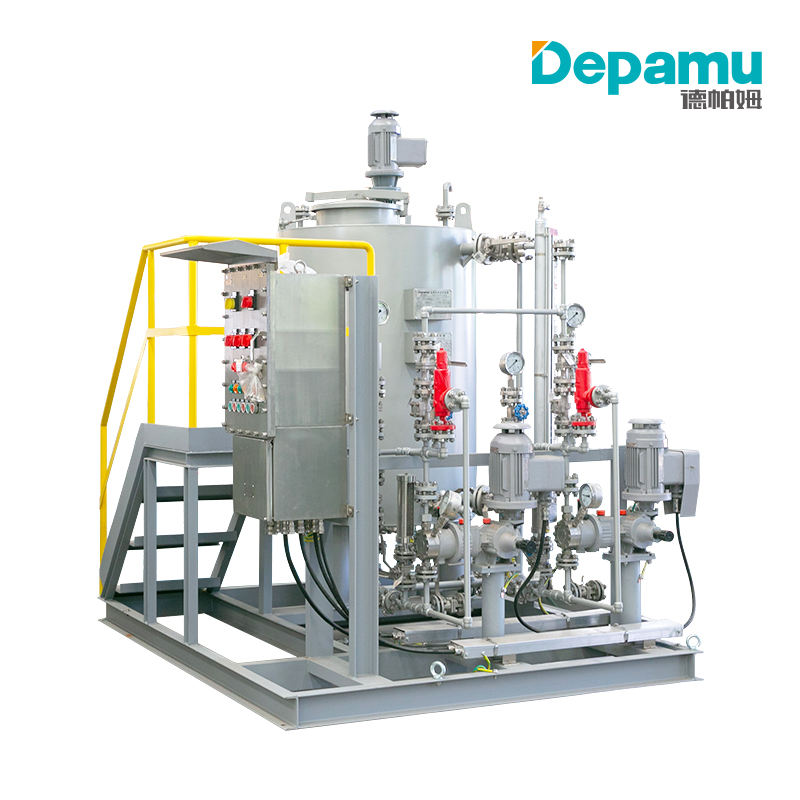
2.2 Chemical Dosing Systems (Skid-Mounted)
For integrated applications, Depamu offers complete chemical dosing systems incorporating Metering Pumps, solution tanks, control systems, and accessories .
Acetone-Specific Applications: These systems find application in:
-
Hydrazine/acetone dosing in boiler feedwater — Acetone is used as a precursor to acetoxime in oxygen scavenger formulations
-
Pharmaceutical processing — Precise acetone addition in synthesis and crystallization
-
Polymer production — Controlled feed of acetone as solvent or chain-transfer agent
System Components: | Component | Specification |
|-----------|---------------|
| Solution Tank | 0.5–20 m³, stainless steel or lined |
| Metering Pump | DP-Series diaphragm or plunger type |
| Control | Manual, automatic, remote, or variable frequency |
| Certification | CE, ISO9001, API675 |
2.3 Rotor Pumps for High-Viscosity Applications
While less commonly used for pure acetone due to its low viscosity, Depamu's rotor pump line offers alternatives for high-solid-content acetone slurries or viscous acetone-based solutions. These pumps, compliant with API 676, handle viscosities up to 2 million cP and solid contents of 60% .
3. Material Compatibility: The Critical Selection Factor
Material selection for acetone service is non-negotiable. Incorrect material choices lead to rapid pump failure, process contamination, and safety incidents.
3.1 Compatible Materials for Acetone
Based on chemical resistance data and manufacturer specifications, the following materials are suitable for acetone contact :