

Depamu Triple/Three Screw Pump for Lube Oil, Diesel, Bitumen and Fuel Oil
Introduction
In the realm of industrial fluid handling, few pumping technologies have demonstrated the versatility and reliability of the three-screw pump. Depamu (Hangzhou) Pumps Technology Co., Ltd., a leading Chinese manufacturer of high-viscosity pumps, has developed a comprehensive range of three-screw pumps that have gained international recognition for their exceptional performance across a wide spectrum of applications. Based on advanced German technology and backed by professional technical certification, Depamu's three-screw pumps represent the convergence of precision engineering and robust industrial design. These pumps are specifically engineered to handle lubricating oils, diesel fuel, bitumen, fuel oils, and a variety of other lubricating liquids, making them indispensable assets in industries ranging from petroleum and marine to construction and power generation.
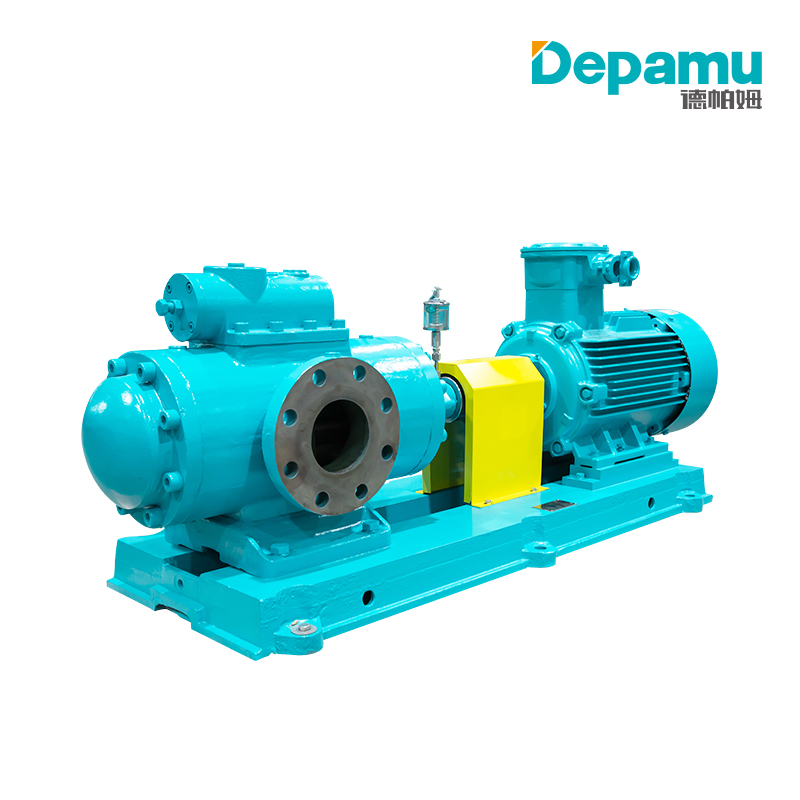
This article provides a comprehensive examination of Depamu's triple/three-screw pump technology, exploring its working principles, technical specifications, and diverse applications across four critical fluid categories: lube oil, diesel, bitumen, and fuel oil.
Operating Principle and Design Architecture
The three-screw pump is a positive displacement pump (PDP) composed of three meshed screw shafts—one active (drive) screw and two driven screws—housed within a pump body that contains them. Together, these components form sealing lines that isolate the suction cavity from the discharge cavity. When the screw shafts rotate, the sealing lines periodically execute axial motion from the suction cavity to the discharge cavity, continuously propelling the medium from the inlet to the outlet.
A defining characteristic of Depamu's three-screw pump design is the hydraulic balancing of the drive screw and the hydraulic powering of the driven screws. Under normal operating conditions, the screws maintain no physical contact with one another. Instead, a thin oil film forms between the drive screw and the driven screws, as well as between the screws and the liner, which protects the screw surfaces from wear and ensures an exceptionally long service life. This hydrodynamic lubrication principle effectively renders the pump "semi-permanent" in terms of operational longevity.
It is noteworthy that during pump startup and shutdown, the drive and driven screws are in a critical state and may momentarily come into direct contact. This necessitates the use of screws with superior strength, surface hardness, and processing precision to withstand such transient conditions. Depamu has developed mature technologies and reliable means to prevent wear issues that could arise from metallic contact, particularly in lubricating oil transfer applications.
The pump body is available in multiple structural configurations to accommodate different flow requirements. For smaller flow rates (0.2 to 6.5 m³/h), the pump body and liner are integrated into a single unit, with mechanical seals serving as the shaft sealing mechanism. For medium to large flow applications, the liner is manufactured as a separate component fixed within the pump body, and large-flow pumps are often constructed as double-suction units in horizontal mounting configurations. Shaft sealing options include both mechanical seals and packing seals, selected based on the specific characteristics of the pumped medium.
Technical Specifications and Performance Parameters
Depamu's three-screw pumps are offered in two primary series: the DPSN series and the DP3G series. Both series share impressive performance specifications:
| Parameter | DPSN Series | DP3G Series |
|---|---|---|
| Maximum Flow Rate | 575 m³/h (9,583 L/min) | 575 m³/h (9,583 L/min) |
| Maximum Differential Pressure | 25 bar | 25 bar |
| Maximum Speed | 2,900 r/min | 2,900 r/min |
| Medium Viscosity Range | 3–760 cSt | 3–760 cSt |
| Maximum Operating Temperature | 300°C | 300°C |
The pumps exhibit strong self-priming capabilities, eliminating the need for bottom valves or auxiliary evacuation equipment. They deliver uniform, continuous flow without pulsation, characterized by high volumetric efficiency and low noise levels. The compact, lightweight design allows for high-speed operation and direct coupling to electric motors or other prime movers, with minimal sensitivity to entrained gases or contaminants.
For medium to large flow models, Depamu incorporates safety valves that automatically redirect high-pressure oil back to the pump inlet when the pressure exceeds the preset threshold, thereby protecting the pump, motor, and piping system from overpressure damage.
Application 1: Lube Oil
Lubricating oil transfer represents one of the most demanding and widespread applications for Depamu's three-screw pumps. The pumps are extensively used in industrial settings as lubrication pumps, in hydraulic systems as Hydraulic Pumps, and in various oil delivery systems as transfer and refueling pumps.
The inherent design of the three-screw pump makes it exceptionally well-suited for lube oil applications. The hydrodynamic oil film that forms between the screws not only protects the pump components but also ensures that the lubricating oil itself is transferred without foaming or turbulence. This is critical because aerated or turbulent oil can compromise lubrication effectiveness in downstream equipment such as turbines, compressors, and large machinery bearings.
Depamu's pumps handle lube oils across a broad viscosity range (3–760 cSt) and at temperatures up to 300°C. The pumps' long service life—significantly exceeding that of gear pumps or Rotor Pumps in comparable applications—makes them particularly attractive for continuous-duty industrial operations where reliability and minimal maintenance are paramount.
The pumps find application across diverse sectors including petroleum refining, metallurgy, machine tools, power generation, marine propulsion systems, and glass manufacturing. In the marine industry, for instance, three-screw pumps are the preferred choice for main engine lube oil circulation, providing stable pressure and flow output that adapt to varying viscosity and temperature conditions.
Application 2: Diesel Fuel
Diesel fuel transfer presents unique challenges due to the fuel's lower viscosity compared to lubricating oils and its role as a combustible fluid requiring safe handling. Depamu's three-screw pumps are designed to address these challenges effectively.
The pumps are employed in diesel fuel supply systems for marine diesel installations on sea and river vessels, as well as in ship boiler installations for fuel supply. In these applications, the pumps must deliver consistent flow without pressure pulsation to ensure proper atomization and combustion in diesel engines and burners.
The three-screw pump's positive displacement nature ensures that the flow rate remains stable regardless of back-pressure variations—a critical characteristic for fuel injection systems where precise fuel metering is essential. Additionally, the pumps' ability to handle fluids without agitation means that diesel fuel maintains its integrity during transfer, without the formation of foam or emulsions that could impair combustion efficiency.
For diesel applications, Depamu offers pumps capable of handling viscosities as low as 0.5 cSt, ensuring reliable operation even with lighter fuel grades. The pumps' self-priming capability further simplifies installation, as no priming or bottom valve is required before startup.
Application 3: Bitumen and Asphalt
Bitumen transfer represents arguably the most challenging application for any pumping technology. Bitumen is an extremely viscous, high-temperature material that exhibits dramatic viscosity changes with temperature fluctuations. At 160°C, bitumen flows relatively freely; at 120°C, cavitation problems begin to emerge. Modified bitumen with polymer additives presents even greater difficulties, often requiring custom-engineered solutions.
Depamu has risen to this challenge with specialized three-screw bitumen pumps featuring heating jacket configurations. These pumps incorporate hydraulic temperature control systems that subject the medium to cold-hot exchange and temperature compensation upon entering the pump head. This ensures correct addition of the medium and, crucially, improves the mobility of the viscous liquid by leveraging the characteristic that liquid viscosity decreases as temperature rises. The result is fluent delivery and accurate metering even with the most challenging bitumen grades.
The heating jacket design also incorporates cooling devices on the mating connection body to mitigate the adverse effects of excessive heat on the mechanical transmission components. This thermal management approach ensures that the pump can maintain reliable operation while handling bitumen at elevated temperatures.
In road construction and maintenance applications, Depamu's three-screw bitumen pumps are used for the transfer of asphalt from storage tanks to mixing plants and paving equipment. The pumps' ability to handle high-viscosity, high-temperature fluids without pulsation ensures consistent delivery of bitumen to spray bars and application systems, contributing to uniform pavement quality.
Application 4: Fuel Oil and Heavy Fuel Oil
Fuel oil applications encompass a broad spectrum of fluids, ranging from light fuel oils to heavy residual fuel oils used in marine and stationary power generation. Depamu's three-screw pumps are well-suited to handle this diversity.
For light fuel oils, the pumps provide efficient transfer and injection in marine fuel systems. The three-screw mechanism ensures smooth, pulsation-free delivery that is essential for maintaining consistent fuel supply to engines and burners.
For heavy fuel oils (HFO) and residual fuels, the pumps' robust construction and ability to handle high-viscosity fluids come to the forefront. The pumps can accommodate viscosities across the full range from 3 to 760 cSt, and with appropriate heating arrangements, can handle even the heaviest fuel grades. Depamu offers specialized heavy fuel oil pump variants, such as the LQ3G series, designed specifically for heat-preserving bitumen and heavy fuel oil transfer.
In oil and gas industry applications, three-screw pumps serve as transfer, circulating, blending, or export pumps for clean, lubricating fluids of varying viscosities, including crude oils, fuel oils, bitumen, grease, and paraffin. The pumps' non-pulsating flow and low shear characteristics are particularly valued in applications where the fluid's chemical or physical properties must be preserved during transfer.
The integration of safety valves in medium to large flow models provides an additional layer of protection in fuel oil systems, where overpressure conditions could lead to catastrophic failures. This safety feature, combined with the pumps' inherent reliability, makes Depamu's three-screw pumps a trusted choice for critical fuel oil transfer operations.
Operational Advantages and Competitive Position
Depamu's three-screw pumps offer a compelling value proposition across all four application categories. Several key advantages distinguish them from competing technologies:
Superior Service Life: The hydrodynamic lubrication principle, combined with high-precision manufacturing, results in service life that significantly exceeds that of gear pumps or rotor pumps. The absence of mechanical contact between screws during normal operation minimizes wear, with the pump's operational life described as "semi-permanent".
Low Noise and Vibration: The axial,匀速 linear motion of the fluid within the pump results in minimal pressure pulsation and low noise levels. The low inertia of rotating components further reduces starting torque and vibration.
High Efficiency: Volumetric efficiency remains high across a wide range of operating conditions, contributing to reduced energy consumption and operating costs.
Versatility: The ability to handle viscosities from 3 to 760 cSt and temperatures up to 300°C makes these pumps suitable for an exceptionally broad range of fluids.
Ease of Maintenance: The durable, compact structure simplifies installation and maintenance. Multiple mounting configurations (horizontal, vertical, and marine-specific versions) accommodate diverse installation requirements.
API Standards Compliance: Depamu's pumps are manufactured to meet API Standard and API675 requirements, ensuring compatibility with international industry standards.
Conclusion
Depamu's triple/three-screw pump technology represents a sophisticated solution to the complex challenges of transferring lubricating oils, diesel fuel, bitumen, and fuel oils across a wide range of industrial applications. Built on a foundation of German engineering expertise and backed by professional certification, these pumps deliver exceptional reliability, efficiency, and longevity.
The pumps' hydrodynamic operating principle, which eliminates mechanical contact between screws under normal conditions, ensures semi-permanent service life—a critical advantage in continuous-duty industrial applications where downtime is costly. Their ability to handle viscosities spanning three orders of magnitude (3–760 cSt) and temperatures up to 300°C makes them extraordinarily versatile.
From lubricating the massive bearings of marine propulsion systems to transferring viscous bitumen for road construction, from supplying diesel fuel to marine engines to handling heavy fuel oil in power generation, Depamu's three-screw pumps have demonstrated their value across the full spectrum of fluid handling challenges. The incorporation of safety valves, heating jacket options, and multiple sealing configurations further extends their applicability to even the most demanding service conditions.
As industries worldwide continue to seek pumping solutions that combine reliability, efficiency, and versatility, Depamu's three-screw pumps stand as a testament to the power of precision engineering applied to the fundamental challenge of moving fluids. With their mature technology, proven performance, and commitment to quality, these pumps are well-positioned to meet the evolving needs of the petroleum, marine, construction, and power generation industries for years to come