

The Depamu Controlled Dose Metering Pump for PCDI Crosslinking Inline Process with Pad Rollers
Abstract
The precision application of crosslinking agents in Pressure Cooker De-Ionization (PCDI) inline processes represents a critical control point in the production of thermally cross-linkable polymer composites. This article examines the integration of Depamu controlled dose metering pumps within an inline PCDI crosslinking system incorporating pad rollers for continuous web coating applications. The discussion addresses the operational principles of Depamu's reciprocating metering pump technology, the specific requirements of crosslinking agent delivery, and the synergistic integration with pad roller coating systems for achieving uniform crosslink density and optimized production efficiency.
1. Introduction
In the production of thermally cross-linkable polymers, the precise incorporation of crosslinking agents—typically liquid thermal cross-linkers and accelerators—into plasticized polymer melts is essential for achieving desired material properties. Recent advancements in inline processing have enabled direct integration of mixing, cooling, and coating operations, eliminating intermediate handling steps that introduce variability and inefficiency. Within this paradigm, the metering pump serves as the critical interface between the chemical dosing system and the polymer processing line.
Depamu (Hangzhou) Pumps Technology Co., Ltd. has established itself as a premier manufacturer of metering and Dosing Pumps since its founding in 2003, combining German engineering principles with Chinese manufacturing capabilities. The company's DP(M)WA and DPMFWA series hydraulic and mechanical Diaphragm Pumps offer the precision, reliability, and chemical resistance necessary for crosslinking agent delivery in demanding industrial applications.
2. PCDI Crosslinking Inline Process Fundamentals
2.1 The Role of Thermal Crosslinking Agents
Thermal crosslinking agents incorporated into polymer melts create covalent bonds between polymer chains, transforming thermoplastic materials into thermoset networks with enhanced mechanical strength, thermal stability, and chemical resistance. The challenge lies in introducing these reactive agents in a controlled manner while preventing premature crosslinking (gelation) that would compromise processability.
2.2 Inline Processing Requirements
The inline processing approach—where plasticized polymers are discharged from the mixing unit and immediately directed to a coating device without intermediate filling or decanting—offers significant advantages:
-
Elimination of reheating requirements
-
Reduced residence time and oxidative degradation
-
Minimized exposure to contaminants
-
Continuous, high-throughput operation
The planetary roller extruder provides the ideal mixing environment, with multiple cylinder assemblies enabling sequential degassing, crosslinker incorporation, and cooling stages. The crosslinking agent must be introduced in the cylinder assembly where degassing has been completed, with subsequent cooling to extend the time to gelation beyond the residence time in the processing equipment.
3. Depamu metering pump Technology
3.1 Design and Operating Principles
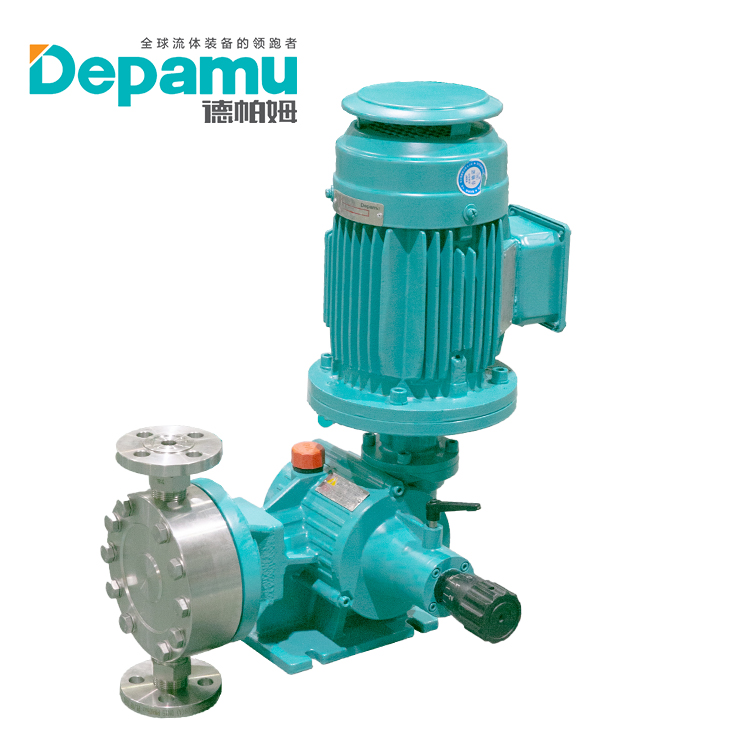
Depamu's metering pumps are reciprocating positive displacement devices that deliver precise, pulsed flow of liquid media. The DP(M)WA hydraulic diaphragm series exemplifies the technology:
Transmission Mechanism: A patented integrated sleeve adjustable eccentric mechanism converts rotary motor motion into reciprocating plunger movement. The stroke length can be adjusted from 0% to 100%, enabling stepless flow rate modulation.
Hydraulic Diaphragm System: The hydraulic diaphragm pump incorporates an internal safety valve and compensation valve that automatically manages air discharge and oil replenishment. This design provides:
-
Reliable sealing between process fluid and power transmission
-
Leak-free operation
-
Automatic pressure compensation for consistent metering accuracy
Check Valve System: High-precision inlet and outlet check valves maintain fluid flow direction and prevent backflow, ensuring metering accuracy of ±0.5% across the 10%-100% adjustment range.
3.2 Control and Integration Capabilities
Depamu pumps offer multiple flow rate adjustment modes suited for inline process integration:
| Adjustment Mode | Application Context |
|---|---|
| Manual | Initial setup and calibration |
| Electric (actuator) | Remote setpoint control |
| Pneumatic | Hazardous area operation |
| Frequency conversion | Continuous, automated process control |
The frequency conversion mode is particularly advantageous for inline PCDI processes, as it allows the pump output to be dynamically linked to upstream polymer flow rates, maintaining the precise crosslinker-to-polymer ratio essential for product consistency.
3.3 Material Compatibility and Performance Specifications
For crosslinking agent delivery, the pump's wetted components can be specified in materials compatible with the specific chemistry:
-
Stainless steel (304, 316, 316L): Broad chemical compatibility
-
Hastelloy C: Superior corrosion resistance for aggressive crosslinkers
-
High-polymer materials: Non-reactive alternatives for sensitive chemistries
The DP(M)WA series achieves discharge pressures up to 8 MPa with flow rates ranging from 10 to 212 L/h depending on plunger diameter and motor configuration. This range accommodates typical crosslinker addition levels in industrial polymer processing.
4. Pad Roller Integration in the Inline Coating Process
4.1 The Pad Roller Coating Principle
The pad roller coating unit, as described in relevant patent literature, typically consists of a multi-roller configuration that forms the polymer blend into a film of precise thickness before transfer to a web substrate. A four-roller coating unit offers optimal control:
-
Dosing roll: Receives the polymer blend from the extruder
-
Doctor roll: Determines the layer thickness through gap control
-
Transfer roll: Conveys the formed film
4.2 The Dosing Interface
The Depamu metering pump delivers the crosslinking agent to a precisely controlled injection point in the planetary roller extruder's compounding section. The integration sequence follows this pattern:
-
Polymer melt enters the extruder feed section
-
Vacuum degassing removes air and volatiles
-
Depamu pump introduces liquid crosslinker under pressure
-
Mixing and incorporation occur in subsequent cylinder assemblies
-
Cooling stabilizes the blend to prevent gelation
-
The blend discharges directly to the pad roller coating unit
This inline configuration eliminates the need for intermediate storage and reheating, reducing thermal history and maintaining the reactive blend in an optimal state for coating.
4.3 Process Control Parameters
Critical parameters requiring close control include:
Pump Stroke Frequency: Determines the instantaneous crosslinker addition rate; synchronized with extruder throughput
Cooling Zone Temperature: Maintained to extend the gelation time beyond the residence time in the extruder and coating unit
Roller Circumferential Speed: Differences in roll speeds affect film thickness and transfer behavior; requires coordination with the discharge rate from the extruder
Web Tension and Speed: Must be matched to the coating application rate for uniform coverage
5. Technical Advantages of Depamu Integration
5.1 Precision and Accuracy
The ±0.5% metering accuracy of Depamu pumps ensures that the crosslinking agent concentration remains within tight tolerances, directly affecting the crosslink density and final product properties. This precision is essential for:
-
Maintaining consistent gelation time
-
Achieving uniform mechanical properties
-
Minimizing rejects from off-spec material
5.2 Process Stability
The hydraulic diaphragm design provides pulsation damping that smooths the flow profile, enabling uniform mixing with the polymer melt. The integrated safety and compensation valves maintain performance despite variations in inlet pressure or viscosity.
5.3 Reliability and Maintenance
Depamu pumps incorporate several features that support continuous inline production:
-
Oil-immersion lubrication for extended transmission component life
-
High-performance plunger materials with special packing
5.4 Regulatory Compliance
The pumps conform to API675 standards and carry CE and ISO certifications, meeting the quality requirements of industrial polymer processing operations.
6. Application Case Study Considerations
6.1 Typical Operating Conditions
For a crosslinking agent with moderate viscosity and a required addition rate of 50-100 L/h at 2-5 MPa discharge pressure, the Depamu DP(M)WA series provides suitable capacity. The 8 mm stroke length and 90-160 strokes per minute range of the mechanical diaphragm models allow fine adjustment of the delivery profile.
6.2 Installation Considerations
The vertical motor installation design ensures leak-free operation and reduces footprint. The pump can be mounted directly adjacent to the extruder feed point, minimizing transfer line length and crosslinker residence time before incorporation.
6.3 System Integration
The pump can be interfaced with the overall process control system through:
-
4-20 mA analog output for flow rate monitoring
-
Electric actuator for remote stroke adjustment
-
Frequency converter for variable-speed operation
7. Conclusion
The integration of Depamu controlled dose metering pumps in PCDI crosslinking inline processes with pad rollers represents a technically mature solution for producing thermally cross-linkable polymer composites. The combination of precise metering accuracy, robust construction, and flexible control options addresses the critical requirements of crosslinking agent delivery:
-
Accurate addition rates maintain crosslink density specifications
-
Continuous, pulsed flow integrates with the extruder mixing process
-
Material compatibility options accommodate diverse chemistries
-
Process control interfaces enable synchronization with upstream and downstream equipment
As polymer processing operations continue to adopt inline methodologies for efficiency and quality improvement, the role of precision metering equipment becomes increasingly central. Depamu's product range, supported by its engineering heritage and manufacturing capabilities, provides a reliable foundation for these demanding applications.