

How Does a Multi-Diaphragm Seal-Less Hydraulic Pump Work?
Introduction
In the world of industrial pumping, the challenge of moving aggressive, abrasive, or hazardous fluids without leakage has long driven innovation. Traditional pump designs that rely on dynamic seals—such as mechanical seals or packing—inevitably wear, leak, and require frequent maintenance. The multi-diaphragm seal-less hydraulic pump represents a breakthrough solution to this problem, combining the pressure-generating capability of hydraulic actuation with the containment integrity of a hermetically sealed pumping chamber. This article examines the working principles, design architecture, and operational characteristics of this advanced pump technology, focusing primarily on the Hydra-Cell® design pioneered by Wanner Engineering, which has become the industry benchmark for seal-less hydraulic Depamu-pumps.com/Diaphragm-Pump.html target='_blank'>Diaphragm Pumping.
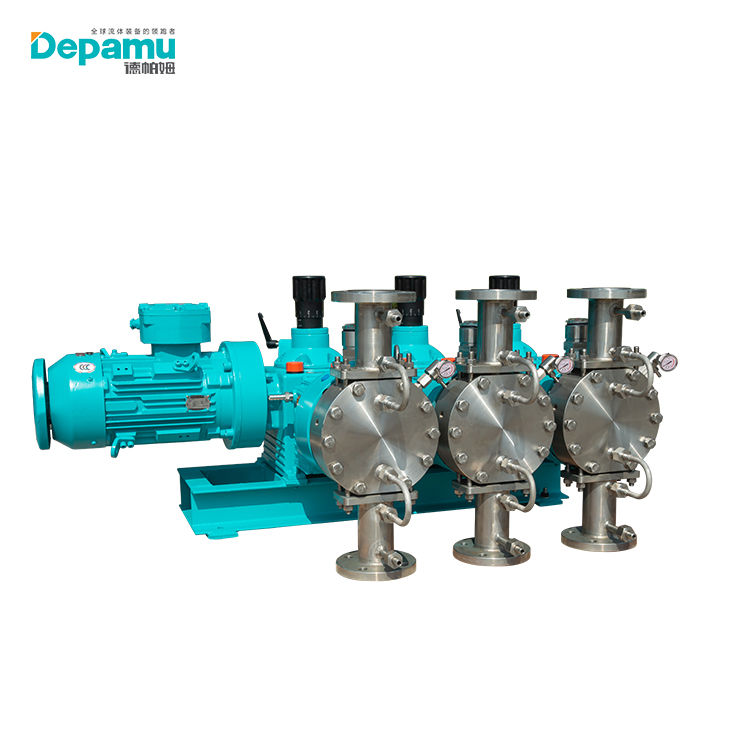
The Fundamental Principle: Positive Displacement with Hydraulic Actuation
At its core, a multi-diaphragm seal-less hydraulic pump is a positive displacement pump. Unlike centrifugal pumps that impart velocity to a fluid, positive displacement pumps trap a fixed volume of liquid and force it into the discharge system. What distinguishes this particular class of pumps is the method by which the pumping action is generated: rather than a mechanical plunger or piston directly contacting the process fluid, hydraulic oil serves as the intermediary that flexes the diaphragms.
The complete pumping mechanism is submerged in a lubricating oil bath. A drive shaft, supported by precision bearings, transmits rotary motion from a motor or engine into the pump housing. The conversion of rotary motion into the linear reciprocating motion required for pumping is achieved through one of two primary mechanisms: a wobble plate or a crank-shaft with cam lobes. In wobble plate models, a fixed-angle cam plate nutates—oscillating forward and back—as the drive shaft turns, converting axial rotation into linear motion. In crank-shaft models, cam shaft lobes and connecting rods perform the same function, with each cam actuating a hydraulic piston.
The critical innovation lies in what happens next. Each hydraulic piston contains a patented hydraulic cell—a sealed chamber filled with oil. As the piston moves forward and backward, it pressurizes and depressurizes this oil. The oil, in turn, acts upon the back side of a flexible diaphragm. Because the oil is incompressible, the diaphragm flexes forward and back in precise response to the piston's motion, creating the pumping action on the process fluid side.
The Multi-Diaphragm Configuration
The term "multi-diaphragm" refers to the use of multiple, independent diaphragms—typically three (triplex) or five (quintuplex)—arranged within a single pump head. Each diaphragm has its own pumping chamber containing an inlet and a discharge check valve assembly. These self-aligning horizontal disk check valves ensure unidirectional flow through each chamber.
The diaphragms are spaced equally from one another and operate sequentially with a phase offset. As the drive shaft rotates, the wobble plate or cam mechanism actuates each diaphragm at a slightly different point in the cycle. This sequential operation is not merely a design convenience; it is fundamental to the pump's performance characteristics. When the flow curves of the individual diaphragms are superimposed, the peaks and valleys of each diaphragm's pulsating output fill in each other's gaps, producing a combined flow that is remarkably steady and low in pulsation. In many applications, this multi-diaphragm configuration eliminates the need for pulsation dampeners entirely, which are otherwise required with single-diaphragm or plunger pumps.
From the perspective of the process fluid, the multi-diaphragm design offers a further advantage: the common inlet manifold distributes fluid to each pumping chamber through its respective inlet check valve, and the common discharge manifold collects the pressurized fluid from each discharge check valve. This parallel arrangement means that each diaphragm operates at the same discharge pressure, and the total flow rate is the sum of the individual contributions.
The Hydraulic Balancing Principle
Perhaps the most elegant aspect of the multi-diaphragm seal-less hydraulic pump is the hydraulic balancing of the diaphragms. A fundamental challenge in diaphragm pump design is that the diaphragm must withstand the full pressure differential between the process fluid and the actuating mechanism. If a diaphragm is subjected to high discharge pressures without adequate support, it will fail prematurely.
The Hydra-Cell design solves this problem through a sophisticated hydraulic balancing system. The oil held in the hydraulic cell behind each diaphragm is maintained at a pressure that closely matches the pressure of the process fluid on the other side. The result is that the diaphragm faces only a tiny pressure differential—approximately 3 psi (0.21 bar)—regardless of the absolute pressure at which the fluid is being delivered. This differential remains constant whether the pump is operating at 100 psi or 2,500 psi.
This hydraulic balancing is not a passive characteristic; it is actively maintained by the pump's design. The hydraulic cell, moved sequentially by the wobble plate or crank-shaft, maintains the precise balance of oil behind the diaphragm regardless of operating conditions. A ball check valve in the bottom of each piston ensures that the cell remains full of oil on the forward stroke, compensating for any minor losses. Because the diaphragm experiences only this minimal pressure differential, it operates under very low mechanical stress, which translates directly into extended diaphragm life and exceptional reliability.
The Seal-Less Design: Containing the Process Fluid
The defining characteristic of this pump technology is its seal-less construction. In a conventional plunger or piston pump, the reciprocating member must pass through a dynamic seal—packing or a mechanical seal—to separate the power end from the fluid end. This seal is inherently a wear component. Compression packing must have some leakage to function, and mechanical seals, while more effective, still exhibit minimal leakage and eventually fail. For hazardous, toxic, or valuable fluids, even minor leakage is unacceptable.
The multi-diaphragm pump eliminates this problem entirely by using the diaphragm itself as the static barrier between the hydraulic oil and the process fluid. The diaphragm is clamped at its periphery between the pump head and the hydraulic chamber, forming a leaktight seal that does not move relative to its sealing surfaces. There is no dynamic seal, no stuffing box, and no mechanical seal to wear, leak, or replace.
This design has profound implications for operational safety and environmental compliance. Hazardous materials and volatile organic compounds (VOCs) are fully contained within the pump, eliminating emissions and the associated clean-up and disposal costs. For operators handling aggressive chemicals, the seal-less design protects personnel from exposure and prevents product loss. The absence of external lubrication requirements further simplifies maintenance and reduces the risk of cross-contamination.
The Role of Check Valves in Flow Control
The check valves in each pumping chamber are critical to the pump's operation. These are typically self-aligning horizontal disk valves, designed to open and close in response to pressure differentials rather than mechanical actuation. During the suction stroke, as the diaphragm moves rearward, the pressure in the pumping chamber drops below the inlet pressure. The inlet check valve opens, allowing fluid to enter the chamber. The discharge check valve remains closed during this phase, preventing backflow from the discharge manifold.
On the forward (discharge) stroke, the diaphragm moves forward, pressurizing the fluid in the chamber. The inlet check valve closes, and the discharge check valve opens, allowing the pressurized fluid to exit into the common discharge manifold. This cycle repeats with each revolution of the drive shaft, with the multiple diaphragms operating in sequence to produce a continuous, low-pulse flow.
The robustness of the check valve design contributes significantly to the pump's ability to handle challenging fluids. Because the valves are the only moving components in contact with the process fluid, their design determines the pump's tolerance for abrasives and particulates. The multi-diaphragm design, combined with robust check valves, enables the pump to handle abrasive particles up to 800 microns in size with less wear than gear, screw, or plunger pumps.
Operational Advantages and Performance Characteristics
The multi-diaphragm seal-less hydraulic pump offers a range of operational advantages that stem directly from its design principles.
Zero Leakage and Emission Containment. Because there are no dynamic seals, the pump achieves zero leakage of process fluid. This is particularly valuable in applications involving hazardous, toxic, or expensive fluids, where even minor leakage represents a safety risk or economic loss. The seal-less design also eliminates the need for external lubrication, further reducing the potential for contamination.
Run-Dry Capability. Unlike many pump types that require a continuous supply of fluid for lubrication and cooling, the multi-diaphragm seal-less pump can run dry indefinitely without damage. This capability is made possible by the hydraulic actuation system: the hydraulic oil provides the lubrication and cooling for the internal components, independent of the process fluid. The pump can also operate with a closed or blocked suction line without harm, which eliminates downtime and repair costs associated with loss of prime or dry running.
Handling of Abrasive and Viscous Fluids. The hydraulic actuation principle allows the pump to handle fluids that would quickly destroy conventional pumps. Because the process fluid contacts only the diaphragm and the check valves—both of which can be manufactured from abrasion-resistant materials—the pump can handle abrasive slurries, viscous liquids, and fluids containing solid particles. The low net positive suction head (NPSH) requirement means the pump can operate even under vacuum conditions on the suction side, without requiring positive inlet pressure.
Low Pulsation and Smooth Flow. The sequential operation of multiple diaphragms produces a remarkably steady flow with minimal pulsation. This characteristic is particularly important in metering and dosing applications, where precise flow control is required. The multi-diaphragm arrangement reduces system pulsation and the damage it can cause to downstream equipment, often eliminating the need for pulsation dampeners.
Energy Efficiency. Positive displacement pumps are generally more energy-efficient than centrifugal pumps, particularly at high pressures. The multi-diaphragm design maintains this efficiency across a wide range of operating conditions, with lower energy costs than centrifugal pumps and other pump technologies.
Applications Across Industries
The unique capabilities of multi-diaphragm seal-less hydraulic pumps have led to their adoption across a diverse range of industries and applications.
In the oil and gas industry, these pumps are used for salt water disposal, injection, hydraulic lift, and chemical transfer. The ability to handle high pressures (up to 241 bar / 3,500 psi in some models) and abrasive fluids makes them well-suited for produced water handling and enhanced oil recovery operations.
In chemical and petrochemical processing, the seal-less design ensures complete containment of hazardous and volatile compounds. The pump can handle corrosive chemicals, solvents, and aggressive fluids without risk of leakage or emissions. The ability to run dry without damage provides an additional margin of safety in processes where feed interruptions may occur.
In mining and mineral processing, the pump's tolerance for abrasive particles up to 800 microns makes it ideal for handling slurries and tailings. The robust check valves and hydraulically balanced diaphragms withstand the wear that would rapidly destroy conventional pumps.
In boiler feed and high-pressure cleaning, the pump's high-pressure capability and smooth flow characteristics are valuable. The seal-less design eliminates the maintenance burden of packing replacement, which is a significant cost in conventional boiler feed pump installations.
In pharmaceutical and biopharmaceutical production, the pump's ability to handle shear-sensitive fluids gently, combined with its leak-free design, supports critical processes where product integrity and operator safety are paramount.
Conclusion
The multi-diaphragm seal-less hydraulic pump represents a sophisticated integration of hydraulic actuation, diaphragm technology, and check valve design. By using hydraulic oil as the force-transmitting medium between the drive mechanism and the diaphragms, the pump achieves a level of pressure capability and diaphragm life that would be impossible with mechanical actuation. By eliminating dynamic seals entirely, it achieves zero leakage and complete containment of the process fluid. And by arranging multiple diaphragms in a sequential, phase-offset configuration, it produces a smooth, low-pulsation flow that rivals the output quality of far more complex pump systems.
The working principle is elegant in its simplicity: hydraulic pressure generated by a wobble plate or crank-shaft mechanism flexes the diaphragms, which displace the process fluid through check valves. Yet the engineering that makes this principle work reliably at pressures up to 3,500 psi and flow rates up to 595 liters per minute is anything but simple. The hydraulic balancing system, the patented hydraulic cell, and the precision manufacturing of the diaphragms and check valves all contribute to a pump that is greater than the sum of its parts.
As industries continue to demand higher levels of safety, environmental compliance, and operational efficiency, the multi-diaphragm seal-less hydraulic pump is likely to play an increasingly important role. Its ability to handle the most challenging fluids—abrasive, corrosive, viscous, hazardous, and shear-sensitive—without leakage or compromise makes it a compelling solution for a wide range of critical applications. The technology's track record of reliability and its demonstrated performance advantages over conventional pump designs suggest that the seal-less hydraulic diaphragm pump will remain a cornerstone of industrial fluid handling for years to come.