

Abstract
The transportation of pulp in paper manufacturing presents one of the most demanding challenges in industrial fluid handling. With consistencies ranging from 3% to 18% and viscosities that can exceed 1,000,000 mPas, pulp slurries exhibit non-Newtonian behavior characterized by high solids content, abrasive fibers, and unpredictable flow patterns. Depamu (Hangzhou) Pumps Technology Co., Ltd., drawing on advanced German engineering principles and over two decades of specialized manufacturing experience, has developed a series of single Screw Pumps (progressive cavity pumps) specifically optimized for these harsh conditions. This article provides a comprehensive technical examination of Depamu’s single screw pump technology for pulp conveying, exploring its operational mechanics, specific design advantages for fibrous media, performance characteristics, and industrial applications.
1. Introduction: The Challenge of Pulp Conveying
The pulp and paper industry operates on a foundation of fluid dynamics that defy conventional pumping solutions. Wood pulp, whether chemical, mechanical, recycled, or dissolved, presents a tripartite challenge: it is highly abrasive due to residual silica and lignin particles; it possesses extreme viscosity that varies with temperature and consistency; and it contains long fibrous strands that can clog traditional centrifugal pumps.
Centrifugal pumps, while efficient for clean liquids, suffer from performance degradation when handling pulp. Their high shear forces break down fibers, reducing the quality of the final paper product, while their dependence on differential pressure makes them prone to cavitation when moving high-consistency slurries. Depamu’s single screw pump technology addresses these limitations through a fundamentally different engineering approach—positive displacement progressive cavity design .
2. Operational Principles of the Depamu Single Screw Pump
2.1 The Progressive Cavity Mechanism
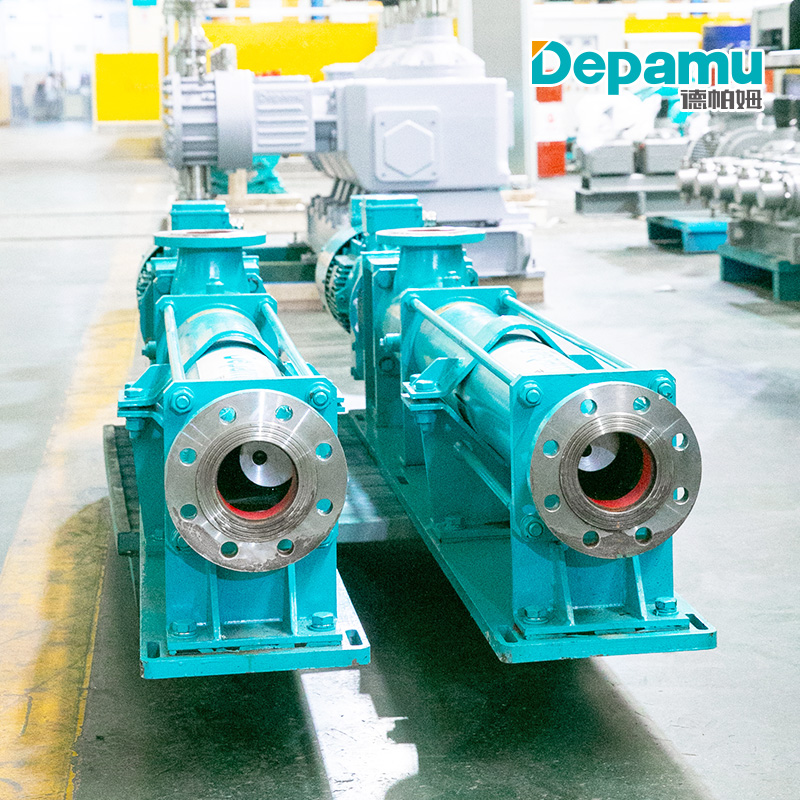
At the heart of Depamu’s pulp conveying solution lies the progressive cavity (PC) pump principle. Unlike centrifugal pumps that impart velocity to fluid, the Depamu single screw pump uses a positive displacement action. The assembly consists of two primary components: a helical rotor (typically made of stainless steel or specialized alloy) and a double-helical stator made of elastomer.
As the rotor turns eccentrically within the stator, sealed cavities form at the suction port. These cavities progress axially along the pump length, carrying the pulp toward the discharge port. For pulp conveying, this mechanism is transformative. The pumping action is entirely non-pulsating and laminar, meaning that the pulp fibers experience minimal mechanical stress .
2.2 Shear-Free Transportation
One of Depamu’s most significant value propositions for pulp applications is the technology’s inherent low-shear characteristic. The product description explicitly states: "No shearing or mixing during transfer ensures no damage to molecular chain structure and specific fluid properties" .
In practical terms, this means that when pumping pulp slurry, the long cellulose fibers remain intact. For paper manufacturers, this translates directly to higher tensile strength in the final product. The pump does not beat or macerate the pulp; it simply moves the mass from one process stage to the next without altering its physical properties.
3. Specific Design Features for Pulp Handling
3.1 Robust Solids Handling Capacity
Depamu single screw pumps are engineered to handle media with a significant content of hard suspended particles and fibrous material. The technical specifications indicate that these pumps can manage solids up to 30mm in diameter . This is particularly relevant for pulp conveying, where wood chips, uncooked fiber bundles, and recycled paper contaminants may be present in the slurry.
For high-consistency pulp applications (typically above 8% consistency), Depamu offers open hopper configurations. Similar to designs available in the market for concentrated sludge and pulp, these hopper-fed variants incorporate feeding augers to force viscous, non-flowing media into the pumping elements . This ensures consistent feed rates even when the pulp exhibits "bridging" behavior—a phenomenon where high-viscosity materials form arches over the pump inlet.
3.2 Material Compatibility and Durability
The pulp and paper environment is corrosive as well as abrasive. White water contains acidic compounds from wood resins; black liquor from chemical pulping is highly caustic; and bleach plant applications involve chlorine dioxide and hydrogen peroxide. Depamu addresses these challenges through flexible material selection.
The pump can handle a pH range of 0 to 14, making it suitable for everything from acidic sulfite pulping to alkaline kraft processes . The temperature range extends from -12°C to +150°C, accommodating hot stock refining and high-temperature bleaching sequences.
Stator materials are selected based on the specific pulp type. For abrasive groundwood pulp, high-nitrile elastomers with enhanced wear resistance are specified. For chemical pulp handling, fluorocarbon or hydrogenated nitrile (HNBR) compounds provide chemical resistance while maintaining the elastic memory required for effective cavity sealing.
3.3 Modular Architecture and Maintenance
Depamu has designed its single screw pump series with modularity as a core principle. The pumps offer multiple structural combinations and flexible mounting types . This is particularly advantageous in pulp mill environments where space constraints and integration with existing pipeline systems vary significantly.
| Design Feature | Benefit for Pulp Conveying |
|---|---|
| Direct-Connection Configuration | Reduced footprint; alignment-free operation; minimized pulsation transfer |
| Modular Stator/Rotor Assembly | Quick replacement without disturbing pipework; reduced downtime |
| Bidirectional Flow Capability | Simplified flushing and cleaning cycles; operational flexibility |
| Flanged Connections (DN32-DN200) | Leak-free integration with existing pulp pipelines |
4. Performance Parameters and Selection Criteria
4.1 Flow and Pressure Characteristics
Depamu’s G-Series single screw pumps offer a comprehensive range of flow rates suitable for various pulp mill applications. From small sampling pumps handling 0.23 m³/h to mainline transfer pumps delivering 64.8 m³/h, the product line covers laboratory-scale trials through full production .
| Model | Flow Range (m³/h) | Max Pressure (MPa) | Drive Motor (kW) | Application |
|---|---|---|---|---|
| CLG015B02J | 0.18 – 0.23 | 0.6 | 0.75 | Laboratory/Additive dosing |
| CLG040B02J | 2.02 – 5.68 | 2.4 | 5.5 | Medium-consistency transfer |
| CLG070B02J | 7.78 – 15.22 | 2.4 | 15 | High-capacity stock prep |
| CLG135B02Z | 44.20 – 64.80 | 2.4 | 45 | Mainline pulp transport |
One critical parameter is the pump’s suction capability. Depamu single screw pumps can achieve suction lift up to 8 meters water column . This self-priming ability is invaluable in pulp mill applications where the pump may be located above a chest or sump, or when handling dewatered pulp with poor flow characteristics.
4.2 Viscosity and Consistency Ranges
The Depamu pump series handles an exceptionally wide viscosity spectrum, from 1 mPas (water-like consistency) to 1,000,000 mPas (semi-solid paste) . For the paper industry, this means a single pump technology can serve multiple points in the process:
-
Low consistency (LC) pulp (1-3%): Standard rotor/stator geometries
-
Medium consistency (MC) pulp (4-10%): Reduced speed operation with reinforced drive trains
-
High consistency (HC) pulp (11-18%): Hopper-fed configurations with auger assist
5. Industrial Applications in Paper Manufacturing
5.1 Stock Preparation and Approach Flow
In the stock preparation area, pulp arrives as thick slurry from digesters or pulpers. Depamu single screw pumps excel at transferring this material to refiners, where fiber properties are modified. Because the pumping action does not pre-shear the fibers, the refiner receives pulp in its natural state, leading to more predictable refining outcomes and lower energy consumption.
5.2 Coating Color and Additive Dosing
Beyond pulp, papermaking involves coating colors, starches, and various functional additives. Depamu single screw pumps are equally capable in these applications. The positive displacement design allows for precise metering—flow rate is directly proportional to rotational speed. When equipped with variable frequency drives, these pumps function as accurate dosing units for expensive pigments and binders .
5.3 Wastewater and Sludge Handling
Paper mills generate significant volumes of primary sludge (fibrous solids from screening) and secondary sludge (biological solids from effluent treatment). Depamu’s open hopper single screw pumps are specifically referenced as ideal for "concentrated sludge, dewatered sludge, [and] concentrated pulp" . These pumps transport dewatered sludge to incinerators, boilers, or landfill compaction systems without clogging or losing prime.
6. Economic and Operational Advantages
6.1 Total Cost of Ownership (TCO)
For paper mill operators evaluating capital equipment, Depamu single screw pumps offer compelling TCO advantages:
-
Energy Efficiency: Unlike centrifugal pumps that require throttling valves for flow control (wasting energy), progressive cavity pumps vary flow by changing speed. This leads to significant electrical savings in variable-demand applications.
-
Reduced Maintenance Intervals: The low-shear, low-pulsation operation minimizes mechanical shock on bearings and seals. Depamu’s documented long service life is attributed to advanced German technology and proprietary rotor/stator geometries .
-
Inventory Simplification: The modular design means that a single pump frame can serve multiple applications by changing rotor/stator combinations, reducing spare parts inventory.
6.2 Reliability in Harsh Conditions
Depamu holds ISO 9001, ISO 14001, ISO 45001, CE, and API certifications . For pulp and paper operations in remote locations or continuous 24/7 production environments, this certification trail provides assurance of reliability. The company serves as a drafter of pump industry standards in China, indicating technical authority in the field .
7. Selection and Sizing Considerations
When specifying a Depamu single screw pump for pulp conveying, engineers must consider several parameters:
Rotor/Stator Fit: Pulp with high abrasive content (e.g., deinked recycled pulp) requires a tighter interference fit between rotor and stator to maintain volumetric efficiency as wear occurs. Depamu offers multiple fit classes for different service conditions.
Speed Selection: Lower rotational speeds generally extend stator life when handling abrasives. Depamu’s technical team can recommend optimal RPM based on pulp consistency and fiber type.
Inlet Conditions: For thick pulp with poor flow characteristics, an open hopper or bridge breaker configuration is recommended . Depamu can customize hopper geometry based on specific bulk solids flow properties.
8. Global Adoption and Case Context
Depamu has established itself as a global supplier, with products exported to over fifty countries including the United States, United Kingdom, France, and Russia . The company has secured long-term strategic partnerships with industrial giants including CNPC, Sinopec, and CNOOC . While these partners are primarily in oil and gas, the same technology platform serves pulp and paper markets through specialized configurations.
The company was established in 2003 and has successfully applied for over 100 technical patents . This sustained investment in research and development suggests continuous refinement of their progressive cavity pump technology, including specific optimizations for fibrous media handling.
9. Conclusion
The Depamu single screw pump represents a technically sophisticated solution for the challenges of pulp conveying in the paper manufacturing industry. By leveraging the progressive cavity principle—with its inherent low-shear, non-pulsating, positive displacement characteristics—Depamu has created a pump that preserves fiber length, handles extreme viscosities, and maintains reliable operation in abrasive, corrosive environments.
Key technical differentiators include solids handling capability up to 30mm, viscosity tolerance from 1 to 1,000,000 mPas, operating temperature range from -12°C to +150°C, and pH compatibility from 0 to 14. The modular design, available hopper-fed configurations, and bidirectional flow capability provide flexibility for mill integration.
For paper manufacturers seeking to reduce fiber damage, minimize downtime, and lower total cost of ownership in stock preparation, coating, and sludge handling applications, Depamu’s German-inspired, Chinese-engineered single screw pumps merit serious consideration. As the industry continues to push toward higher consistencies and greater use of recycled fibers, the progressive cavity pump’s role will only expand—and Depamu has positioned itself as a qualified supplier for this demanding application space.