

In the intricate world of industrial fluid handling, precision and reliability are not merely preferences—they are absolute necessities. Whether it is injecting precise amounts of coagulants in a water treatment plant or adding fragrance in a pharmaceutical production line, the equipment tasked with these missions must perform with infallible accuracy. Among the pantheon of industrial pumps, the Depamu mechanical diaphragm Metering Pump stands out as a paragon of robust engineering and chemical compatibility.
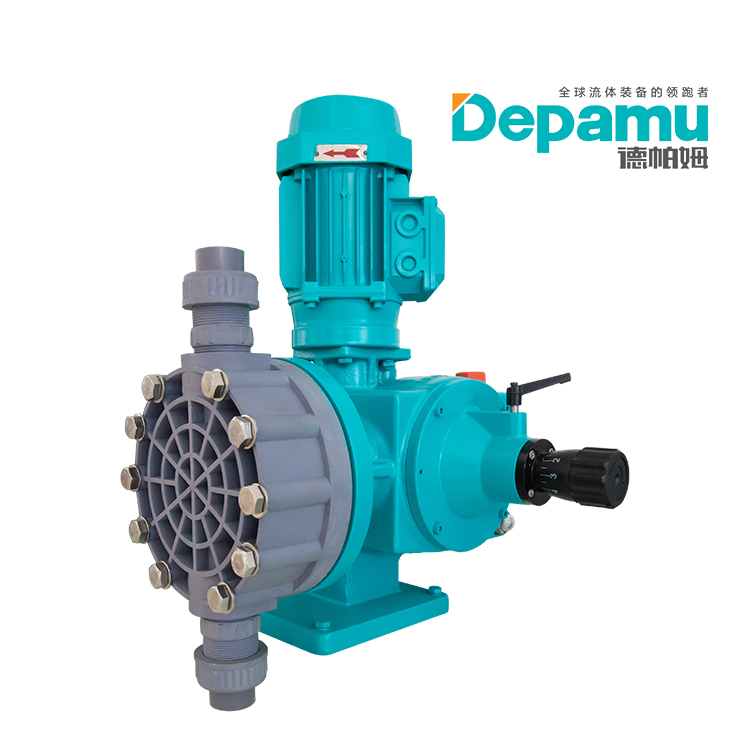
But what lies beneath its robust exterior? How does this machine take a rotating electric current and convert it into a precise, pulsed flow of chemical liquid? This article delves deep into the mechanics of the Depamu Mechanical Diaphragm Metering Pump, dissecting its working principle, core components, and the physics that make it an industry standard.
1. The Core Mission: What is a Metering Pump?
Before exploring the "how," it is essential to understand the "what" and "why." A standard centrifugal pump is designed to move a high volume of liquid from point A to point B with little regard for exact quantity. A metering pump, also known as a dosing pump, is a positive displacement device designed to move a precise volume of liquid within a specific time period, even against varying system backpressure .
The Depamu mechanical Diaphragm Pump belongs to the positive displacement family. Unlike rotodynamic pumps that impart velocity, positive displacement pumps trap a specific amount of fluid and force it into the discharge pipe. The signature feature of the Depamu design is the diaphragm—a flexible, impermeable membrane that physically separates the pumped chemical from the moving mechanical parts of the pump .
2. The Power End: From Rotary Motion to Reciprocating Force
Every journey of a chemical droplet through a Depamu pump begins not in the liquid, but in the motor. The "Power End" (or transmission case) is responsible for converting energy into motion.
The Electric Motor and Gearing
Depamu pumps are typically driven by a standard electric motor. However, motors spin fast (usually 1400-1750 RPM), and metering requires slow, deliberate movements. To achieve this, the pump utilizes a worm gear pair . The motor shaft turns the worm (a threaded screw-like gear), which rotates the worm wheel. This serves two critical purposes:
-
Speed Reduction: It drastically reduces the high RPM of the motor to a slower, usable speed.
-
Torque Multiplication: It increases the torque, giving the pump the mechanical advantage needed to push thick or heavy liquids.
The Eccentric Mechanism and Slide Rod
This is where the magic of conversion happens. After the gear reduction, the rotary motion is passed to an eccentric mechanism (or crank linkage). An eccentric is essentially a circle (cam) mounted off-center on a rotating shaft.
"The motor drives worm gear pair, changes rotary motion of the motor into reciprocating movement of the slide rod through the eccentric mechanism."
As the eccentric rotates, it pushes and pulls a slide rod (or plunger/connecting rod). This mechanical assembly transforms the smooth, continuous rotation of the motor into a linear, back-and-forth (reciprocating) motion. Think of a car engine piston, but in reverse: instead of linear motion creating rotation, rotation creates linear motion.
3. The Hydraulic End: The Heart of Chemical Isolation
The slide rod connects directly to the mechanical diaphragm. This assembly, known as the "Hydraulic End" or "Liquid End," is where the fluid is actually moved. The diaphragm acts as a seamless wall between the oil-bathed mechanics and the corrosive chemicals.
The Mechanical Diaphragm
The diaphragm is typically manufactured from PTFE (Polytetrafluoroethylene), commonly known by the brand name Teflon. Depamu utilizes a mechanically driven PTFE film . Unlike hydraulically actuated diaphragms (which use oil to push the diaphragm), the mechanical diaphragm is physically bolted or connected to the slide rod.
As the slide rod moves forward, it pushes the diaphragm into the pump head. As it moves backward, it pulls the diaphragm out. This direct connection allows for high precision and eliminates the need for a complex hydraulic refill system .
The Pump Head and Valve System
The diaphragm sits inside a cavity known as the pump head. This head is equipped with two crucial check valves: the inlet valve (suction) and the outlet valve (discharge).
These valves are unidirectional—they allow fluid to flow in only one direction. They typically consist of a seat, a ball or sphere, and a spring or guide. The interaction between the diaphragm and these valves creates the pumping cycle.
4. The Two-Stroke Cycle: Suction and Discharge
The operation of the Depamu mechanical diaphragm metering pump is a continuous loop of two distinct phases: the Suction Stroke and the Discharge Stroke .
Phase 1: The Suction Stroke
As the motor turns the eccentric, the slide rod begins to retract (pull back).
-
Diaphragm Movement: The mechanical diaphragm is pulled backward into the "suction" position.
-
Volume Expansion: The volume of the cavity inside the pump head increases.
-
Pressure Drop: According to Boyle's Law, increasing volume decreases pressure. A vacuum is created within the pump head.
-
Inlet Valve Opens: The atmospheric pressure (or supply pressure) pushing down on the fluid in the tank is now higher than the pressure inside the pump head. This pressure differential pushes the inlet check valve ball off its seat.
-
Fluid Intake: The chemical is pushed up the suction line, through the open inlet valve, and into the pump cavity .
Phase 2: The Discharge Stroke
The eccentric continues to rotate, and the slide rod now begins to extend (push forward).
-
Diaphragm Movement: The mechanical diaphragm is pushed forward into the pump head.
-
Volume Reduction: The volume inside the pump head decreases.
-
Pressure Increase: The fluid trapped in the cavity has nowhere to go but out. The mechanical force compresses the fluid slightly, raising its pressure drastically.
-
Inlet Valve Closes: The reverse pressure forces the inlet ball back onto its seat, sealing the suction line to prevent backflow.
-
Outlet Valve Opens: Once the internal pressure exceeds the pressure in the discharge pipe (the system backpressure), the outlet check valve ball is forced off its seat.
-
Fluid Discharge: The precise volume of liquid is pushed through the outlet valve and into the process pipeline .
The cycle then repeats. Each rotation of the motor corresponds to a specific, fixed volume of liquid being moved—provided the system is properly calibrated.
5. Precision Control: Adjusting the Flow Rate
One of the defining features of a Depamu metering pump is its ability to adjust flow rate while the pump is running (or stationary). How does it change volume if the motor speed stays the same?
The answer lies in Stroke Length Adjustment.
Inside the transmission case, the connection between the eccentric and the slide rod includes a variable mechanism (often an adjustable eccentric or a yoke). By turning a manual dial or an electronic actuator:
-
The physical distance the slide rod travels (the stroke length) is altered .
-
Longer Stroke: The diaphragm pushes further into the head, displacing more fluid per cycle (100% flow).
-
Shorter Stroke: The diaphragm barely flexes, displacing very little fluid (0-10% flow).
Depamu pumps offer a turndown ratio of 10:1 (or higher) with a steady-state accuracy of ±2% . This allows operators to fine-tune chemical injection without changing the motor speed, utilizing manual, electric, or frequency conversion (variable frequency drive) controls .
6. The Depamu Advantage: Materials and Durability
Depamu distinguishes itself not just by how it moves fluid, but by how it survives the fluids it moves.
Material Science
-
Wetted Parts: The pump head and valves can be manufactured from a variety of materials depending on the chemical being pumped. Common options include PVC (for acids/alkalis), PVDF (for high-purity and aggressive chemicals), PTFE (universal inert), and Stainless Steel (304/316L) for high-pressure or solvent applications .
-
Self-Cleaning Check Valves: The check valves in Depamu pumps often feature a "self-cleaning" structure. As the ball seats and unseats at high frequencies, it naturally crushes and dislodges small particulates that might otherwise cause the valve to stick .
Diaphragm Longevity
The mechanical diaphragm is often cited as the "wear part" of such pumps. However, Depamu engineering focuses on longevity. The PTFE diaphragm is designed to be flexible and fatigue-resistant. When handling abrasive slurries (such as lime slurry in pH adjustment), the diaphragm’s ability to "flex" rather than "slide" like a piston greatly extends the Mean Time Between Failures (MTBF).
7. Applications and Configuration
A single Depamu pump is versatile, but complex systems require creativity. The DP-Series offers configurations to solve specific problems:
-
Single Head: Simple, precise dosing for one liquid.
-
Double Head (Duplex): Two pump heads driven by the same motor. This serves two purposes:
-
High Temperature: For fluids up to 100°C, specific pump head materials like PTFE or Alloy are required .
8. Why Choose Mechanical Diaphragm Over Hydraulic?
It is worth briefly contrasting the Depamu mechanical design with hydraulic diaphragm pumps.
-
Mechanical (Depamu): The diaphragm is physically connected to the plunger. It is simpler, cheaper, and more compact. It is ideal for lower pressures (typically up to 0.6 - 1.0 MPa) and lower flow rates common in water treatment.
-
Hydraulic: Uses oil to push the diaphragm. It is more expensive and complex but can achieve much higher pressures (up to 20 MPa+).
The Depamu mechanical design hits the "sweet spot" for the majority of industrial applications, offering the leak-proof benefits of a diaphragm without the maintenance complexity of a hydraulic system .
Conclusion
The Depamu Mechanical Diaphragm Metering Pump is a masterpiece of applied physics. It converts the brute force of an electric motor into a delicate, controlled dance of diaphragms and check valves. By isolating the corrosive chemical agents within a PTFE-lined head and using a robust eccentric mechanism to flex a diaphragm, it guarantees that the right amount of fluid arrives at the right time.
From ensuring your drinking water is clear to making sure your industrial process runs smoothly, the rhythmic, reciprocating heartbeat of the Depamu pump is an unsung hero of modern industry. Its design prioritizes safety (no leaks), accuracy (positive displacement), and durability (corrosion-resistant materials). Understanding this process reveals why the Depamu mechanical diaphragm metering pump remains a preferred choice for engineers worldwide.