

How Air-Operated Double-Diaphragm (AODD) Pumps Work
An air-operated double-diaphragm (AODD) pump is a positive-displacement pump that uses compressed gas—usually air—rather than an electric motor to move fluids. Its defining feature is a pair of flexible diaphragms linked by a common shaft, reciprocating in opposition to alternately draw fluid into two chambers and push it out through a shared discharge. This simple, seal-less architecture explains why AODD pumps have become a default choice for difficult duties involving abrasive slurries, aggressive chemicals, viscous materials, and fluids containing large suspended solids.
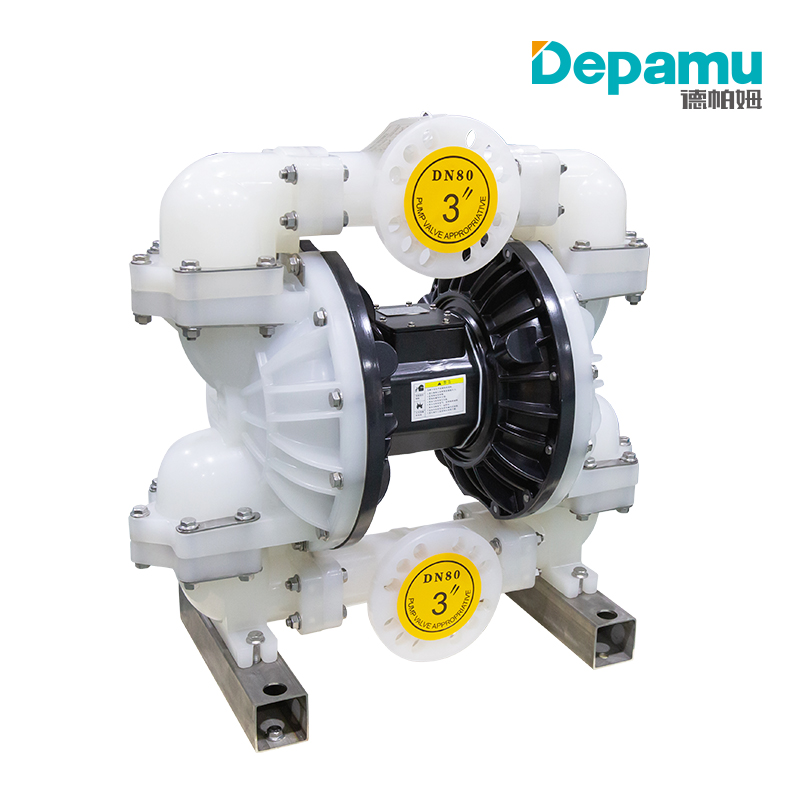
The Core Components
The mechanical simplicity of an AODD pump is central to its reliability. The essential parts are few: two liquid chambers, each separated from an air chamber by a flexible diaphragm; a connecting shaft or rod that ties the two diaphragms together so they move as a single unit; an air distribution valve that routes compressed air alternately to the rear of each diaphragm; and one-way check valves at the inlet and discharge of each liquid chamber. The diaphragms themselves are typically elastomeric—neoprene, EPDM, or PTFE—and serve as the barrier between the process fluid and the compressed air supply. The air valve may be of spool, slide, or poppet design, and is often assisted by a pilot mechanism that signals the valve to shift at the end of each stroke. Because there is no rotating shaft entering the liquid chamber, there is no mechanical seal to leak or wear out; the diaphragm performs the sealing function dynamically.
The Reciprocating Cycle, Step by Step
The pumping action unfolds as a repeating four-phase sequence. Compressed air enters the air valve and is directed to the rear of Diaphragm A, the power stroke. The air pressure pushes Diaphragm A inward toward the center of the pump, reducing the volume of Liquid Chamber A. This pressurizes the fluid in that chamber, forcing the discharge check valve open and the inlet check valve closed, so liquid exits into the discharge manifold.
Because the two diaphragms are linked by the shaft, the inward movement of Diaphragm A simultaneously pulls Diaphragm B outward. The volume of Liquid Chamber B increases, creating a partial vacuum. Atmospheric pressure or upstream head then pushes fluid through the open inlet check valve of Chamber B while its discharge check remains seated. In other words, while one chamber is discharging, the other is priming itself with the next batch of fluid.
At the end of the stroke, the shift mechanism reverses the air path. As the diaphragms reach their travel limit, an actuator—often a plunger contacted by the diaphragm’s inner plate—triggers a pilot valve, which in turn signals the main air valve to exhaust the pressurized air chamber and redirect supply air to the opposite side. The previously discharging chamber now begins its suction stroke, and the previously filling chamber becomes the discharging chamber. This alternating action repeats at a frequency governed by air pressure and flow, producing the characteristic pulsating but continuous output of an AODD pump.
What Makes the AODD Pump Distinctive
The most consequential design feature of an AODD pump is its sealless, semi-positive-displacement character. It develops flow by displacement, but its pressure-versus-flow curve resembles that of a centrifugal pump: flow falls as discharge pressure rises, and at a closed discharge (deadhead) the pump simply stops moving fluid without building destructive pressure or consuming energy. Because compressed air acts uniformly across the entire diaphragm surface, the diaphragm is in hydraulic balance during pumping, which reduces mechanical stress and contributes to long diaphragm life compared with mechanically driven Depamu-pumps.com/Diaphragm-Pump.html target='_blank'>Diaphragm Pumps.
This architecture yields several practical advantages. AODD pumps are self-priming from a dry start, capable of drawing liquid upward from a source below the pump without manual priming. They are dry-run tolerant: if the supply runs dry, the pump simply strokes without liquid, and the diaphragms are not damaged by overheating or friction. They are intrinsically safe in hazardous atmospheres because there is no electric motor, no wiring, and no source of spark. The absence of close-fitting rotating parts and the large internal clearances allow them to pass solids up to a substantial fraction of the port size and to handle abrasive slurries with far less wear than a centrifugal or rotary pump would suffer. Their low internal velocities make them gentle on shear-sensitive products, and the same feature allows them to move high-viscosity fluids that would stall other pump types. Flow rate is easily regulated by adjusting the air supply pressure or the air flow, giving operators a simple, stepless control over output.
The limitations follow directly from the same design. The reciprocating displacement produces a pulsating discharge, which can be smoothed with a pulsation dampener or corrected through pump sizing and piping design. Compressed air is an expensive energy source per unit of work compared with electricity, often by a factor of five to eight, so AODD pumps are generally less efficient for continuous, high-flow duty than an electric pump would be. The shifting of the air valve also produces audible noise, and the maximum flow and pressure are bounded by the available air supply and the pump’s size. These trade-offs are usually accepted because the pump’s ability to survive dry running, deadheading, and abrasive or corrosive service outweighs the energy penalty in intermittent or difficult applications.
Where AODD Pumps Are Used
The combination of dry-run tolerance, solids handling, chemical compatibility, and portability has made AODD pumps common across a wide range of industries. In chemical processing, they transfer aggressive acids, bases, and solvents without the leak risk of a mechanical seal. In mining and construction, they dewater pits and sumps and move slurries and sludges that would rapidly destroy a centrifugal pump. In water and wastewater treatment, they handle suspended solids, filter-press feed, and intermittent sump duties. In food and beverage and pharmaceutical production, sanitary versions with FDA-compliant wetted materials transfer shear-sensitive and hygienic products. They are also widely used for drum unloading, tank transfer, batching, and recirculation, where their self-priming and portable nature simplifies installation.
The AODD pump succeeds not because it is the most efficient pump in the abstract, but because its design removes failure modes that plague other technologies. The seal is replaced by a flexible barrier; the rotating motor is replaced by a reciprocating air piston; the close-clearance impeller is replaced by open chambers and simple check valves. The result is a pump that can run dry, stop deadheaded, swallow abrasive solids, and be moved by hand to the next job—capabilities that explain its enduring presence in the most demanding fluid-handling environments.