

The Depamu Reagent Dosing Unit (Chemical Injection Package) for Yamal LNG: An Engineering Overview
Abstract
The Yamal LNG project, located on the Arctic coast of the Russian Yamal Peninsula, represents one of the most ambitious energy infrastructure developments of the 21st century. Operating in extreme climatic conditions with temperatures dropping below -50°C, the project demands equipment of exceptional reliability and precision. This paper examines the Depamu Reagent Dosing Unit—a Chemical Injection Package employed in the Yamal LNG facility—as a critical component ensuring operational integrity through precise chemical management. The analysis covers the technical specifications, design philosophy, and operational significance of this dosing system within the broader context of the world's most challenging LNG production environment.
1. Introduction
1.1 The Yamal LNG Project Context
The Yamal LNG project is an integrated venture for the production, liquefaction, and supply of natural gas, based on the resource base of the South Tambey gas condensate field. With proven and probable gas reserves of approximately 926 billion cubic meters, the project has been designed to produce about 16.5 million tons of LNG annually across three production trains, with additional capacity for up to 1.2 million tons of gas condensate.
The final investment decision was made in December 2013, with construction executed in three stages and operational launches in 2017, 2018, and 2019. The project's joint venture structure includes NOVATEK (50.1%), Total (20%), CNPC (20%), and the Silk Road Fund (9.9%).
1.2 The Arctic Operational Challenge
What distinguishes Yamal LNG from conventional LNG facilities is its extreme Arctic location. The Sabetta port and associated infrastructure were constructed in permafrost conditions where environmental preservation demands sophisticated engineering solutions. The environmental and social impact assessment for the project explicitly addressed the need for chemical management protocols, including bunding of fuel storage tanks, provision of low permeability liners, and adherence to regulatory standards to minimize spillages. These conditions impose unique requirements on all process equipment, particularly chemical injection systems that must maintain precise performance despite extreme temperature differentials and logistical constraints.
1.3 The Role of Chemical Injection Packages
Chemical injection packages, or reagent dosing units, serve as the circulatory system for chemical process control in LNG production. These skid-mounted systems precisely meter and inject treatment chemicals into process streams to prevent corrosion, inhibit hydrate formation, control scaling, and maintain water quality parameters. For the Yamal LNG facility, where process interruption carries extraordinary costs and environmental risks, the reliability of these dosing units is paramount.
2. The Depamu Chemical Injection Package: Technical Architecture
2.1 Company Profile and Manufacturing Philosophy
Depamu (Hangzhou) Pumps Technology Co., Ltd. (DPM), established in 2003, has positioned itself as a specialist manufacturer of Metering Pumps, Dosing Pumps, and complete dosing systems. The company's approach combines German engineering principles with Chinese manufacturing capability—a synthesis reflected in the design philosophy of their chemical dosing packages.
Depamu's product portfolio is distinguished by adherence to rigorous international standards, including API 675 (American Petroleum Institute), DNV (Det Norske Veritas), ISO 9001:2000, and ISO 14001:2004. These certifications are particularly relevant for Arctic LNG applications, where equipment must satisfy the most demanding owner requirements and class society approvals.
2.2 System Architecture
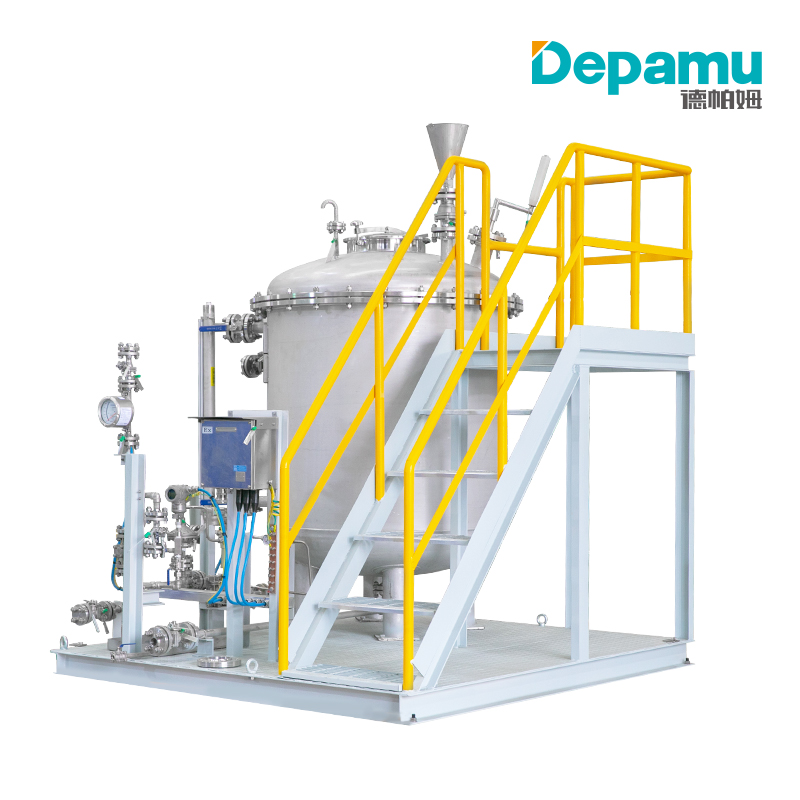
The Depamu chemical injection package is a modular, skid-mounted system that integrates the following primary components on a single structural base:
Solution Tank: Fabricated from materials selected based on corrosion resistance requirements, typically 304 stainless steel, 316 stainless steel, carbon steel with rubber lining, FRP, or PE depending on the chemical service. Tank capacities range from 0.5 to 20 cubic meters depending on the specific application.
Metering Pumps: The heart of the dosing system, Depamu offers multiple pump configurations:
-
Hydraulic Diaphragm Metering Pumps (including multi-diaphragm configurations with alarm functions)
-
Plunger-type pumps
For critical services at Yamal LNG, multiple pump configurations including working and standby arrangements are typically specified.
Piping and Valving: Complete internal pipe systems incorporating safety valves, pressure gauges, level gauges, pulsation dampers, and all necessary flow control components.
Electrical Control System: PLC-based automatic control with capability for local manual control, semi-automatic, or full automatic operation. The system can receive signals from flow meters, pH analyzers, conductivity sensors, turbidimeters, and dissolved oxygen sensors to enable real-time dosage adjustment. Communication with DCS (Distributed Control System) or host computer systems is provided via standard 4-20mA signals.
2.3 Modular Design and Flexibility
A distinguishing feature of the Depamu dosing package is its modular construction. The systematic design approach eliminates the compatibility issues common in traditional single-equipment designs. This modularity allows for:
-
Integration of components from various reputable brands at the customer's discretion
-
Flexible control modes (manual, semi-automatic, automatic)
-
Scalable configurations with multiple tanks and pumps
The base dimensions and weight vary according to configuration, with typical packages ranging from 1,800 kg to 7,600 kg and occupying footprints from 1.8m × 1.9m to 4.5m × 3.0m.
3. Application Scenarios in the Yamal LNG Process
3.1 Inlet Facilities Chemical Management
The Yamal LNG process begins with the hydrocarbon mixture from well clusters being fed to an integrated complex for gas preparation and liquefaction. At the inlet facilities, separation occurs to remove mechanical impurities, water, methanol, and gas condensate from the gas. This stage demands injection of:
-
Demulsifiers for breaking emulsions
-
Corrosion inhibitors to protect carbon steel piping from sour gas components
Depamu's packages for petroleum and natural gas exploitation can accommodate flow rates of 10-200 L/hour at discharge pressures up to 4.0 MPa. The injection packages are specifically designed to handle the challenging nature of these chemicals, with materials selected for compatibility with aggressive media.
3.2 Hydrate Prevention and Methanol Injection
A critical application for chemical dosing at Yamal LNG is hydrate prevention. Hydrates—crystalline ice-like structures formed from water and natural gas under high pressure and low temperature—pose a severe operational risk in Arctic gas processing. Methanol injection is the primary mitigation strategy at Yamal's inlet and pre-treatment facilities.
The Depamu methanol injection package for natural gas gathering and transportation applications features:
-
Solution tank volumes from 0.5 to 20 m³
-
Pump capacities from 10-500 L/hour
-
Discharge pressures up to 32 MPa for high-pressure service
The control system for methanol injection must respond to changing flow and temperature conditions. Depamu's automatic control system can receive signals for flow rate, temperature, and differential pressure through PLC or DCS integration, adjusting pump speed and stroke to maintain optimal methanol concentration—sufficient to prevent hydrate formation without wasteful over-injection.
3.3 Boiler Feedwater and Steam System Treatment
The Yamal LNG facility includes thermal systems requiring precise feedwater chemistry management. For these applications, Depamu provides specialized injection packages for:
Hydrazine Injection: Dissolved oxygen in boiler water systems is a primary cause of corrosion. After mechanical deaeration, hydrazine is injected as a chemical oxygen scavenger. The Depamu hydrazine injection package automatically adjusts dosing volume based on dissolved oxygen measurement, maintaining hydrazine concentration within optimal ranges. Over-injection is avoided not only for economic reasons but also to prevent environmental discharge issues and maintain water quality.
Phosphate Injection: For internal boiler water treatment, phosphate injection packages maintain appropriate pH levels and precipitate hardness compounds before they can form scale on heat transfer surfaces. Depamu offers phosphate injection systems with capacities from 20-70 L/hour at pressures up to 32 MPa.
Ammonia Injection: For pH adjustment in condensate and feedwater systems, ammonia injection packages are provided with similar capacity ranges.
3.4 Wastewater and Environmental Compliance
Arctic operations demand rigorous environmental protection. The Yamal LNG project's ESIA emphasized the importance of chemical spill prevention through bunding, low-permeability liners, and adherence to regulatory standards. Depamu's wastewater treatment injection packages address:
-
Flocculant and dispersant injection for solids removal
-
Acid and alkali injection for pH adjustment
The control systems for these applications can receive signals from pH analyzers, turbidimeters, and flow meters to maintain discharge water within compliance specifications.
4. Arctic-Specific Design Considerations
4.1 Material Selection for Low Temperatures
Operating in Arctic conditions imposes severe material requirements. While Depamu's standard packages utilize 316 or 304 stainless steel for the solution tanks, the Yamal LNG application demands:
-
Low-temperature carbon steel (LTCS) for structural components
-
Special seals and elastomers for pump components
-
Appropriate material selection for all wetted parts to avoid brittle fracture at -50°C
The modular design allows for material upgrades to meet project-specific requirements. This adaptability is critical for the Yamal application where material selection must satisfy both DNV certification and Russian regulatory requirements.
4.2 Pulsation Dampening and Flow Stability
The precision dosing required in LNG production demands stable, pulse-free flow. Depamu addresses this requirement through incorporation of pulsation dampers in the injection package design. These devices reduce the flow pulsations inherent in reciprocating metering pumps, ensuring:
-
Consistent chemical concentration in the process stream
-
Reduced wear on downstream valving and instrumentation
-
Extended pump component life
4.3 Automation and Remote Operation
The harsh Arctic environment and the remote location of the Sabetta facility necessitate extensive automation. Depamu's injection packages feature control systems that enable:
-
Frequency converter control for variable speed pump operation
-
Stroke adjustment for fine-tuning of dosing rates
-
Remote start/stop capability from DCS or host computer
-
Alarm and diagnostics for fault conditions transmitted to control room
Under automatic control, the PLC processes signals from flow meters, analyzers, and other instruments to continuously adjust pump output within the 0-100% range. This automation reduces the need for operators to venture into hazardous or extreme conditions.
5. Operational and Maintenance Considerations
5.1 Installation and Skid Design
Depamu's skid-mounted packages offer significant advantages for Arctic installation:
-
Pre-fabrication minimizes on-site construction work
-
Factory testing ensures system integrity before shipment
-
Compact footprint reduces heated and enclosed space requirements
-
Simplified hook-up to electrical, instrument, and process connections
For the Yamal LNG project, where construction was executed in a remote Arctic location during limited seasonal windows, these features were essential for meeting the ambitious project timeline.
5.2 Redundancy and Reliability
Critical injection applications at Yamal LNG require high reliability. Depamu packages can be configured with:
-
Working and standby pumps to ensure uninterrupted operation
-
Multiple solution tanks to allow for batch mixing without interrupting injection
-
Dual or triple diaphragm configurations with alarm functions for leak detection
The ability to switch between tanks or pumps while maintaining continuous operation is particularly important for hydrate prevention, where even brief interruptions could lead to blockages.
5.3 Maintenance Access
The Arctic environment presents unique maintenance challenges. Depamu's modular design with integrated piping and components on a common skid facilitates:
-
Standardized maintenance procedures
-
Reduced spare parts inventory requirements
-
Easy access to critical components through well-planned layout
The solution tanks are provided with level gauges and appropriate connections for filling and sampling, enabling effective condition monitoring without excessive manual intervention.
6. Conclusion
The Depamu Reagent Dosing Unit for the Yamal LNG project exemplifies the engineering sophistication required for extreme-environment natural gas processing. The chemical injection package, through its integration of precision metering pumps, modular skid design, and advanced control systems, addresses the critical process requirements of one of the world's most challenging LNG production facilities.
Key design features that make the Depamu package suitable for Yamal LNG include:
-
API 675 and DNV certification ensuring compliance with international oil and gas standards
-
Modular construction facilitating efficient installation and maintenance in remote locations
-
Multiple configuration options for various chemical services including methanol, hydrazine, phosphate, corrosion inhibitors, and demulsifiers
-
Flexible control systems enabling automatic, semi-automatic, or manual operation with DCS integration
-
Redundancy options including working and standby pumps wit