

The Marine Installation of Depamu High-Pressure Plunger Pumps: A Technical and Operational Analysis
Aboard a modern vessel, few pieces of machinery are tasked with a mission as precise and critical as the marine Metering Pump. Among these, the Depamu high-pressure plunger pump stands out as a sophisticated piece of engineering designed to handle the most demanding fluid transfer and injection tasks at sea. Installing such a pump on a vessel is not a simple matter of "placing and connecting"; it is a complex integration of hydraulic, mechanical, and safety systems that requires careful planning and execution. This essay explores the technical characteristics, installation considerations, operational functions, and maintenance imperatives of the Depamu high-pressure plunger pump in the unforgiving environment of a ship.
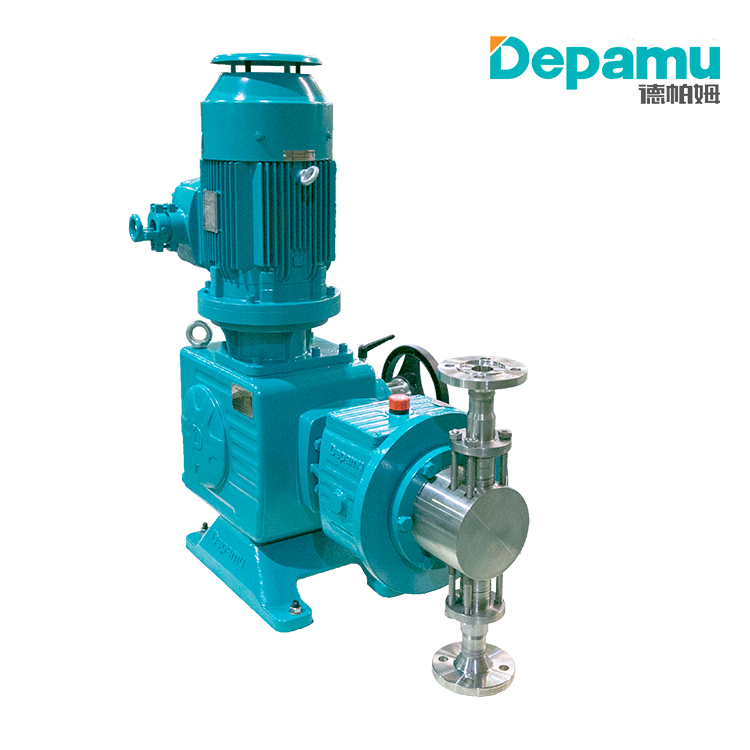
Core Engineering and Principles
The Depamu high-pressure plunger pump operates on the fundamental principle of positive displacement. The plunger, which directly contacts the fluid, moves back and forth within a sealed cylinder . Each forward stroke reduces the volume of the working chamber, forcing the liquid out through the discharge check valve. Conversely, the return stroke creates a vacuum, drawing a precise volume of liquid from the suction side . This direct, cyclic action allows the pump to achieve exceptionally high pressures, with Depamu models rated for pressures up to an extraordinary 228 MPa (approx. 33,000 psi) .
Several key design features make the Depamu pump suitable for the rigors of marine service. Its transmission mechanism utilizes a high-performance worm gear pair designed for low noise and high efficiency, a crucial consideration in a vessel's engine room where noise abatement is a priority . The entire transmission assembly is oil-immersed for splash lubrication, ensuring long-term reliable operation even under continuous duty cycles . Furthermore, the pump incorporates an integrated sleeve adjustable eccentric mechanism, which allows for stroke adjustment from 0 to 100%. This enables stepless flow rate adjustment with a metering accuracy of ±0.5% in its operable range, which is paramount for precise chemical dosing .
Installation and Integration Aboard Ship
Installing a Depamu pump on a vessel demands meticulous attention to integration. The pump must be properly aligned with its prime mover, typically an electric motor or diesel engine . The pump's ability to accept various flow rate adjustment modes, including manual, electric, pneumatic, or frequency conversion, offers flexibility in designing the control system . Electric actuators, for instance, can interface with the ship's main automation system, enabling remote or automatic control of flow rates without requiring an engineer to be physically present at the pump .
A critical aspect of the installation is the provision of a pressure relief valve on the discharge pipeline. The Depamu documentation explicitly notes that its pump has "no safe relief device" and strongly recommends installing a relief valve . This is not optional but an essential safety requirement. As a positive displacement pump, it cannot be deadheaded. If the discharge valve is closed or blocked, the pump will continue building pressure until either the piping fails or the pump is destroyed. The relief valve must be set to open at a designated pressure, safely routing the high-pressure fluid back to the suction side or a dedicated return tank .
Operational Functions and Applications
The primary role of the Depamu high-pressure plunger pump on a vessel is as a precision metering or dosing pump. In this capacity, its performance is non-negotiable; accuracy is vital for both operational efficiency and safety.
Marine Boiler Water Treatment: One of the most critical applications is the precise injection of chemical additives into marine boilers. These chemicals are essential for controlling corrosion, removing dissolved oxygen, and preventing scale formation. An over-dosing of chemicals is wasteful and can create excessive foam, while under-dosing can lead to rapid corrosion of boiler tubes and potentially catastrophic failure. The ±0.5% metering accuracy of the Depamu pump ensures that boiler water chemistry remains strictly within acceptable parameters .
Seawater Reverse Osmosis (SWRO) Systems: To produce fresh water from seawater, a vessel's SWRO plant relies on high-pressure pumps to force seawater through semi-permeable membranes. The required pressure typically needs to be in the range of 40 to 70 bar to overcome the osmotic pressure and system losses . In such applications, a multi-head triplex plunger pump configuration is often used to provide the high pressure with a steady, low-pulse flow . The Depamu's ability to be configured with multiple heads allows it to be used in a similar capacity, providing the consistent high pressure vital for efficient membrane operation and reducing pulsation in the system.
Cargo and Process Support: The pump's capability to handle a wide variety of fluids, from high-viscosity liquids to corrosive chemicals, makes it useful in cargo handling systems for specialized vessels. The availability of pump head materials like 316L stainless steel, Hastelloy C, and high polymers allows engineers to select a configuration that is chemically compatible with the specific media being pumped, whether it is a chemical additive or a hydrocarbon-based product .
Maintenance and Reliability
In a shipboard environment, maintenance is a continuous process. The Depamu pump's design supports this with a "simple structure" and "convenient maintenance" philosophy . Key components like the high-performance plunger, special packing, and sealing components are designed for a long service life, but they are also the primary wear points. Regular inspection and replacement of these parts is a standard part of preventive maintenance, with the intervals being highly dependent on the duty cycle and the nature of the fluid pumped .
The oil-immersed lubrication system plays a significant role in reliability, protecting the internal gears, bearings, and eccentric mechanism from the constant stresses of reciprocation. Maintaining the correct type and level of oil in the gearbox is essential for the long-term integrity of the transmission. The variety of adjustment modes, from manual handwheels to electronic controllers, also adds a maintenance layer; calibration of electronic actuators must be verified to ensure the commanded flow matches the actual delivered flow .
Conclusion
The installation of a Depamu high-pressure plunger pump on a vessel represents a commitment to precision, safety, and reliability in fluid management. Its ability to generate immense pressures with high accuracy makes it indispensable for critical tasks like boiler feedwater treatment and seawater desalination. However, its successful integration depends on a holistic approach that accounts for precise alignment, robust structural mounting, a safe and properly configured pressure relief system, and a compatible control interface. The pump's inherent durability, combined with its design for convenient maintenance, makes it a formidable asset for any ship operator. As vessels continue to demand more sophisticated and automated systems for efficiency and safety, the role of the high-pressure plunger pump will only grow more central to marine engineering practice