

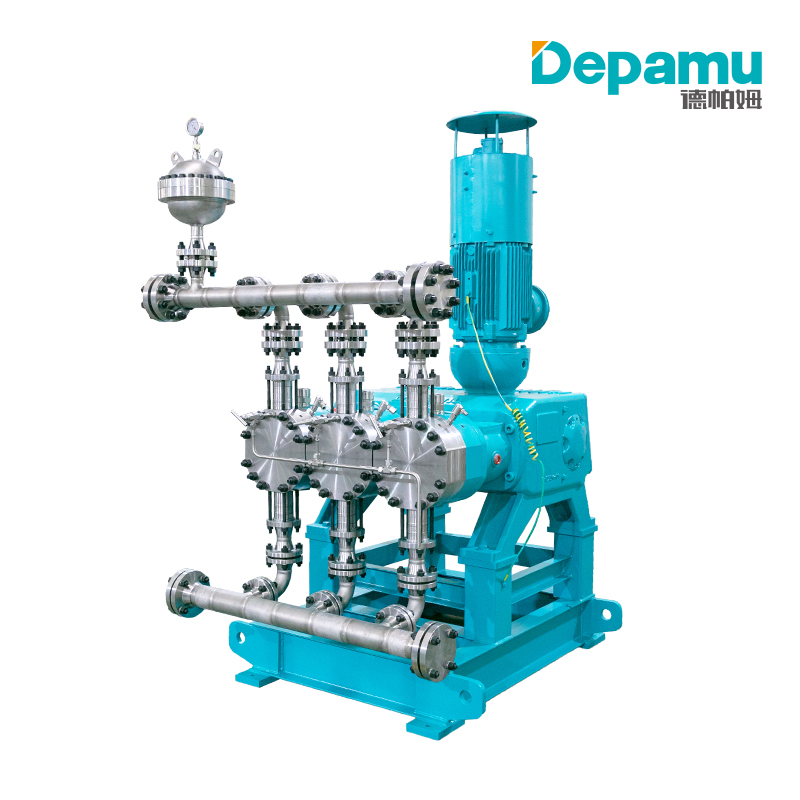
Depamu High Efficiency Reciprocating Pump for Steam Boiler Feed Applications
Introduction
In modern industrial steam generation systems, the boiler feed pump serves as the critical link between water supply and steam production. While centrifugal pumps have long dominated high-flow, medium-pressure boiler feed applications, the growing demand for ultra-high-pressure and once-through boiler systems has exposed significant limitations in centrifugal technology. Depamu's high-efficiency Reciprocating Pumps, designed in accordance with the American Petroleum Institute standard API 674, offer a compelling alternative for steam boiler feed applications where precision, reliability, and energy efficiency are paramount.
Understanding Boiler Feed Pump Requirements
Steam boiler feed applications present uniquely demanding operating conditions. The feed pump must overcome substantial system backpressure while delivering precise flow rates that match evaporation rates. In high-pressure and ultra-high-pressure boiler systems, the feed pump discharge pressure can reach several tens of megapascals, requiring robust construction and exceptional sealing performance.
Centrifugal pumps, while offering advantages in high-flow scenarios, experience a sharp drop in efficiency under ultra-high pressure conditions. They are prone to cavitation and unstable operation when the pressure differential becomes excessive. Furthermore, multistage centrifugal configurations, which are often necessary to achieve high discharge pressures, introduce complexity in shaft sealing and increase the physical footprint of the pumping equipment.
Reciprocating pumps, by contrast, operate on the principle of positive displacement. The flow output depends primarily on the plunger stroke volume and reciprocating frequency, remaining essentially independent of the discharge pressure. This fundamental difference makes reciprocating technology particularly well-suited to high-pressure, low-to-medium flow boiler feed applications.
Depamu's Technology and Design Advantages
API 674 Compliance and Engineering Excellence
Depamu's reciprocating pumps are engineered to meet the stringent requirements of API 674, the international standard governing positive displacement reciprocating pumps for petroleum, petrochemical, and gas industry services. This compliance ensures that the pumps can withstand extremely severe working conditions while transporting media accurately and reliably. The company has obtained numerous patents that attest to its technological leadership in reciprocating pump design.
Compact Modular Architecture
One of the most notable features of Depamu's reciprocating pumps is their compact, modular structure. Compared to the bulky multistage centrifugal alternatives, Depamu pumps offer a significantly smaller footprint and lighter weight, making them easier to integrate into existing boiler feed systems, particularly in space-constrained industrial environments. The modular design also facilitates customization, allowing the pump configuration to be tailored to specific pressure, flow, and media requirements.
Advanced Drive and Transmission System
At the heart of Depamu's high-efficiency design is an integrated worm gear pair and adjustable eccentric transmission mechanism. This patented system enables stepless stroke adjustment across a 0% to 100% range, providing precise control over flow output. The internal-meshing double helical gears and reducer configurations deliver stable and reliable transmission with low noise and minimal friction losses, contributing directly to the pump's high overall efficiency.
Material Versatility and Leak-Free Operation
Boiler feed water often contains dissolved oxygen, chemical additives, and corrosion inhibitors that can attack pump components. Depamu addresses this challenge by offering a comprehensive range of wetted materials, including alloy steel, stainless steel, dual-phase steel, titanium, and Hastelloy. The process Diaphragm Pump design ensures no leakage during transportation of toxic, flammable, or abrasive media, providing an additional safety layer in high-temperature boiler feed applications.
Efficiency Advantages in Boiler Feed Applications
Superior Volumetric Efficiency
Reciprocating pumps are characterized by high and stable volumetric efficiency, particularly under high-pressure operating conditions. Unlike centrifugal pumps, whose impeller efficiency decreases with increasing fluid viscosity or pressure, the volumetric efficiency of reciprocating pumps remains largely unaffected by these variables. This makes Depamu reciprocating pumps particularly advantageous when boiler feed water contains condensate oil, chemical additives, or is in a low-temperature, high-viscosity state.
Direct Energy Transfer
The working principle of reciprocating pumps involves direct compression of the fluid by the plunger, resulting in fewer energy transfer steps and higher conversion efficiency compared to centrifugal systems. In practical terms, this means that Depamu pumps convert a greater proportion of the drive motor's power into useful hydraulic work, reducing long-term electricity costs for boiler operators. For facilities operating continuously, the cumulative energy savings can be substantial.
Precise Flow Control
Boiler drum water level control is critical to safe and efficient steam generation. Depamu's reciprocating pumps offer precise, linear flow control by directly altering the plunger stroke length or adjusting the crankshaft speed. This regulation mechanism responds quickly, offers high repeatability, and produces minimal error. The flow rate adjustment range of 10% to 100% with a metering accuracy of ±0.5% ensures that the feed pump can maintain the precise water level required for stable boiler operation.
Operational Reliability and Maintenance
Simplified Maintenance Procedures
The structural design of Depamu's reciprocating pumps facilitates straightforward maintenance in boiler feed systems. The core components—plunger, cylinder liner, and valve assembly—are designed as independent modules, allowing for on-site disassembly and reassembly without the need for specialized lifting equipment. This stands in contrast to multistage centrifugal pumps, which feature complex impellers, guide vanes, and precision sealing systems that demand more elaborate maintenance procedures.
Extended Service Life
The robust construction of Depamu pumps, combined with oil-immersion lubrication of the transmission mechanism, ensures reliable long-term operation. High-performance plungers, special packing, and sealing components are engineered for extended service intervals. The check valves incorporate a self-cleaning structure, further reducing maintenance frequency. These design features contribute to a design life that meets the demanding requirements of continuous boiler feed service.
Intelligent Monitoring and Diagnostics
Modern Depamu pump systems can be equipped with PLC and DCS monitoring systems that provide real-time fault warning and diagnostic capabilities. These intelligent systems improve maintenance efficiency by enabling predictive rather than reactive maintenance strategies. For boiler feed applications where unplanned downtime carries significant operational costs, this capability represents a substantial advantage.
Application Scenarios and Selection Considerations
High-Pressure and Ultra-High-Pressure Boilers
For subcritical and supercritical steam boilers, where feed pressure requirements exceed the practical limits of single-stage centrifugal pumps, Depamu reciprocating pumps offer a clear advantage. The positive displacement principle allows a single pump stage to achieve discharge pressures that would require multiple centrifugal stages in series. This reduces both the capital cost and the maintenance complexity of the feed system.
Variable Load and Wide Turndown Applications
Boiler systems that experience significant load fluctuations—such as those in combined heat and power plants or industrial facilities with varying steam demand—benefit from the wide turndown ratio of reciprocating pumps. Depamu pumps maintain stable flow output across a broad range of operating conditions, whereas centrifugal pumps may operate inefficiently or unstably at low flow rates.
High-Viscosity and Contaminated Feed Water
In certain industrial boiler applications, the feed water may contain residual oils, suspended solids, or chemical treatment agents that increase viscosity or introduce abrasive particles. Depamu's process diaphragm pump design provides an additional barrier between the pumped medium and the drive mechanism, ensuring reliable operation even with challenging fluid properties.
Conclusion
The selection of a boiler feed pump is a critical decision that affects the efficiency, reliability, and operational cost of any steam generation system. Depamu's high-efficiency reciprocating pumps, designed to API 674 standards, offer a technologically superior solution for high-pressure and ultra-high-pressure boiler feed applications. With their compact modular construction, advanced transmission systems, superior volumetric efficiency, and precise flow control capabilities, these pumps address the limitations of conventional centrifugal technology in demanding operating conditions.
As industrial boiler systems continue to evolve toward higher pressures and more stringent efficiency requirements, the advantages of positive displacement reciprocating pump technology become increasingly relevant. Depamu's commitment to innovation, evidenced by its extensive patent portfolio and continuous product development, positions the company as a reliable partner for industries seeking to optimize their steam boiler feed operations. For applications requiring high pressure, stable efficiency, and precise flow control, Depamu reciprocating pumps represent a sound engineering choice that delivers measurable operational and economic benefits over the life of the equipment.