

Depamu Dosing Package (Metering Pump) for the Ethane Cracker (EC) Project
Abstract
The ethane cracker (EC) project represents one of the most critical investments in the petrochemical industry, converting ethane feedstock into ethylene—the foundational building block for countless plastics and chemical products. Within this complex processing environment, precision chemical dosing is not merely an auxiliary function but a mission-critical operation that directly impacts product quality, equipment longevity, and operational safety. The Depamu Dosing Package, engineered with advanced metering pump technology, emerges as a comprehensive solution tailored to the demanding requirements of ethane cracking facilities. This paper examines the technical specifications, operational principles, application scope, and strategic value of Depamu's dosing systems within the EC project context, drawing upon industry standards and documented product capabilities.
1. Introduction: The Ethane Cracker Environment
Ethane crackers operate under extreme conditions that test the limits of industrial equipment. The cracking process subjects feedstocks to temperatures exceeding 800°C while maintaining precise control over residence times and pressure parameters . In this environment, chemical additives serve multiple essential functions: corrosion inhibition to protect carbon steel piping and furnace tubes, fouling prevention to maintain heat transfer efficiency, and product stabilization to ensure ethylene quality specifications are met.
The complexity of modern olefin plants—often operating multiple cracking furnaces in parallel, processing gas feeds containing at least 50 wt% ethane, propane, or LPG—demands dosing systems that combine precision, reliability, and adaptability . Industry leaders such as LEWA have long recognized that metering pumps and systems are integral to refineries and cracker operations, supporting distillation, coker, and cracker applications . Depamu's entry into this specialized field reflects a maturation of Chinese manufacturing capabilities in meeting international petrochemical standards.
2. Depamu Dosing Package: System Architecture and Components
2.1 Integrated Skid-Mounted Design
The Depamu DPJY-series Injection Packages represent a systematic approach to chemical dosing, departing from the piecemeal equipment configurations that historically characterized many industrial sites. Each package integrates the complete dosing circuit onto a single structural steel base, encompassing solution tanks, metering pumps, piping systems, valves, instrumentation, and electrical controls .
This skid-mounted architecture delivers tangible operational advantages. Traditional installations often required separate procurement and field assembly of individual components, introducing coordination challenges and potential system incompatibilities. The integrated design, by contrast, undergoes factory assembly and testing before shipment, compressing site installation timelines and reducing commissioning risks . For EC projects, where construction schedules are measured in months and production start-up delays carry substantial financial penalties, this prefabrication approach offers measurable value.
2.2 Modular Configuration Flexibility
Depamu's modular design philosophy accommodates the diverse dosing requirements encountered across an ethane cracker complex. Standard configurations include:
-
1 Tank + 2 Pumps: Suitable for single-additive applications with one operating and one standby pump
-
2 Tanks + 3 Pumps: Enables alternate tank operation or simultaneous use of two additives
-
2 Tanks + 4 Pumps: Provides redundancy for critical services
-
3 Tanks + 5 Pumps: Supports complex multi-additive dosing regimes
This scalability allows engineering procurement and construction (EPC) contractors to standardize on a single product family while addressing site-specific requirements. The solution tank capacity range of 0.5 to 20 cubic meters accommodates both continuous high-volume dosing and intermittent batch operations .
3. Metering Pump Technology: Precision at the Core
3.1 Plunger Metering Pump Fundamentals
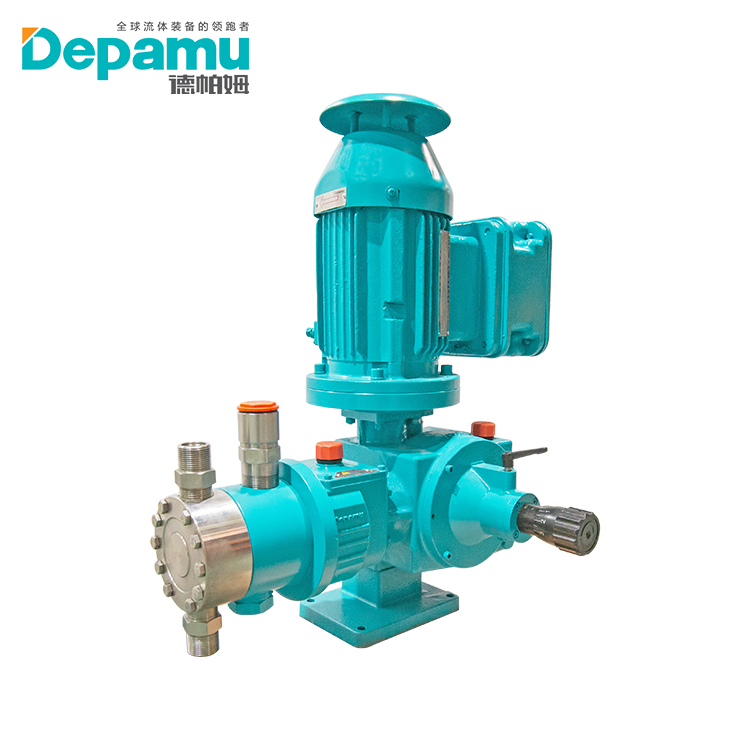
At the heart of the Depamu dosing package lies the plunger metering pump, a technology selected for its ability to deliver precise volumetric flow against high discharge pressures. The operating principle is straightforward yet effective: a reciprocating plunger cyclically varies the working chamber volume, with inlet and outlet check valves rectifying flow direction .
The key performance characteristic distinguishing these pumps is metering accuracy of ±0.5% within the 10-100% stroke adjustment range. This precision is achieved through the combination of high-performance plunger materials, specialized sealing components, and high-precision inlet/outlet check valves . For ethylene production, where additive concentration variations of even a few parts per million can affect catalyst performance or product specifications, this accuracy translates directly to process stability.
3.2 Flow Control and Automation
Depamu offers multiple stroke adjustment modes—manual, electrical, pneumatic, or frequency conversion—enabling integration with plant-wide distributed control systems (DCS) . Electric actuators facilitate remote automatic control, allowing process engineers to modulate dosing rates in response to real-time analyzer readings or feedstock composition changes.
The capability to connect multiple pump heads in parallel—up to 12 heads maximum—provides additional flexibility . Parallel operation can serve two distinct purposes: transporting the same fluid with reduced pulsation, or transporting multiple media as a proportional pump. In ethane cracker applications, this could manifest as simultaneous injection of corrosion inhibitor, antifoulant, and pH control chemicals, all synchronized from a single dosing package.
3.3 Pressure and Flow Capabilities
The technical parameters of Depamu's plunger metering pumps align well with petrochemical service requirements:
These specifications compare favorably with industry benchmarks. LEWA, a recognized leader in this field, similarly deploys hermetically sealed metering pumps for refinery and cracker applications where pressures can reach 1,200 bar and temperatures exceed 300°C . The high-pressure capability is particularly relevant for injection points located on the discharge side of process pumps or at furnace feed locations where system pressures are elevated.
4. Material Selection for Corrosion Resistance
4.1 Wetted Parts Materials
The corrosive nature of ethane cracker process streams and the chemicals employed for treatment necessitates careful material selection. Depamu offers pump head and wetted component options including:
-
Stainless steels: 304, 316, 316L for general corrosion resistance
-
High-performance alloys: 904L, Hastelloy C for severe corrosive services
-
High polymer materials: For specialized chemical compatibility
This material versatility mirrors the approach of established manufacturers. LEWA, for instance, standardizes on stainless steel 316/316L for many applications while offering higher-grade alloys for demanding services . The availability of multiple material options within a single product family simplifies procurement for EPC contractors, who can specify a consistent design basis while selecting appropriate metallurgy for each service.
4.2 Solution Tank Materials
The solution tanks, an integral component of the dosing package, are available in configurations matching the process requirements:
-
304 or 316 stainless steel
-
Carbon steel (with rubber or plastic lining)
-
FRP (fiber-reinforced plastic)
For ethane cracker applications, the choice of tank material reflects consideration of the additive being stored—whether acidic, alkaline, or neutral—and the ambient environmental conditions.
5. Application Scope: Ethane Cracker Specific Services
5.1 Corrosion Inhibitor Dosing
Corrosion inhibition represents one of the most critical dosing services in ethane cracker operations. The high-temperature cracking environment, combined with the presence of trace contaminants and process water, creates conditions conducive to corrosion of carbon steel piping and furnace tubes. Depamu's corrosion inhibitor dosing packages, utilizing the DP(M)WA plunger metering pump, are specifically designed for robust performance in petrochemical applications .
The dosing rates for corrosion inhibitors in cracker applications typically range from 10 to 200 L/H at discharge pressures of 0.5 to 4.0 MPa, well within the capabilities of Depamu's standard offerings .
5.2 Antifoulant and Polymerization Inhibitor Dosing
Ethylene production is plagued by fouling—the formation of carbonaceous deposits or polymerized materials on heat transfer surfaces. This fouling reduces furnace efficiency, increases fuel consumption, and necessitates costly decoking operations. Controlled injection of antifoulants and polymerization inhibitors at strategic points in the cracking and quench sections helps maintain clean surfaces and extend run lengths.
5.3 Boiler Water and Feedwater Treatment
Ethane crackers incorporate extensive steam generation and heat recovery systems. Depamu's boiler water injection packages address the full spectrum of feedwater treatment requirements:
-
Ammonia injection: pH adjustment
-
Hydrazine or acetoxime injection: Oxygen scavenging
The DPJY series boiler water packages, with solution tank capacities of 0.5 to 2.5 cubic meters and pump capacities of 20 to 70 L/H at pressures up to 32 MPa, provide complete water chemistry management .
5.4 Wastewater and Cooling Water Treatment
The olefin plant's cooling water systems and wastewater treatment facilities represent additional dosing opportunities. Depamu's circulating water injection packages handle scale inhibitors, corrosion inhibitors, and biocides at capacities up to 1,500 L/H . Wastewater treatment packages provide flocculant, dispersant, acid, and alkali injection for pH adjustment and solids removal.
6. Automation and Control Integration
6.1 Control System Options
Modern ethane crackers rely on advanced process control systems to optimize operations and maximize profitability. Depamu's dosing packages support multiple control modes:
-
Local manual control: For commissioning and maintenance
-
Semi-automatic control: With local setpoint adjustment
-
Full-automatic control: Integrated with plant DCS via 4-20 mA signals or fieldbus communication
The electrical control cabinet, typically mounted on the skid, serves as the interface point for instrument signals. Inputs from flow meters, pH analyzers, conductivity sensors, and turbidity meters can be processed by frequency converters to modulate pump speed and maintain setpoints automatically .
6.2 Redundancy and Reliability
The provision of working and standby pumps on each skid addresses a fundamental reliability requirement: continuous additive injection. Even brief interruptions in inhibitor or antifoulant feed can lead to accelerated corrosion or fouling, with consequences ranging from reduced efficiency to unscheduled shutdowns. The automatic switchover capability ensures uninterrupted operation when a pump requires maintenance.
7. Industry Standards and Compliance
7.1 API Standard 675
Depamu positions its metering pumps and dosing packages as conforming to API Standard 675, the industry specification for controlled-volume positive displacement pumps . Compliance with this standard provides assurance of:
-
Minimum performance requirements for design, materials, and testing
-
Vibration and pulsation criteria
-
Nameplate data and documentation requirements
For EC projects, specifying equipment to API 675 simplifies procurement by establishing a common basis for technical evaluation among multiple prospective suppliers.
7.2 Certifications
Depamu's products carry CE and ISO certifications, facilitating export to international markets and acceptance by global engineering firms . These certifications, combined with the company's 17-year track record as a SGS/BV-audited supplier, provide project stakeholders with confidence in the manufacturing quality and compliance.
8. Comparative Positioning
Within the competitive landscape of chemical dosing packages for petrochemical applications, Depamu occupies an interesting position. At one end of the spectrum, established Western manufacturers such as LEWA bring decades of process expertise, hermetically sealed pump designs for hazardous fluids, and extensive global reference installations . Their solutions command premium pricing and are often specified for critical services involving toxic, flammable, or environmentally hazardous materials.
Depamu, by contrast, offers a cost-competitive alternative that incorporates "advanced production processes and technologies from America, Germany, Japan, etc." into its designs . The product philosophy emphasizes "systematic design" to avoid the inconsistencies of traditional single-equipment approaches, combined with "modular design of product structure in an integrated combination" .
For EC projects where budget constraints are significant and where the operating environment, while demanding, does not require the specialized containment features of hermetically sealed pumps, Depamu's offering presents a viable value proposition. The availability of multiple material options, API 675 compliance, and proven performance in petroleum and chemical applications supports this positioning.
9. Conclusion
The Depamu Dosing Package, built around plunger metering pump technology and integrated skid-mounted design, offers a comprehensive solution for chemical injection requirements in ethane cracker projects. Its technical capabilities—including metering accuracy of ±0.5%, pressure ratings up to 228 MPa, and flow rates to 12,100 L/H—align with the demanding requirements of olefin plant operations.
The systematic design philosophy, modular configurability, and material selection versatility provide engineering contractors with flexibility in specifying packages for diverse services including corrosion inhibition, antifoulant injection, boiler water treatment, and wastewater management. Automation options support integration with modern DCS systems, while compliance with API Standard 675 and international certifications facilitate project acceptance.
For the ethane cracker project evaluating chemical dosing solutions, Depamu represents a credible option that balances technical performance with cost competitiveness. The company's integration of international manufacturing practices with localized production economics, evidenced by its DPJY series product line, positions it to serve the growing global demand for ethylene production capacity