

Depamu Zero-Leak Chemical Injection Package for Water Treatment and Environmental Protection
Introduction
In an era of increasingly stringent environmental regulations and growing industrial demand for precise chemical management, the safe and accurate injection of treatment chemicals has become a critical operational concern. Chemical leaks in water treatment and industrial processes not only waste costly reagents but also pose severe risks to personnel safety and the surrounding ecosystem. Depamu (Hangzhou) Pumps Technology Co., Ltd., a leading Chinese manufacturer of Metering Pumps and packaged chemical dosing systems, has developed a comprehensive line of zero-leak Chemical Injection Packages designed to address these challenges. Drawing on advanced hydraulic diaphragm technology originally introduced from Germany in the early 1990s, Depamu has established itself as a professional enterprise specializing in metering pumps, high-pressure Reciprocating Pumps, leakage-free chemical pumps, and packaged chemical dosing devices. This article examines the technical foundations, product architecture, and practical applications of Depamu's zero-leak chemical injection packages, with particular emphasis on their role in water treatment and environmental protection.
The Technical Foundation of Zero-Leak Design
The concept of zero leakage in chemical injection begins at the pump level. Depamu's Hydraulic Diaphragm Metering Pumps employ a design philosophy fundamentally different from traditional plunger-type pumps. In a conventional plunger pump, the reciprocating plunger must pass through a dynamic seal, which is inherently vulnerable to wear and ultimately permits fluid to escape. Depamu's diaphragm metering pumps eliminate this weakness entirely. The static seal of the diaphragm at the hydraulic end replaces the dynamic seal of the plunger, meaning that the medium being transported never comes into contact with a moving shaft seal. As a result, the medium will not leak under any operating condition.
This principle is further reinforced in the company's process Diaphragm Pumps, which are specifically engineered to ensure no leakage during the transportation of toxic, flammable, or abrasive media with harsh requirements, without restriction from different fields. For applications involving the most aggressive chemical agents, Depamu offers double-diaphragm configurations made of PTFE, which boasts excellent corrosion resistance and leakage-proof capacity. Some models go even further, integrating diaphragm leakage alarm pumps equipped with a diaphragm-broken alarm function, allowing operators to detect and respond to diaphragm integrity issues before any environmental release occurs. This layered approach to containment—combining static sealing, material selection, and real-time monitoring—forms the basis of the zero-leak guarantee.
The DPJY Series: A Comprehensive Injection Package Architecture
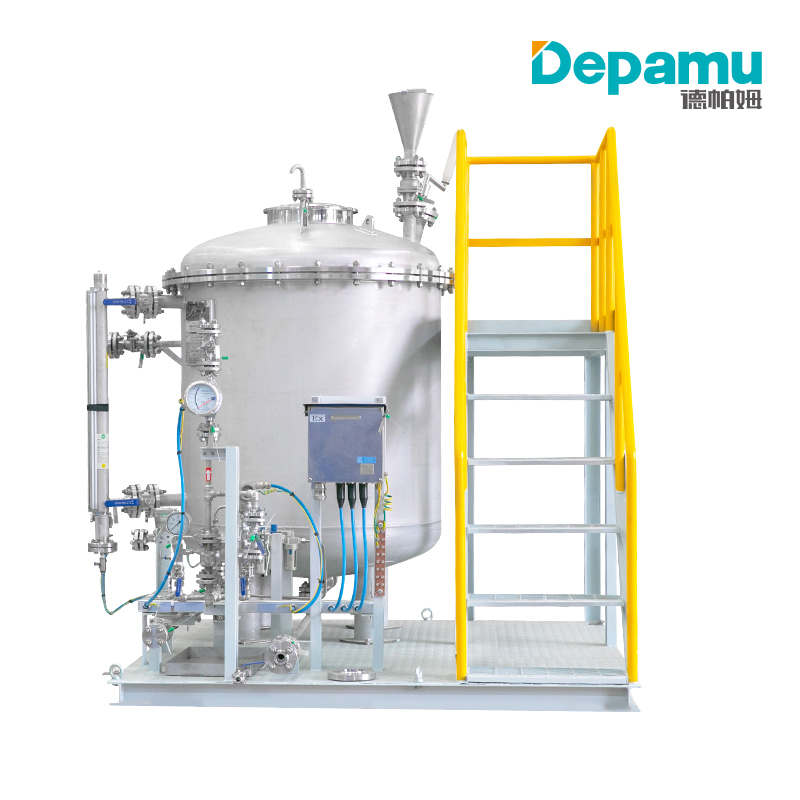
Depamu's zero-leak philosophy extends beyond individual pumps into fully integrated chemical injection packages. The company's flagship DPJY-series injection packages are complete-set devices that consolidate the entire dosing process into a single skid-mounted unit. Each package comprises a solution tank, one or more metering pumps, a level gauge, a safety valve, a pulsation damper, various valves and pipes, and an electrical control cabinet—all installed on a common iron base. This integrated combination achieves the functions of chemical dissolving, preparation, metering, and injection within a compact structure that is easy to transport and install.
The modular design philosophy underlying these packages is a significant advantage. The metering pumps within a unit can be randomly assigned as working or standby pumps, and when two or more solution tanks are present, they can be operated alternately through valve switching or used simultaneously. This flexibility ensures continuous operation even during maintenance or unexpected equipment failure—a critical requirement for municipal water treatment plants and industrial facilities that cannot afford dosing interruptions.
Material selection in the DPJY series reflects a deep understanding of the corrosive nature of treatment chemicals. Depending on the specific anti-corrosion requirements, solution tanks can be fabricated from 316 or 304 stainless steel, carbon steel, carbon steel with rubber or plastic lining, fiberglass-reinforced plastic, polyethylene, or PVC. Wetted parts similarly accommodate a range of materials to match the chemical compatibility requirements of each application. This customization capability ensures that the zero-leak design is not compromised by material degradation over time.
Applications in Water Treatment
Depamu's zero-leak chemical injection packages serve a broad spectrum of water treatment processes, spanning boiler feedwater treatment, circulating water systems, raw water pretreatment, and wastewater treatment. Each application demands a tailored approach to chemical injection, and the modular nature of the DPJY series accommodates these varying requirements.
In boiler water treatment, the packages are deployed for the injection of ammonia, hydrazine, acetoxime, and phosphate. Solution tank volumes range from 0.5 to 2.5 cubic meters, with metering pump capacities of 20 to 70 liters per hour and discharge pressures of 0.5 to 32 MPa, depending on the specific reagent and system requirements. The zero-leak design is particularly important in this context because hydrazine, a common oxygen scavenger, is toxic and requires careful handling. The diaphragm-based sealing mechanism ensures that no hydrazine escapes into the operating environment.
For circulating water systems, Depamu offers injection packages configured for scale inhibitors, corrosion inhibitors, and germicides. These systems feature larger solution tanks (1 to 4 cubic meters) and higher pump capacities (50 to 1,500 liters per hour) to match the continuous dosing demands of cooling water circuits. The precise metering capability, with accuracy reaching ±0.5 to 0.2 percent when equipped with a high-precision flow recorder or weightless flow control system, ensures that chemical consumption is optimized while maintaining effective treatment.
Wastewater treatment represents perhaps the most environmentally sensitive application for chemical injection packages. Depamu's systems are deployed for flocculant, dispersant, acid, and alkali injection in municipal and industrial wastewater facilities. The automatic dissolving and injection packages can automatically and continuously prepare liquid media in different concentrations from dry powder and granular chemicals, which are then accurately injected into the process system by a metering pump, with the entire process under automatic control. This automation not only improves dosing accuracy but also reduces the risk of human error that could lead to chemical overuse or environmental release.
Environmental Protection Applications
The environmental protection dimension of Depamu's zero-leak injection packages extends beyond water treatment into petroleum, petrochemical, and industrial processing applications where chemical leaks could have serious ecological consequences.
In petroleum and natural gas exploitation, gathering, and transportation, Depamu's injection packages are used for demulsifier, corrosion inhibitor, deoxidant, reverse demulsifier, germicide, and methanol injection. These packages can accept process medium parameters in real time through online instrument testing, automatically regulate the ratio between chemical injection volume and process medium flow (the PPM value), and simultaneously receive feedback data on the actual effect after chemical injection, achieving intelligent online control of the optimal injection volume with accuracy below ±1 percent. The zero-leak design is especially critical in this sector, where the injected chemicals are often toxic, flammable, or both, and where any release could contaminate soil and groundwater.
The environmental benefits of zero-leak design are further amplified when considering the life-cycle costs of chemical treatment. When leaks are eliminated, every liter of treatment chemical is delivered to its intended target rather than being lost to the environment. This reduces the total volume of chemicals that must be purchased, transported, and stored, thereby lowering the overall environmental footprint of the treatment process. For facilities subject to increasingly strict discharge regulations, the ability to demonstrate zero chemical loss is not merely a cost-saving measure but a compliance imperative.
Intelligent Control and Safety Systems
Modern chemical injection packages must do more than prevent leaks; they must also operate reliably with minimal human intervention. Depamu's injection packages incorporate sophisticated control systems that support manual, semi-automatic, and full-automatic operation modes. The electrical control cabinet can be configured to meet the specific automation requirements of each installation, from simple in-place manual control to fully automated operation with remote monitoring capabilities.
The automatic dissolving and injection packages feature a PLC automatic control system, dry powder storage system, dry powder accurate injection device, moisture-proof heater, and stainless-steel mixer. A scientific and reasonable servo mechanism and a unique powder transport system avoid powder heating, caking, or sticking, thus securing high injection precision. The system also includes functions of self-diagnosis and alarm output, enabling operators to identify and address potential issues before they escalate into safety incidents or environmental releases.
For offshore platform applications, Depamu has developed injection packages with modular design, compact structure, and excellent resistance to salt-spray corrosion. These packages feature advanced automation, unmanned continuous operation capability, and self-diagnosis with alarm output, making them suitable for the harsh and remote environments typical of offshore oil and gas operations.
Quality Assurance and International Standards
The reliability of Depamu's zero-leak injection packages is underpinned by adherence to rigorous international standards. The company's products conform to API 675 and API 674 standards of the American Petroleum Institute, and have passed certifications from international authorities including DNV, ISO 9001:2000 Quality Management System, ISO 14001:2004 Environmental Management, and CE European Community Certification. These certifications provide independent verification that the equipment meets internationally recognized benchmarks for quality, safety, and environmental performance.
Depamu has developed 86 housing types and over 4,000 specifications and models of metering pumps and chemical pumps, including internationally leading three-diaphragm pumps, four-diaphragm pumps, diaphragm leakage alarm pumps, heat-insulating diaphragm pumps, and special-feature pumps, many of which incorporate patented technologies. This extensive product range enables the company to provide tailored solutions for virtually any chemical injection requirement, from standard municipal water treatment to the most demanding petrochemical processes.
Conclusion
Depamu's zero-leak chemical injection packages represent a mature and comprehensive response to the dual challenges of precise chemical dosing and environmental protection. By eliminating the dynamic seals that are the primary source of leaks in conventional pump designs, employing corrosion-resistant materials matched to each application, and integrating intelligent control and monitoring systems, these packages deliver reliable performance across a wide range of water treatment and environmental protection applications. As regulatory requirements tighten and industries seek to minimize their environmental impact, the value of zero-leak technology will only continue to grow. Depamu's combination of German-derived engineering principles, Chinese manufacturing capability, and continuous innovation positions the company as a significant contributor to safer and more sustainable chemical management practices worldwide.