

Feeding the Future: Depamu High-Pressure Process Hose Pumps for Hydrothermal Liquefaction Reactors
Hydrothermal liquefaction (HTL) has emerged as one of the most promising thermochemical pathways for converting wet biomass, sewage sludge, and organic wastes into biocrude oil. By processing slurries at elevated temperatures and pressures above the vapor pressure of water, HTL avoids the energy-intensive drying steps required by pyrolysis and can achieve high carbon yields. Yet the very conditions that make HTL attractive also create one of its most persistent engineering bottlenecks: feeding a highly viscous, fibrous, and abrasive slurry into a reactor operating at 15–20 MPa and 300–350 °C. The feed pump sits at the hydraulic heart of the process, and its reliability, wear life, and pressure stability directly determine whether an HTL plant can operate continuously and economically. Among the positive-displacement technologies available, the Depamu high-pressure process hose pump offers a distinctive combination of features that align unusually well with the demands of HTL slurry feeding. This article examines the technology, specifications, and operational rationale for deploying Depamu hose pumps in HTL feed service.
The HTL Feed Challenge: Why Conventional Pumps Struggle
The HTL feed stream is not a simple fluid. It is typically a paste-like slurry containing 15–25 wt% biomass solids, often fibrous and non-Newtonian, with particle sizes that may range from tens of microns to several millimetres. The slurry must be pressurised to 15–20 MPa (approximately 2200–2900 psi) before entering the reactor, and in many designs the pump must deliver this pressure in a single stage to avoid the cost and complexity of interstage heating and pressurisation. Unlike clean fluids, biomass slurries tend to dewater or segregate under pressure, forming plugs and causing erratic flow. Abrasive solids accelerate wear on valves, seats, and sealing surfaces. Fibrous particles can bridge across narrow passages and obstruct check valves. Furthermore, the pump must maintain steady, low-pulsation flow because pressure fluctuations propagate into the reactor and disturb the delicate balance of temperature, residence time, and reaction chemistry.
The Pacific Northwest National Laboratory’s assessment of commercial feed and pumping options for HTL identified this feeding step as “a significant challenge to the scale-up of the HTL process”. The study evaluated piston, diaphragm, and rotary lobe pumps, concluding that while solids piston pumps are the most proven base choice, “Diaphragm Pumps, especially the hose pump, should be considered due to unique pumping characteristics that may be favorable in this pumping application”. The FELUWA hose pump, a close analogue of the Depamu design, was specifically noted as a “very unique pump that should be further assessed for HTL application”. The reason lies in the architecture of the hose-diaphragm principle itself.
Depamu High-Pressure Process Hose Pump: Operating Principle and Design Architecture
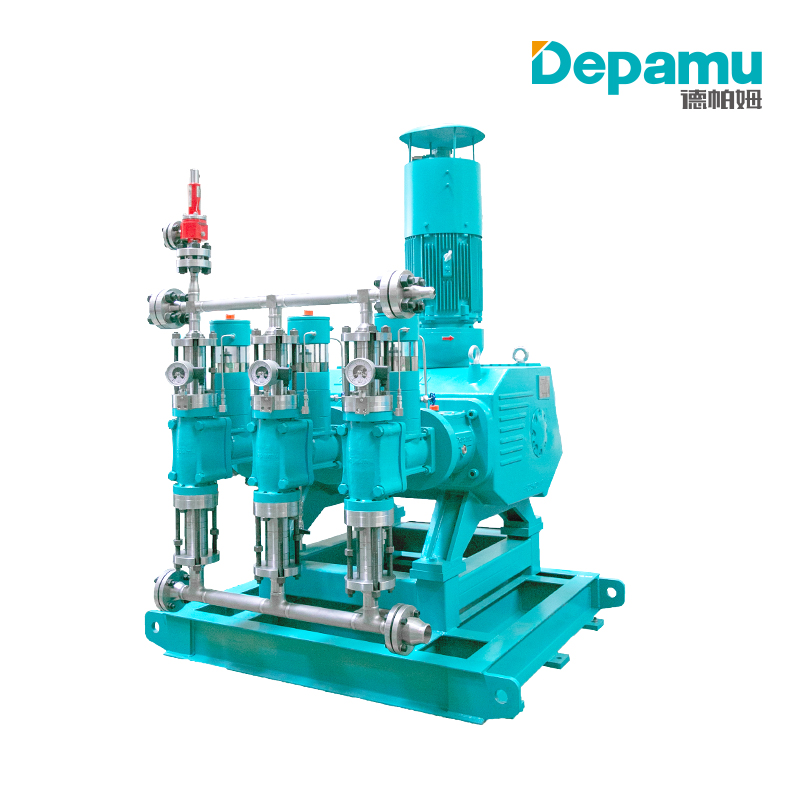
Depamu’s high-pressure process hose pump is a positive-displacement reciprocating pump in which the conventional piston-and-cylinder interface is replaced by a flexible hose diaphragm. The driver rotates a crankshaft through a reduction gearbox; a crank–connecting-rod mechanism converts rotary motion into reciprocating piston motion, which displaces hydraulic oil in a closed chamber. The hydraulic oil, in turn, transmits pressure and volumetric change to the exterior of the hose diaphragm. As the diaphragm is cyclically squeezed and released, the internal fluid chamber alternately contracts and expands, drawing slurry through the inlet check valve and discharging it through the outlet check valve.
The critical design feature is that the process fluid never contacts the pump’s mechanical components. The fluid is confined entirely within the hose diaphragm; the hydraulic oil, pistons, bearings, and seals operate on the outside of that barrier. This separation has profound consequences for HTL service. Abrasive solids wear the inside of the hose rather than precision metal parts. There is no packing gland or mechanical seal to leak or to be destroyed by fibrous solids. And because the hose is the only wetted moving element, maintenance is reduced to periodic hose replacement rather than frequent overhaul of valves, plungers, or seats.
Depamu has engineered several refinements around this principle that are directly relevant to slurry feeding. The connecting rod and main shaft are joined via a roller bearing rather than a bushing, allowing stable operation at very low speeds—rated speeds below 60 r/min—without loss of lubricating film. Low speed is advantageous for abrasive slurries because it reduces linear wear rates and shear exposure. The pump head cavity is of a direct-through design without unthreaded recesses where particles could settle, specifically to accommodate fluids with high solid content, large particle size, and a tendency to precipitate. A forced lubrication system in the power end supports long-term operation at low speed, and a diaphragm rupture alarm provides real-time monitoring of hose integrity, a safety feature of particular value when handling hot or hazardous process streams. The pump is designed in accordance with API 674, the American Petroleum Institute standard for positive-displacement Reciprocating Pumps, signalling a level of mechanical integrity and documentation consistent with industrial duty.
Technical Specifications and Their Alignment with HTL Duty
Depamu’s published specifications for the high-pressure process hose pump family include capacities up to 450 m³/h, discharge pressures up to 35 MPa (approximately 5,076 psi), fluid temperatures up to 120 °C, viscosities below 1500 cP, and solid contents up to 80%. These figures require careful interpretation in the HTL context, because the pump is not required to operate at reactor temperature; it feeds ambient or preheated slurry into the reactor system, and the downstream heat exchangers raise the slurry to reaction temperature after pressurisation. The relevant pressure requirement for HTL is typically 15–20 MPa, although some designs specify pressures of 3000 psi (207 bar) or higher to maintain a condensed phase. Depamu’s 35 MPa ceiling therefore provides a comfortable margin above typical HTL feed pressures, accommodating pressure surges, fouling allowances, and the higher end of commercial-scale designs.
The solid-content capability is equally significant. HTL slurries are often limited to 15–25 wt% solids because of pumpability constraints, but the ability to handle up to 80% solids means the pump is not the limiting component when operators seek to increase feed concentration to improve process economics. Higher solids loading reduces the amount of water that must be heated and later separated, directly lowering energy consumption and capital cost per tonne of biocrude. The viscosity limit of 1500 cP is consistent with many biomass slurries, although highly fibrous or pre-gelatinised feedstocks can exceed this range; in such cases, feed formulation and temperature control become important system-level considerations.
The temperature specification deserves explicit discussion. Depamu rates the hose pump to 120 °C, whereas HTL reactions occur at 300–350 °C. This is not a mismatch but a deliberate process architecture: the feed pump operates on the cold side of the heat-recovery train, pressurising the slurry before it is heated in one or more heat exchangers en route to the reactor. Operating the pump at lower temperature protects the elastomeric hose from thermal degradation and preserves its mechanical fatigue life. The hose material must nevertheless resist the chemical species present in the slurry—organic acids, alcohols, and potential salts—and Depamu’s experience with coal–water slurry, ore pulp, and kitchen waste confirms that the hose compounds are selected for aggressive, abrasive service.
Operational Advantages for HTL Feed Service
The first and most important advantage of the hose-pump architecture is seal-free and gland-free operation. Because the process fluid is contained within the hose, there is no dynamic seal between a reciprocating plunger and a cylinder. In conventional plunger pumps, abrasive particles migrate into the packing and cause rapid wear, leakage, and loss of pressure. In a hose pump, the only wear surface exposed to the slurry is the elastomeric hose interior, which is designed to be sacrificial and replaceable. This characteristic is particularly relevant to HTL because biomass slurries are not only abrasive but also fibrous; fibres tend to wick into packing and destroy seals in a matter of hours. The hose pump eliminates this failure mode entirely.
Second, the low-speed, low-shear operation of the Depamu design is favourable for shear-sensitive slurries. High shear can alter the rheology of biomass slurries, promote premature gelation, or damage flocs in sludge-derived feeds. The low stroking rate and gentle, positive displacement of the hose diaphragm reduce shear exposure while still generating high pressure. The same low-speed operation reduces the kinetic energy imparted to abrasive particles, extending hose life.
Third, pulsation control is built into the system architecture. Reciprocating positive-displacement pumps inherently produce pulsating flow, and in HTL service pulsation can excite resonance in the feed piping, disturb heat-exchanger performance, and propagate pressure oscillations into the reactor. Depamu addresses this with a combined hose–bladder pulsation damper on the discharge line. The damper’s wetted parts mirror the pump-head construction, with a direct-through hose separating the slurry from the bladder and other damper structures. This prevents particle deposition and ensures that the pulsation-suppression effect remains stable over long periods; the bladder itself operates in hydraulic oil and never contacts the process fluid, so it does not wear or leak. The result is a feed flow that is sufficiently steady for reactor control without the need for an oversized downstream dampener.
Fourth, the handling of large particles and precipitation-prone slurries is explicitly designed in. The direct-through fluid chamber avoids dead zones where particles can settle and compact. The check valves use a double-valve arrangement with a soft buffer and secondary seal, reducing the risk of a single large particle holding a valve open and causing capacity loss or reverse flow. For HTL feedstocks that contain chips, stalks, or agglomerates, this robustness reduces the need for fine grinding—an energy-intensive and costly upstream step. PNNL’s analysis noted that size reduction of HTL feedstock can be a major economic penalty, and pump designs that tolerate larger particles can lower the overall plant energy demand.
Fifth, the intelligent hydraulic control and monitoring features reduce operational risk. The pump’s hydraulic oil system performs automatic oil make-up, venting, and pressure relief, maintaining stable displacement even during long continuous runs. The diaphragm rupture alarm allows operators to detect hose failure immediately, before process fluid can contaminate the hydraulic system or leak to the environment. In an HTL plant handling hot, odorous, and potentially corrosive slurries, this level of containment assurance is a significant safety and environmental benefit.
Integration Considerations for HTL Plants
A feed pump does not operate in isolation, and the Depamu hose pump is best deployed as part of an integrated feed system. PNNL’s HTL assessment strongly recommends a twin-screw feeder or similar positive feed device upstream of the pump to ensure that a consistent, de-aerated slurry enters the pump chamber. The feeder conditions the slurry, breaks up lumps, and provides a modest pressure boost that improves pump filling efficiency. Downstream, the pulsation damper and a pressure-relief system protect the pump and the reactor from overpressure. Instrumentation for suction pressure, discharge pressure, hose-diaphragm position, and hydraulic-oil condition should be tied into the plant control system so that the pump can be tripped safely if feed quality deteriorates.
Compliance with API 674 is a meaningful integration advantage for engineering, procurement, and construction contractors. API 674 defines requirements for reciprocating pump design, materials, testing, and documentation, and its use simplifies vendor qualification and spare-parts planning. Depamu’s broader product range—including Metering Pumps, diaphragm pumps, and plunger pumps—also allows a plant to standardise on a single supplier for multiple dosing and transfer duties, reducing spare-parts inventory and training burden.
Comparative Perspective and Application Outlook
The HTL literature does not declare a single “best” pump type. Piston pumps are the most proven for high-pressure solids service and have demonstrated pilot-scale operation. Diaphragm pumps, including hose-diaphragm designs, offer seal-free containment and are particularly attractive when abrasion and fibre content are high. Rotary lobe pumps with chopper blades can serve as boosters or front-end feeders and may offer energy recovery through reverse operation. The Depamu hose pump occupies a valuable position within this landscape: it provides the pressure capability of a reciprocating pump, the containment of a diaphragm pump, and a wetted-path simplicity that reduces maintenance in abrasive service. Its current temperature rating makes it a cold-side feed pump rather than a hot-side booster, but that is precisely the duty required in most HTL configurations.
Scale-up is the remaining question. Depamu’s capacity range extends to 450 m³/h, which is substantial for a positive-displacement hose pump, but HTL production-scale plants in the range of 2000 dry metric tonnes per day may require multiple pump trains or very large single units. PNNL’s review emphasised that pumpability testing on the actual feedstock is essential, because biomass slurries vary widely in rheology, particle size, and dewatering behaviour. A pilot-scale Depamu hose pump trial using representative HTL slurry—measuring discharge pressure stability, hose wear rate, valve performance, and pulsation—would be the appropriate next step for any project considering this technology. The favourable assessment of hose-diaphragm pumps in the HTL literature, combined with Depamu’s API 674 design and slurry-specific engineering, justifies that trial.
Conclusion
Hydrothermal liquefaction transforms wet, low-value feedstocks into high-value biocrude, but the process is only as reliable as its feed system. The Depamu high-pressure process hose pump addresses the central feeding challenges of HTL—abrasive solids, fibrous particles, high pressure, and the need for steady flow—through a design in which the process fluid is isolated inside a flexible hose and never contacts mechanical seals, plungers, or packing. Its pressure capability comfortably exceeds typical HTL feed requirements, its solids and viscosity ratings are well matched to biomass slurries, and its low-speed operation, pulsation dampening, and rupture monitoring are directly relevant to continuous plant operation. While no pump is universal, the hose-pump principle has been identified in independent HTL assessments as a technology worthy of serious consideration, and Depamu’s implementation offers a mature, API-compliant platform for that service. As the HTL industry moves from pilot demonstrations to commercial-scale plants, the selection of a feed pump that can tolerate the slurry rather than fight it will be a decisive factor in project economics. The Depamu high-pressure process hose pump deserves a place on the shortlist for that critical duty.