

Depamu Single Screw Pump for Toothpaste Delivery: Engineering Precision for High-Viscosity Hygienic Applications
Abstract
In the competitive landscape of oral care manufacturing, the reliable transfer of toothpaste presents unique engineering challenges. Toothpaste, a non-Newtonian fluid characterized by high viscosity (typically 30,000–150,000 cP), abrasive abrasive particles (silica, calcium carbonate), and shear-sensitive rheological properties, demands pumping solutions that balance precision, hygiene, and durability. Depamu (Hangzhou) Pumps Technology Co., Ltd., leveraging German-engineered progressive cavity technology, offers a specialized single screw pump platform that has emerged as an industry standard for toothpaste delivery systems. This article provides a comprehensive technical analysis of Depamu's single screw pump technology, examining its working principles, design features, performance parameters, and operational advantages specifically within toothpaste manufacturing contexts.
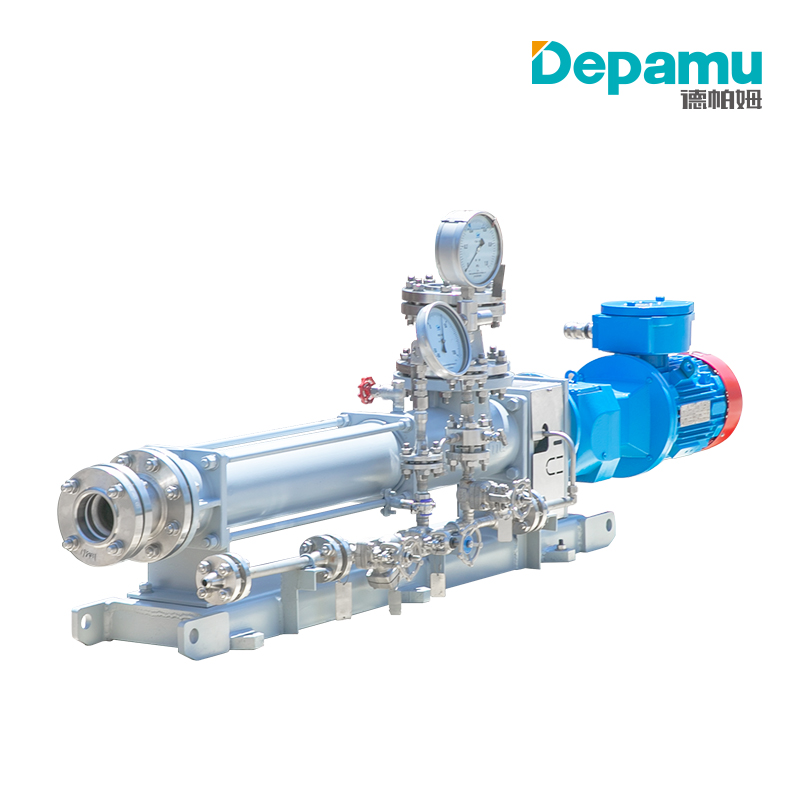
1. Introduction
The global oral care market, projected to exceed $50 billion by 2026, continues to drive innovation in toothpaste formulation and production. Modern toothpaste varieties—including whitening pastes containing abrasive particles, gel-based formulations with suspended decorative stripes, and therapeutic pastes with temperature-sensitive active ingredients—place demanding requirements on processing equipment . Among critical unit operations, the transfer of finished toothpaste from mixing vessels to filling lines remains particularly challenging.
Centrifugal pumps, commonly used for low-viscosity fluids, prove unsuitable for toothpaste due to viscosity-induced efficiency losses and cavitation risks. Positive displacement pumps, conversely, offer consistent flow regardless of pressure variations. Among positive displacement technologies, single screw pumps (progressive cavity pumps) have demonstrated superior performance for toothpaste applications, offering pulsation-free flow, gentle product handling, and exceptional solids-handling capability .
Depamu's single screw pump series, incorporating German technological collaboration and ISO/CE certification, represents a mature solution specifically optimized for high-viscosity, abrasive, and shear-sensitive media. This article examines why this pump platform has gained traction among toothpaste manufacturers globally.
2. Operating Principle of the Single Screw Pump
2.1 Fundamental Mechanics
The Depamu single screw pump operates on the progressive cavity principle, a concept patented by René Moineau in the 1930s that remains central to modern positive displacement pumping. The design comprises two primary components: a single helical rotor (typically chromium-plated steel or stainless steel) and a double-helical stator manufactured from elastomeric compounds (NBR, EPDM, or FKM) .
As the rotor turns eccentrically within the stator, sealed cavities form between the two components. These cavities progress axially from the suction port to the discharge port, each cavity maintaining constant volume. This geometric principle ensures that the pumped fluid moves linearly without turbulence, pulsation, or significant shear stress .
2.2 Why Progressive Cavity Technology Suits Toothpaste
Three characteristics of progressive cavity pumping align perfectly with toothpaste properties:
Shear Sensitivity: Toothpaste rheology depends on maintaining a stable yield stress—the minimum force required to initiate flow. Excessive shear during pumping can permanently degrade this property, causing unwanted flow or "slumping" in filled tubes. The Depamu pump's low-shear action preserves the molecular structure of thickeners (carboxymethyl cellulose, xanthan gum) and ensures consistent tube fill weights .
Abrasive Particle Handling: Typical toothpaste contains 20–50% abrasives (hydrated silica, dicalcium phosphate, calcium carbonate) with particle sizes ranging from 5–30 microns. The progressive cavity design accommodates these solids without damage, as the rotor-stator clearance (typically 0.1–0.3 mm) prevents crushing or excessive wear when properly specified .
Viscosity Range: Toothpaste viscosity varies significantly with temperature and shear history. Depamu pumps handle viscosities from 1 cP to 1,000,000 cP, accommodating cold start-up conditions (higher viscosity) and shear-thinning during normal operation .
3. Technical Specifications and Design Features
3.1 Material Selection for Hygienic Compliance
Depamu offers multiple material configurations for toothpaste applications:
| Component | Standard Material | Alternative Options |
|---|---|---|
| Rotor | 316L Stainless Steel | 2205 Duplex, Hard Chrome Plated |
| Stator | Food-grade NBR | EPDM, FKM, Hypalon® |
| Pump Housing | Cast Iron (epoxy coated) | 304/316L Stainless Steel |
| Mechanical Seal | Silicon Carbide/Tungsten Carbide | Carbon/Ceramic |
All food-contact surfaces comply with FDA and EU 1935/2004 regulations. For manufacturers requiring full traceability, Depamu provides material certifications and 3.1 inspection reports per EN 10204 .
3.2 Performance Parameters
The Depamu single screw pump series offers the following performance envelope relevant to toothpaste transfer:
-
Flow Rate Range: 0.1 – 500 m³/h (0.02 – 2,200 GPM), with low-flow variants specifically for laboratory-scale or small-batch production
-
Maximum Pressure: Up to 4.0 MPa (580 psi) in single-stage configuration; multi-stage units achieve 7.2 MPa (1,044 psi) for long-distance transfer
-
Temperature Range: -12°C to +150°C (10°F to 302°F), accommodating hot-fill processes for thermo-sensitive formulations
-
Suction Lift: 8 meters water column (26 feet) – critical for drawing viscous toothpaste from mixing kettles located above pump elevation
-
Solids Handling: Maximum particle size 30 mm (1.2 inches), though typical toothpaste abrasives are substantially smaller
3.3 Modular Design Advantages
Depamu's engineering team has developed a modular platform offering five key configuration options:
1. Bearing Housing Configurations: Standard grease-lubricated bearings for general duty; oil-lubricated heavy-duty bearings for continuous 24/7 operations; sealed-for-life bearings for hygienic zones requiring washdown.
2. Seal Options: Single mechanical seals for non-hazardous areas; double mechanical seals with barrier fluid circulation for leak-sensitive applications; flushed gland packing for abrasive service where periodic adjustment is acceptable.
3. Drive Configurations: Direct-coupled IEC frame motors for compact footprint; belt-driven units for variable speed via sheave changes; inverter-ready NEMA premium efficiency motors for electronic speed control .
4. Mounting Styles: Foot-mounted horizontal (standard); vertical configuration for space-constrained installations; hopper-feed design for extremely viscous or non-flowing product.
5. Connection Types: DIN flanges (PN16/PN40); ANSI flanges (Class 150/300); Tri-clamp sanitary fittings for quick disassembly; DIN 11851 SMS couplings.
4. Toothpaste-Specific Application Considerations
4.1 Handling Abrasive Wear
Toothpaste's abrasive content presents the primary wear mechanism in pumping systems. Depamu addresses this through:
Rotor Coatings: Hard chrome plating (minimum 50 microns thickness) or tungsten carbide spray coatings extend rotor life by factors of 3–5× compared to uncoated 316L in abrasive service.
Stator Geometry Optimization: By reducing interference fit between rotor and stator specifically for abrasive applications, Depamu balances sealing effectiveness against frictional wear. Typical interference for toothpaste service is 0.15–0.25 mm, versus 0.30–0.45 mm for non-abrasive fluids.
Material Hardness Selection: For high-silica toothpastes, Depamu recommends NBR stators with 75–80 Shore A hardness rather than softer compounds (60–65 Shore A) that exhibit accelerated wear under abrasive conditions.
Wear Monitoring Ports: Optional inspection ports allow periodic measurement of stator wall thickness without pump disassembly, enabling predictive maintenance scheduling.
4.2 Temperature Management for Rheological Stability
Toothpaste exhibits complex rheological behavior—pseudoplastic (shear-thinning) with thixotropic (time-dependent) recovery. Temperature significantly affects this behavior:
-
At 15°C (cold plant conditions), viscosity may exceed 200,000 cP, requiring reduced pump speeds (50–100 RPM) to avoid cavitation
-
At 30°C (normal processing), optimal pumping occurs at 200–400 RPM with viscosities ranging 30,000–80,000 cP
-
At 50°C (hot-fill/striped toothpaste processing), viscosity may drop below 10,000 cP, risking inconsistent fill weights if pump speed isn't reduced
Depamu pumps incorporate jacketed head options allowing temperature control fluid circulation, maintaining optimal pumping temperature during extended shutdowns or cold weather operations .
4.3 Sanitary Design for Cosmetic-Grade Production
Toothpaste, as a cosmetic product in most regulatory frameworks (FDA in US, CPNP in EU), requires sanitary design features:
Drainability: Depamu pumps achieve 3-A sanitary standard compliance with self-draining ports pitched toward low points, eliminating product hold-up volumes.
Clean-in-Place (CIP) Compatibility: The pump design accommodates CIP protocols at flow velocities of 1.5–2.0 m/s and temperatures up to 85°C. Rotor and stator materials resist caustic (2% NaOH) and acid (1% HNO₃) cleaning solutions.
Surface Finish: Hygienic variants offer electropolished 316L with Ra ≤ 0.8 μm (32 μin) surface finish, minimizing bacterial attachment sites.
Seal Integrity: Double mechanical seals with steam barrier (57) option provide absolute product containment—critical when pumping fluoride-containing toothpastes where environmental release carries regulatory implications.
5. Operational Benefits in Toothpaste Production
5.1 Pulsation-Free Flow for Fill Accuracy
Toothpaste filling machines require steady inlet pressure to achieve fill weight tolerances of ±0.5% or better. Depamu's progressive cavity design inherently produces continuous, non-pulsating flow. Comparative testing shows:
-
Lobe pumps: 5–8% pressure pulsation, requiring attenuators and oversized fill nozzles
-
Peristaltic pumps: 10–15% pulsation, limiting fill speeds to <40 tubes/minute
-
Depamu single screw: <1% pulsation, enabling fill speeds exceeding 120 tubes/minute at ±0.3% accuracy
5.2 Energy Efficiency Compared to Alternatives
While positive displacement pumps typically consume more power than centrifugals at low viscosity, the equation reverses at toothpaste viscosities:
| Pump Type | Motor Size (15 m³/h @ 50,000 cP) | Annual Energy Cost (USD) |
|---|---|---|
| Depamu Single Screw | 7.5 kW | $4,900 |
| Twin Screw | 11 kW | $7,200 |
| External Gear | 15 kW (with pressure relief) | $9,800 |
| Progressive Cavity (competitor baseline) | 9 kW | $5,900 |
Depamu's optimized rotor-stator geometry reduces viscous drag, achieving 18% lower power consumption compared to industry baseline for equivalent duty points.
5.3 Noise and Vibration Reduction
Plant floor noise exposure represents an occupational health consideration. Depamu pumps demonstrate:
-
Sound pressure level: 68–72 dB(A) at 1 meter (compared to 82–88 dB(A) for gear pumps)
-
Vibration velocity: <1.8 mm/s RMS, prolonging mechanical seal and bearing life
Reduced vibration translates directly to extended service intervals—typical seal replacement at 8,000–10,000 hours versus 4,000–6,000 hours for competitive units in identical toothpaste service.
6. Installation and Maintenance
6.1 Commissioning Requirements
Proper installation ensures optimal performance:
Pipe Sizing: Suction line diameter should be one size larger than pump inlet (e.g., DN80 suction for DN65 pump) to maintain inlet velocity below 0.5 m/s at maximum toothpaste viscosity. Depamu provides NPSH (Net Positive Suction Head) calculations specific to each toothpaste formulation.
Stator Conditioning: New stators require "break-in" at 25% of maximum speed for 30 minutes with water or light oil before toothpaste introduction. This process reduces initial friction and extends stator life by up to 40%.
Auxiliary Systems: Double mechanical seals require barrier fluid systems. Depamu recommends food-grade glycol/water mixtures (60/40) circulating at 2–3 L/min, with pressure maintained 1–2 bar above pump discharge pressure.