

The extraction and processing of hydrocarbons in the contemporary energy landscape is a complex chemical engineering challenge that extends far beyond simple drilling. As easily accessible reserves dwindle, the industry has shifted toward enhanced recovery techniques and operation in extreme environments—from the high-pressure depths of the South China Sea to the corrosive conditions of East African oilfields. At the heart of these operations lies the critical technology of chemical injection. This paper examines the technical specifications, engineering innovations, and market positioning of Depamu (Hangzhou) Pumps Technology Co., Ltd., a Chinese manufacturer that has emerged as a significant player in this niche. By analyzing case studies, performance data, and compliance with international standards such as API 674, this article argues that Depamu represents a broader trend of technological self-sufficiency in China’s industrial equipment sector, effectively breaking long-standing monopolies held by Western manufacturers in high-pressure metering and injection systems.
1. Introduction
In the oil and gas industry, the chemical injection pump is often referred to as the "heart" of the processing facility. Whether on a Floating Production Storage and Offloading (FPSO) vessel or a remote desert wellhead, these pumps are tasked with delivering precise volumes of chemicals—such as corrosion inhibitors, methanol, demulsifiers, and scale preventatives—into the production stream at extreme pressures .
For decades, the high-end segment of this market was dominated by European and American manufacturers. However, the past decade has witnessed a significant shift with the rise of Asian engineering firms. Depamu (Hangzhou) Pumps Technology Co., Ltd. is at the forefront of this shift. Having served clients including CNOOC, Sinopec, and international projects in Uganda, Depamu has demonstrated that domestically engineered equipment can meet, and in some cases exceed, the rigorous demands of API 674 (Positive Displacement Pumps—Reciprocating) standards . This paper will explore the technological anatomy of Depamu’s solutions, focusing on their modular design, material science adaptations for harsh environments, and their role in strategic national projects.
2. Engineering Architecture: Modularity and Precision
The complexity of modern crude oil processing requires equipment that is highly adaptable. Depamu’s product line, particularly the DPJY series and the 2DP(M)DA hydraulic diaphragm Metering Pumps, showcases a philosophy of modular engineering.
2.1 The Hydraulic Diaphragm Advantage
Traditional plunger pumps, while effective for high pressure, suffer from seal wear when handling abrasive or corrosive fluids. Depamu has heavily invested in hydraulic diaphragm technology to address this. The 2DP(M)DA series utilizes a hydraulic diaphragm system where a piston compresses hydraulic fluid, which in turn flexes a diaphragm to displace the process chemical .
This design offers three distinct advantages critical to oilfields. First, it ensures "zero leakage," which is essential when handling toxic chemicals like mercaptans or hydrate inhibitors. Second, the hydraulic system incorporates internal safety valves and automatic air-release mechanisms, preventing damage from over-pressure events—a common failure point in rigid metering systems. Third, the patented integrated sleeve adjustable eccentric transmission mechanism allows for stepless flow adjustment from 0% to 100% while maintaining a metering accuracy of ±0.5% .
2.2 Skid-Mounted Integration
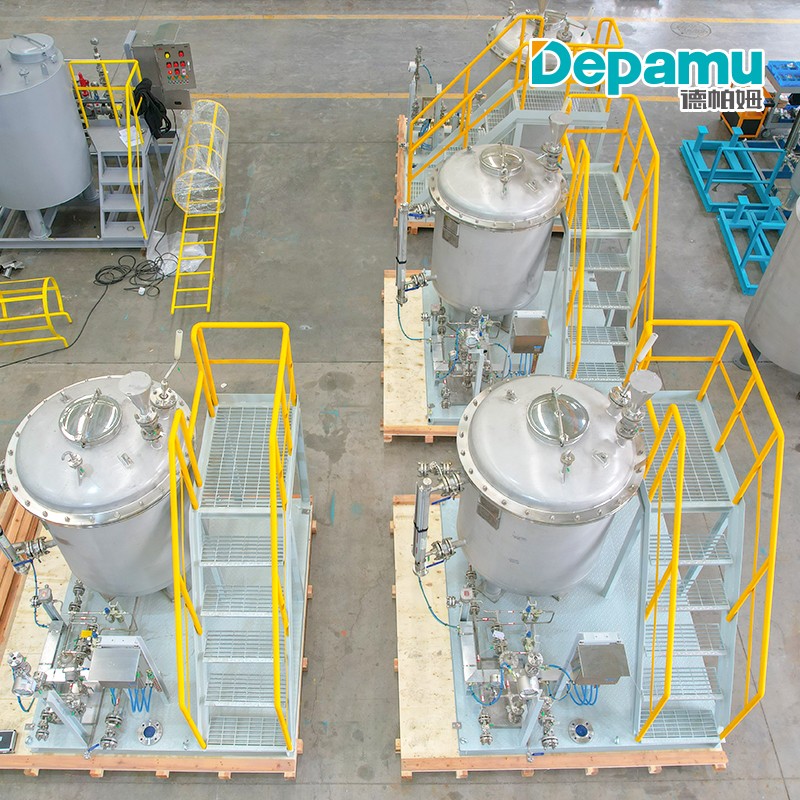
One of Depamu's most marketable competencies is its "Injection Package" (撬装设备). Instead of selling standalone pumps, Depamu provides pre-assembled skids that include solution tanks, pulsation dampeners, control valves, piping, and PLC-based automation systems .
The delivery of 29 such skids to the Kingfisher油田 in Uganda exemplifies this approach. The project required equipment that could handle the complex crude composition of the Albertine Graben while meeting stringent local content requirements. Depamu’s solution utilized an integrated combination of 2 or 4 pump heads per skid, allowing for the simultaneous injection of different chemicals—such as demulsifiers and corrosion inhibitors—from a single compact footprint .
3. Case Studies: From the South China Sea to East Africa
The validity of engineering is proven through operational history. Depamu’s resume includes deployments in some of the most geologically and logistically challenging environments in the world.
3.1 Deep-Sea Dominance: The CNOOC FPSO Project
In 2025, Depamu completed delivery of a "Super Large Water Injection Pump" for a CNOOC FPSO operating in the South China Sea. This platform is crucial for China's strategy to secure energy resources in deep-sea fields.
The specifications required were daunting. The pump had to support secondary oil recovery by injecting water into the reservoir to maintain pressure. Depamu delivered a unit powered by an 800kW motor capable of producing 30MPa of pressure while injecting 2,000 cubic meters of water per day .
While this water injection unit handles the bulk volume, the associated chemical injection skids regulate the water chemistry to prevent formation damage. Furthermore, the equipment met the DNV-GL (Det Norske Veritas) classification rules, which are mandatory for marine and offshore installations. The "耐盐雾腐蚀设计" (salt mist corrosion-resistant design) was specifically engineered to withstand the high humidity and saline atmosphere of the South China Sea, ensuring uptime in a region where maintenance windows are narrow and expensive .
3.2 Hydrate Inhibition and Flow Assurance
In deepwater or cold-environment pipelines, one of the biggest risks is hydrate formation—ice-like crystals that block flow lines. Depamu’s high-pressure methanol Injection Packages are designed to mitigate this risk.
These packages are engineered to inject methanol or ethylene glycol directly into the wellhead or pipeline at pressures capable of overcoming the line pressure (often exceeding 2,500 psi). The control systems in these units utilize frequency converters to adjust dosage based on real-time differential pressure and temperature readings, preventing waste of expensive inhibitors .
4. Breaking the Monopoly: The "470Bar" Milestone
Perhaps the most significant indicator of Depamu's technological maturity is its success in replacing imports in "stuck" applications. Historically, Chinese oilfields reliant on high-pressure injection for unconventional reservoirs had to purchase expensive, custom-built units from European manufacturers with long lead times.
According to industry reports, Depamu successfully developed a high-pressure reciprocating Diaphragm Pump capable of reaching 470 Bar (approx. 6,800 PSI). This achievement was specifically cited as a solution to a "bottleneck" problem, breaking the long-term foreign monopoly on such high-pressure equipment for the offshore sector .
Achieving 470 Bar in a diaphragm pump is not merely a matter of building a stronger casing. It requires solving the complex problem of diaphragm deflection under extreme fatigue loads. Depamu’s patent on the "integrated sleeve adjustable eccentric transmission mechanism" allows the pump to handle these immense loads while maintaining the precision necessary for metering. For state-owned enterprises like CNOOC and Sinopec, the localization of this technology reduces supply chain risk and capital expenditure by an estimated 30-40% compared to imported equivalents .
5. Automation and the Digital Interface
Modern oilfields are moving toward "smart" fields with minimal human intervention. Depamu has integrated Industry 4.0 concepts into its skid designs.
5.1 Real-Time Closed-Loop Control
The DPJY series features a PLC-based architecture that monitors pressure, flow, and temperature in real-time. The system automatically adjusts the pump stroke or motor speed to maintain the exact set point. In the CNOOC FPSO project, the system achieved a fault prediction accuracy rate of ≥99% . This level of predictive maintenance is vital for offshore platforms where a pump failure can lead to lost production costing millions of dollars per day.
5.2 Versatility in Media
A single oilfield requires dozens of different chemicals. Depamu’s specifications list demonstrates versatility across the pH scale and viscosity range. For upstream applications, they handle:
-
Demulsifiers: Breaking water-in-oil emulsions to meet export specs.
-
Corrosion Inhibitors: Protecting carbon steel pipelines from H2S and CO2.
-
Scale Inhibitors: Preventing calcium carbonate or sulfate scaling in near-wellbore formations.
-
Biocides: Controlling sulfate-reducing bacteria (SRB) that cause souring and corrosion .
6. Challenges and Future Outlook
Despite its technical achievements, Depamu faces the classic challenge of new entrants in the heavy machinery sector: brand equity in Western markets. While they hold API 674 and CE certifications, many international oil companies (IOCs) still default to legacy European brands for flagship projects.
However, the geopolitical shift toward de-risking supply chains works in Depamu’s favor. The concept of "China+1" strategies often leaves room for high-quality Chinese OEMs to serve as primary suppliers for Chinese NOCs operating internationally. The successful delivery of the Uganda project—a joint venture involving Chinese and international capital—serves as a global reference point .
Looking forward, Depamu is likely to focus on two areas:
-
Higher Pressures: As shale and tight oil exploitation expands via water fracturing, pumps capable of 1,000+ Bar will be needed.
-
Electrification: Replacing hydraulic or diesel-driven pumps with high-efficiency electric drives to reduce the carbon footprint of chemical injection.
7. Conclusion
Depamu Chemical Injection Pumps represent a convergence of global standards and local innovation. By mastering the "holy trinity" of oilfield pumping—high pressure (470 Bar), high flow (2,000 m³/day), and high accuracy (±0.5%)—Depamu has positioned itself as a critical supplier for the energy transition and energy security.
The company’s trajectory mirrors that of China’s industrial policy: moving from simple equipment manufacturing to complex, intelligent system integration. For the oil and gas industry, Depamu offers a viable, reliable, and cost-effective alternative to traditional Western suppliers. Whether preventing hydrates in the cold depths of the East Africa Rift or boosting recovery in the hot, saline spray of the South China Sea, the precision engineering of Depamu pumps is proving that high-pressure chemical injection is no longer a technological bottleneck, but an enabler of modern energy production.