

Depamu Mechanical Diaphragm Metering Pump Complying with CE: Dosing Pump Applications in the Water and Sewage Treatment Industry
1. Introduction
Precise chemical dosing is fundamental to modern water and wastewater treatment. Whether adjusting pH, removing phosphorus, disinfecting effluent, or conditioning sludge, the reliability of the dosing pump directly determines treatment effectiveness and operational cost. Mechanical Diaphragm Metering Pumps have become the preferred solution for these duties because they combine high metering accuracy with robust construction and low maintenance requirements.
Depamu (Hangzhou) Pumps Technology Co., Ltd., established in 2003 and located in Hangzhou Qiantang Area, is a high-tech enterprise specializing in the research, development, production, and sales of metering pumps, including plunger type, mechanical diaphragm type, and hydraulic diaphragm type models. The company's mechanical diaphragm metering pumps, particularly the DP Series and DPMFWSA Series, are engineered to deliver precise, repeatable dosing in the demanding conditions typical of municipal and industrial water treatment facilities. Critically, these products hold CE certification, confirming their compliance with the European Union's rigorous health, safety, and environmental protection standards.
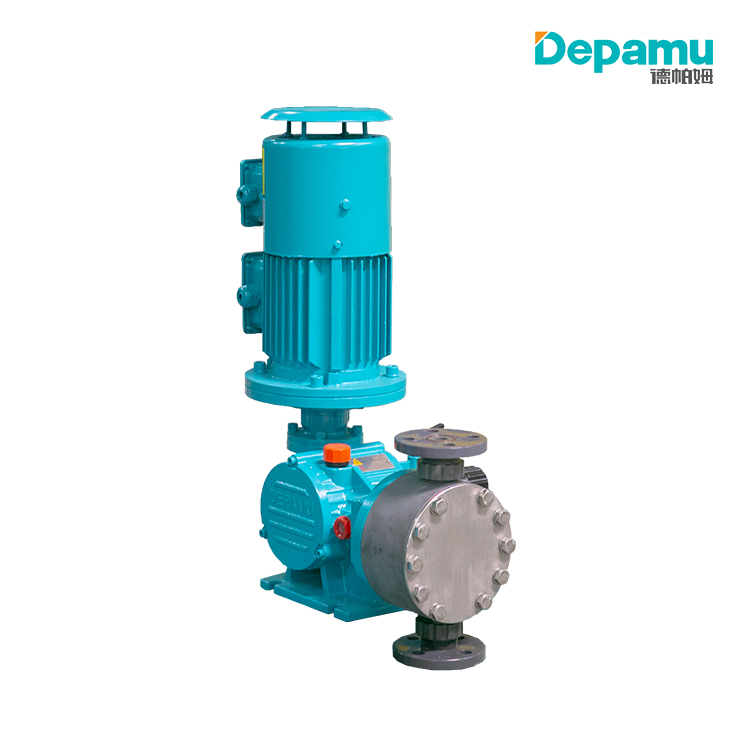
This article examines the technical characteristics of Depamu mechanical diaphragm metering pumps, the significance of their CE certification, and their specific applications in the water and sewage treatment industry.
2. Understanding CE Certification for Metering Pumps
The CE mark is a mandatory conformity marking for products sold within the European Economic Area (EEA). For industrial pumps, CE certification primarily involves compliance with the Machinery Directive 2006/42/EC, which establishes essential health and safety requirements for machinery. The directive requires that machinery be designed and constructed to eliminate or reduce risks to operators, maintenance personnel, and the environment.
For metering pumps, the harmonized standard EN 809 (Pumps and pump units for liquids — Common safety requirements) provides the technical framework for demonstrating compliance. Additionally, EN ISO 12100 (Safety of machinery — General principles for design) and the Low Voltage Directive 2014/35/EU, which covers electrical components, are typically applicable.
Depamu has passed CE certification alongside API, ISO 9001, ISO 14001, and ISO 45001 certifications, reflecting a comprehensive commitment to quality management, environmental responsibility, and occupational health and safety. The company adheres to API 674 and API 675 standards from the American Petroleum Institute, and its products have also obtained certifications from DNV and other international authorities.
For end users in the water and sewage treatment industry, CE certification provides concrete benefits. First, it ensures that the pump meets harmonized European safety standards, reducing liability risks for plant operators. Second, CE marking facilitates procurement in European markets and in countries that recognize European standards. Third, the certification process requires documented risk assessment, traceable manufacturing quality, and verified performance data — all of which provide assurance that the pump will perform reliably over its service life. For municipal utilities and engineering firms specifying equipment for international projects, CE certification is often a mandatory technical requirement.
3. Mechanical Diaphragm Metering Pump Technology
3.1 Working Principle
The mechanical diaphragm metering pump operates through a straightforward but highly precise mechanism. A motor drives a worm gear pair, which converts the rotary motion of the motor into reciprocating movement of a slide rod through an eccentric mechanism. The slide rod then drives the mechanical diaphragm to perform periodic deformation, thereby realizing fluid suction and discharge.
This design offers several inherent advantages for water treatment applications. Because the diaphragm separates the pumped fluid from the drive mechanism, only the pump head and diaphragm come into contact with the chemical being dosed, protecting the drive components from corrosive attack. The use of a PTFE diaphragm driven mechanically without a protection plate at the feeding side allows smooth material transfer and safe operation.
3.2 DP Series: High-Capacity Performance
The DP Series represents Depamu's high-capacity mechanical diaphragm metering pump, designed for demanding industrial environments. Key performance parameters include:
| Parameter | Specification |
|---|---|
| Maximum flow rate per head | 2,300 L/h |
| Maximum discharge pressure | 1.2 MPa |
| Allowable pumping temperature (PVC) | ≤40°C |
| Allowable pumping temperature (PTFE) | ≤80°C |
| Turndown ratio | 10:1 |
| Steady-state accuracy | ±2% |
| Maximum suction head lift | 4 m |
| Maximum inlet pressure | 2 bar |
These specifications make the DP Series suitable for high-flow dosing duties in large municipal wastewater treatment plants, where chemical feed rates may range from several hundred to several thousand liters per hour. The adjustable eccentric mechanism guarantees smooth and stable flow rate changes with minimal pulsation, and flow rate can be adjusted in both static and dynamic states with a range of 0–100%. The pump offers manual, electric, and variable frequency stroke adjustment options, with variable frequency motor power starting from 0.55 kW.
The power end features bath lubrication, which ensures a long service life of drive parts, while the hydraulic end can be configured with multiple materials and structures, including single or double Diaphragm Pump head options. Check valves are designed with a self-cleaning structure, and maintenance intervals extend to 4,000 hours at pressures up to 1.0 MPa and 8,000 hours at pressures up to 0.7 MPa.
3.3 DPMFWSA Series: Precision for Lower Flow Applications
For applications requiring lower flow rates with high precision, the DPMFWSA Series provides an ideal solution. This series delivers flow rates up to 150 L/h with maximum discharge pressure of 1.2 MPa and the same ±2% steady-state accuracy and 10:1 turndown ratio as the DP Series.
The power end of the DPMFWSA Series features a cast aluminum housing that provides good heat dissipation, lightweight construction, and surface plastic-spray treatment, making it well-suited for acid-base fluid transport while ensuring non-toxicity and no abnormal odor. The pump can be installed above a solution tank, which renders a high degree of safety — an important consideration when dosing hazardous chemicals. Manual stroke adjustment allows precise flow control in both static and dynamic states.
The DPMFWSA Series is specifically recommended for treatment processes involving municipal water, industrial water, wastewater, and swimming pool water. Its compact design and wide material compatibility — with wetted parts available in 304, 316, 316L stainless steel, PVC, PVDF, PP, and PTFE — make it adaptable to a broad range of chemical dosing requirements.
4. Applications in Water and Sewage Treatment
4.1 Chemical Dosing in Wastewater Treatment
Chemical dosing is most often used for the treatment of sewage, as part of the anaerobic digestion process for making energy from organic waste, and for cleaning industrial effluent before it is returned to natural water courses. Typical dosing applications include pH buffering, disinfection, phosphate removal, and lime dosing.
Depamu metering pumps are widely deployed across these applications. For pH correction, the pump must deliver precise volumes of acid or alkali to maintain effluent within regulatory limits. The ±2% steady-state accuracy of Depamu pumps ensures that pH setpoints are consistently achieved without over-dosing, which reduces chemical consumption and avoids the risk of residual chemicals entering receiving waters.
For phosphorus removal — a critical requirement in regions with stringent nutrient discharge standards — metal salts such as polyaluminium chloride (PAC) and ferric chloride must be dosed proportionally to influent flow. The turndown ratio of 10:1 allows the pump to track flow variations without loss of accuracy, accommodating the diurnal flow patterns typical of municipal wastewater treatment plants.
4.2 Polymer and Flocculant Dosing
Flocculation is a cornerstone of both drinking water and wastewater treatment. Depamu's automatic dissolving and Injection Packages are applicable to flocculation treatment for municipal or industrial wastewater, flocculation during sludge dewatering processes, and drinking water purification. The metering pump at the heart of these packages must handle viscous polymer solutions without clogging or loss of accuracy.
The DP Series is particularly well-suited to this duty because its adjustable eccentric mechanism maintains smooth flow with minimal pulsation, which is essential when dosing high-viscosity polyelectrolytes. The self-cleaning check valve structure further reduces the risk of fouling — a common problem when dosing polymer solutions that tend to form gels or deposits.
4.3 Disinfection and Odor Control
Disinfection of treated effluent is mandatory in most jurisdictions. Sodium hypochlorite, calcium hypochlorite, and peracetic acid are commonly used disinfectants, all of which are corrosive and require careful handling. The DPMFWSA Series, with its cast aluminum housing and optional wetted materials including PVC, PVDF, and PTFE, provides excellent chemical compatibility for these aggressive chemicals.
4.4 Chemical Feed Packages and Skid Systems
Beyond individual pumps, Depamu manufactures complete chemical dosing packages that integrate metering pumps, solution tanks, and electric control cabinets into skid-mounted units. These packages are applicable to boiler water feeding treatment, boiler water treatment, circulating treatment, raw water pretreatment, sewage treatment, and petrochemical industry applications.
A key feature of these packages is the ability to provide both working and standby pumps on the same skid. This redundancy ensures uninterrupted chemical dosing during pump maintenance or unexpected failure — a critical requirement for municipal treatment plants that must meet discharge permits 24 hours a day, 365 days a year. The metering pump on the device can be provided with a working pump and standby pump at will according to demands, with automatic switchover available.
4.5 Integrated Water Treatment Solutions
Depamu's product ecosystem extends beyond metering pumps to include water-steam sampling devices, water-treatment equipment, and supercritical fluid equipment. This integration capability allows the company to supply complete chemical dosing and water treatment solutions rather than individual components. Products are widely applied to oil and gas field exploitation, nuclear power, chemical, electricity, pulp and paper, pharmacy, food, new energy, and environmental protection industries. The company has established long-term strategic partnerships with large-scale enterprises including CNPC, SINOPEC, CNOOC, and CNNC, and its products have been exported to over 50 countries and regions including the USA, the UK, and France.
5. Why Depamu Mechanical Diaphragm Pumps Excel in Water Treatment
Several design features make Depamu mechanical diaphragm metering pumps particularly well-suited to the water and sewage treatment industry:
Hermetic separation of fluid and mechanism. The diaphragm completely isolates the pumped chemical from the drive components, eliminating leakage and protecting the pump from corrosive attack. This is essential when dosing hazardous or aggressive chemicals.
High metering accuracy. With ±2% steady-state accuracy and a 10:1 turndown ratio, Depamu pumps deliver precise chemical volumes across the full operating range. This accuracy translates directly into chemical cost savings and consistent treatment performance.
Adjustable flow in operation. The ability to adjust flow rate in both static and dynamic states — manually or via electric or variable frequency control — allows operators to respond to changing treatment conditions without shutting down the pump.
Extended maintenance intervals. With maintenance periods of up to 8,000 hours at moderate pressures, Depamu pumps minimize downtime and reduce total cost of ownership. The self-cleaning check valve design further extends service life when handling fouling-prone chemicals.
Comprehensive material options. Wetted parts can be specified in 304, 316, 316L stainless steel, PVC, PVDF, PP, and PTFE, enabling compatibility with virtually any chemical used in water treatment.
CE compliance. CE certification provides independent verification that the pump meets European safety and quality standards, giving plant operators and engineering firms confidence in the equipment's reliability and regulatory compliance.
6. Conclusion
The water and sewage treatment industry demands dosing equipment that is accurate, reliable, and safe. Depamu's mechanical diaphragm metering pumps — the DP Series for high-flow applications and the DPMFWSA Series for precision lower-flow duties — deliver on all three counts. Their CE certification confirms compliance with the EU Machinery Directive and harmonized standards, providing assurance to plant operators and procurement teams worldwide.
From pH correction and phosphorus removal to polymer flocculation and disinfection, Depamu metering pumps and chemical dosing packages provide the precise, controllable chemical injection that modern treatment processes require. Backed by more than 100 technical patents, multiple international certifications, and a global footprint spanning over 50 countries, Depamu continues to advance fluid transfer technology for the environmental protection and water treatment industries. As discharge standards tighten and the demand for water reuse grows, the role of accurate, reliable dosing will only become more critical — and mechanical diaphragm metering pumps that comply with CE standards will remain at the center of these essential treatment processes.