

Depamu Progressive Cavity Single Screw Pump for Sewage Sludge / Polymer Chemicals Dosing
Introduction
In the demanding landscapes of municipal wastewater treatment and industrial chemical processing, the reliable transfer of difficult fluids remains a cornerstone of operational success. From the abrasive, high-solids nature of sewage sludge to the precise metering requirements of polymer flocculants, the equipment selected must navigate a complex matrix of viscosity, solids content, and chemical aggression. The progressive cavity (PC) pump, a positive displacement technology recognized for its ability to handle such challenging media with minimal shear, has emerged as an industry standard . Among the manufacturers of this technology, Depamu (Hangzhou) Pumps Technology Co., Ltd. has established itself as a significant player. This article examines the Depamu progressive cavity single screw pump, analyzing its operational principles, key features, and suitability for the twin critical applications of sewage sludge transfer and polymer chemical dosing.
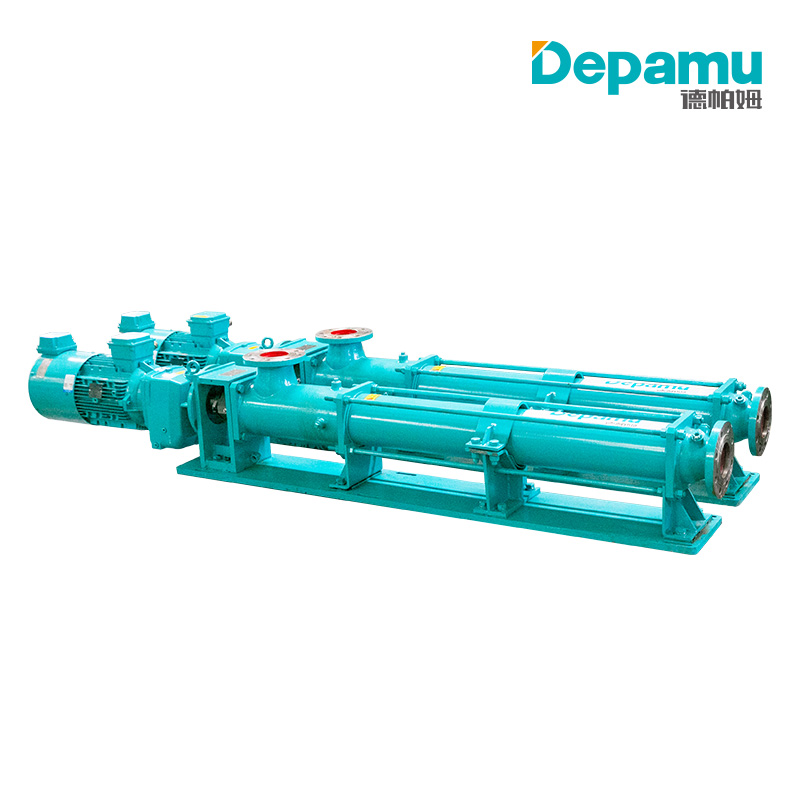
Operational Principle and Design
The functionality of the Depamu progressive cavity pump is rooted in a design that has proven effective for over nine decades. The pump consists of two primary components: a single external-thread helical rotor, typically made of metal, and a double internal-thread stator, usually manufactured from an elastomer such as natural rubber (NR), nitrile (NBR), or fluorocarbon (FPM) . The rotor turns eccentrically within the stator, creating a continuous, interference-fit seal. This action forms a series of sealed, discrete cavities that progress linearly from the suction to the discharge port as the rotor rotates .
This mechanism defines the pump's key advantages. The cavities move the fluid without significant compression or turbulence, resulting in a smooth, virtually pulsation-free flow . This low-shear characteristic is vital for handling shear-sensitive fluids, such as polymer solutions, where mechanical degradation would compromise the chemical's effectiveness . Furthermore, the positive displacement nature of the design allows for consistent volumetric flow, which is directly proportional to the rotational speed, making it an inherently suitable platform for precise metering and dosing applications.
Engineering and Performance Specifications
Depamu manufactures its progressive cavity pumps according to the API 676 standard, ensuring a baseline of quality and performance for industrial applications . The company's product line demonstrates a significant capacity for handling difficult media. According to Depamu specifications, their pumps can handle fluids with a viscosity up to 2 million centipoise (cP) and slurries with a solid content of up to 60% . This capability places them firmly in the realm required for demanding sludge transfer duties.
The flow rate range is extensive, spanning from 0.1 to 3000 m³/h, with a maximum discharge pressure reaching 1.5 MPa for standard configurations . For applications requiring higher pressures, a multistage design can achieve up to 3.0 MPa . A notable feature of Depamu's design is the double support structure, which enhances rotor stability and contributes to higher achievable pressures and a longer operational lifespan . The pumps also boast excellent self-priming capabilities, with a maximum suction lift of up to 9 meters, a feature that simplifies installation and operation .
Application: Sewage Sludge Transfer
Sewage sludge is a notoriously challenging medium. Often defined as containing 1% to 12% solids, it is an abrasive, viscous, and non-homogeneous fluid that can contain grit and fibrous materials . The pumping of this material—from primary and secondary clarifiers to digesters, thickeners, and dewatering equipment—requires a pump that can handle high solids content and maintain efficiency under challenging conditions .
The Depamu progressive cavity pump is well-suited for this duty. Its construction, with a metal rotor and a resilient elastomer stator, is inherently designed to accommodate abrasive particulates. The ability to pass incompressible materials up to 80mm in diameter minimizes the risk of blockages, a common problem with other pump types . Moreover, because flow rate is a function of speed, operators can reduce pump RPM to manage wear from abrasives, a key operational strategy to extend the life of the rotor and stator components . The availability of specialized stator materials, such as NBR and FPM, ensures compatibility with the chemical and thermal characteristics of the sludge being handled .
Application: Polymer Chemicals Dosing
In water and wastewater treatment, polymer flocculants are crucial for enhancing solids separation and dewatering performance. The effectiveness of these high-molecular-weight polymers is highly dependent on their molecular chain structure. Subjecting them to high shear forces or turbulence, as might occur in a centrifugal pump, can break these chains, reducing the polymer's effectiveness and increasing chemical costs.
The progressive cavity pump is the preferred technology for polymer dosing due to its inherently low-shear operation. The smooth, gentle conveyance through the pump's cavities preserves the polymer's molecular integrity . The pump's flow rate, which can be precisely and reliably controlled via speed adjustment, makes it ideal for the accurate metering of polymer solutions into the process stream . Depamu highlights the low pulsation of their pumps as a key benefit, ensuring a consistent, uniform chemical feed without the need for complex damping systems . This precision is not limited to polymers; the same principles apply to the dosing of other treatment chemicals, including coagulants and lime slurry .
Conclusion
The Depamu progressive cavity single screw pump represents a purpose-built solution for the most demanding fluid handling challenges in environmental and chemical processing. Its design, which creates a series of moving cavities, directly addresses the need for a pump that can convey high-solids, viscous, and abrasive fluids—like sewage sludge—without the risk of blockages or excessive wear. Simultaneously, the pump's gentle, low-shear action and precise flow control make it the industry standard for metering sensitive polymer chemicals, where maintaining product integrity is paramount . By combining robust construction, adherence to international standards like API 676, and a wide range of material options, Depamu provides a versatile and reliable platform for these critical applications, contributing to the efficiency and reliability of modern industrial and municipal operations .