

Depamu Diaphragm Metering Pump for Polyethylene Plant
Abstract
Polyethylene production represents one of the most demanding industrial applications for fluid handling equipment. The precise injection of catalysts, co-catalysts, and chemical additives into high-pressure reactor systems requires metering pumps that deliver exceptional accuracy, reliability, and safety. Depamu diaphragm metering pumps have emerged as a competitive solution for these critical services, offering advanced engineering features specifically designed to meet the rigorous demands of polyethylene manufacturing. This article examines the technical characteristics, operational advantages, and application considerations of Depamu mechanical and Hydraulic Diaphragm Metering Pumps in polyethylene plant environments.
1. Introduction
With over 60 million tons of polyethylene manufactured annually worldwide, the production of this ubiquitous plastic represents a cornerstone of the global chemical industry. The manufacturing process involves the catalytic polymerization of ethylene monomers under high pressure and temperature, requiring precise dosing of catalysts and chemical agents at critical stages of production. The consequences of inaccurate metering can be severe—ranging from off-specification product to catastrophic reactor failures costing hundreds of thousands of dollars per hour in lost production.
In this demanding environment, diaphragm metering pumps have become the technology of choice for critical chemical injection services. Unlike plunger-type pumps, Diaphragm Pumps eliminate dynamic seals that could leak hazardous or volatile process fluids, making them inherently safer for handling the toxic and flammable chemicals common in polyethylene production. Depamu (Hangzhou) Pumps Technology Co., Ltd., with over 17 years of industry presence, offers a comprehensive range of diaphragm metering pumps engineered for these demanding applications.
2. Technical Fundamentals of Depamu Diaphragm Metering Pumps
2.1 Mechanical Diaphragm Design
The Depamu Mechanical Diaphragm Metering Pump operates on a principle that combines simplicity with reliability. An electric motor drives a worm gear pair, converting rotational motion into reciprocating movement through an eccentric mechanism. This reciprocating motion is transmitted via a slide rod to a mechanical PTFE diaphragm, which undergoes periodic deformation to alternately draw fluid into and discharge it from the pump head.
The design features several notable engineering innovations. The eccentric mechanism incorporates a patented integrated sleeve adjustable configuration that ensures smooth, stable flow with minimal pulsation. The diaphragm itself undergoes uniform grinding during manufacturing, enhancing durability and service life. Furthermore, the static seal design at the hydraulic end replaces the dynamic seals traditionally used in plunger pumps, fundamentally eliminating leakage pathways—a critical advantage when handling hazardous process chemicals.
2.2 Double Diaphragm Safety Systems
For applications where process integrity is paramount, Depamu offers double PTFE diaphragm configurations. This redundant design provides exceptional corrosion resistance and leakage prevention. Perhaps most significantly, these pumps incorporate a diaphragm status monitoring system that detects rupture of the primary diaphragm. Upon detection, the system can either send an alarm signal while the pump continues operating on the backup diaphragm, or initiate immediate shutdown—preventing contamination of process fluids and avoiding hazardous chemical release.
2.3 Hydraulic Diaphragm Alternative
For higher-pressure applications common in polyethylene reactor services, Depamu offers hydraulic diaphragm metering pump variants. These pumps utilize a hydraulic fluid system to actuate the diaphragm, incorporating built-in automatic air release, pressure relief, and oil replenishment functions. The hydraulic design enables much higher discharge pressures—up to 18 MPa (2,600 psi) in some configurations—while maintaining excellent metering accuracy.
The hydraulic diaphragm configuration operates with balanced pressure between the hydraulic fluid and process fluid sides of the diaphragm. This pressure equilibrium minimizes diaphragm stress, contributing to exceptional longevity—industry benchmarks for similar technology suggest service lives up to 96,000 hours (approximately 10 years of continuous operation) with minimal maintenance.
3. Critical Performance Parameters
3.1 Flow Capacity and Pressure Range
Depamu diaphragm metering pumps are available in configurations covering a broad spectrum of process requirements. The 2DPMFXAA series, for instance, offers single-head flow rates up to 3,200 L/h at discharge pressures up to 0.6 MPa. For higher-pressure applications, the DP(M)ZA hydraulic diaphragm series can deliver flows up to 2,800 L/h at pressures reaching 18 MPa, with various intermediate configurations to match specific process conditions.
The broad pressure and flow ranges enable plant designers to specify Depamu pumps for various applications, including:
-
Catalyst injection to polymerization reactors
-
Co-catalyst and activator metering
-
Additive and stabilizer dosing
-
Chemical package injection for process control
3.2 Metering Accuracy and Turndown Ratio
Precision metering is non-negotiable in polyethylene production. As industry experts emphasize, metering pumps must deliver ±1% steady-state accuracy with turndown ratios of 100:1 or greater to accommodate the dynamic nature of chemical processing. Depamu mechanical diaphragm pumps achieve ±2% steady-state accuracy with 10:1 turndown ratios for standard configurations. While this meets many process requirements, the hydraulic diaphragm variants offer enhanced performance with ±1% metering accuracy and the ability to adjust flow across the full 0-100% range.
Flow adjustment can be performed while the pump is running or stopped, providing operational flexibility that is particularly valuable in continuous production environments. Multiple adjustment options are available—manual, electric, pneumatic, and frequency conversion (variable speed)—allowing integration with plant automation systems.
3.3 Material Compatibility
The aggressive nature of polyethylene process chemicals demands careful material selection for wetted pump components. Depamu provides extensive material options, including 304 and 316 stainless steel, 316L, PVC, PTFE, PVDF, and PP. For high-temperature applications, PTFE-rated components can handle fluid temperatures up to 80°C, while PVC variants are suitable for lower-temperature services up to 40°C.
For critical catalyst injection services, Gylon or other specialized diaphragm materials may be specified, similar to the custom solutions engineered by manufacturers for the most demanding applications.
4. Safety and Reliability Features
4.1 Leak-Free Operation
The elimination of rotating seals in diaphragm pump designs provides inherent safety advantages for polyethylene plants. Because hydrocarbons can ignite when mixed with air, metering pumps used in these applications should not have any rotating seals that could potentially leak. Depamu's diaphragm pumps achieve this objective through sealed diaphragm designs, with double diaphragm configurations providing an additional layer of protection.
4.2 Self-Cleaning Check Valves
Processing challenges in polyethylene plants often include handling fluids with solids content or high viscosity. Depamu addresses this with self-cleaning check valve structures that prevent clogging and maintain consistent flow performance. This feature is particularly important when pumping catalyst slurries or other fluids containing particulates that could otherwise cause valve failure.
4.3 Maintenance and Lifecycle Considerations
Predictive maintenance is essential for minimizing costly production interruptions. Depamu mechanical diaphragm pumps have specified maintenance intervals of 4,000 hours at pressures up to 1.0 MPa, extending to 8,000 hours at pressures below 0.7 MPa. For hydraulic diaphragm designs, the balanced diaphragm principle yields even longer service life—a critical factor in 24/7 continuous operations where unplanned downtime can be catastrophic.
The simpler mechanical design offers easier maintenance compared to hydraulically driven alternatives, as the direct mechanical actuation eliminates the additional hydraulic system complexity.
5. Application to Polyethylene Production
5.1 Critical Service Requirements
Polyethylene reactors typically operate at pressures ranging from moderate to very high, with accurate catalyst injection being essential for product quality and process control. Industry case studies highlight the consequences of inadequate metering pump performance: a major polyethylene plant experienced numerous failures with competitors' pumps, leading to catalytic reactor unit shutdowns and losses of hundreds of thousands of dollars per hour.
Depamu pumps are engineered specifically to meet critical service requirements, with features including:
-
Customizable liquid ends to match specific process chemistry
-
Explosion-proof motor options (applicable for hazardous area classification)
-
Compatibility with polyethylene process conditions through appropriate material selection
-
Multiple pump head configurations for flexibility in system design
5.2 Chemical Injection Package Integration
For turnkey chemical dosing solutions, Depamu offers Chemical Injection Packages combining metering pumps with solution tanks, valves, piping, instrumentation, and electrical controls on a common skid. These packages are applicable to boiler feed water treatment, circulating water treatment, and petroleum chemical applications. For polyethylene plants, such packages can be customized to include multiple working and standby pumps, ensuring uninterrupted operation even during maintenance.
The integrated package design offers significant advantages: compact footprint, reduced installation complexity, and guaranteed compatibility among components. Solution tanks can be fabricated from 304 or 316 stainless steel, carbon steel with linings, FRP, or other materials to suit specific chemical compatibility requirements.
5.3 Multiplex Configurations
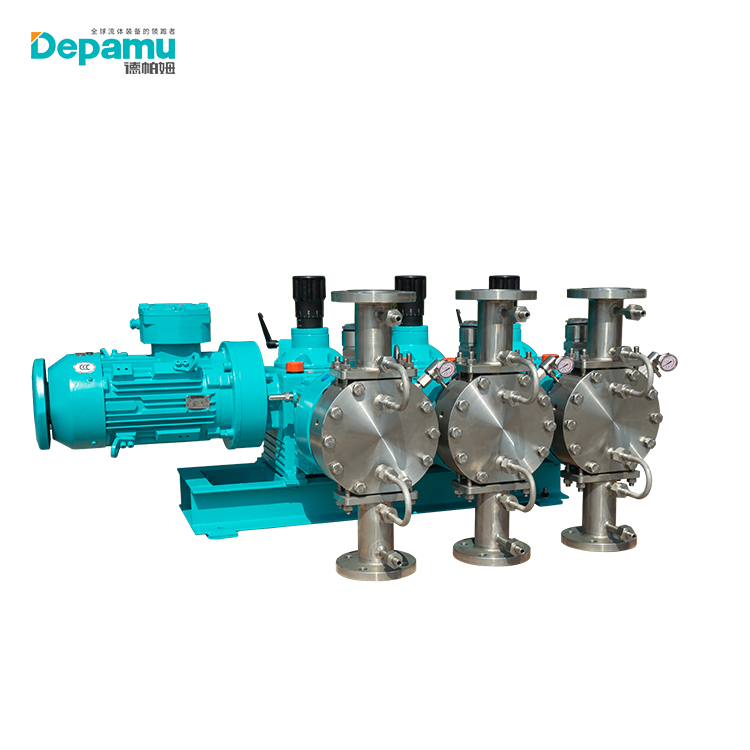
When multiple chemical streams must be injected simultaneously, Depamu can configure up to twelve pump heads in parallel on a single drive. This multiplex arrangement offers two distinct operational modes: all heads can pump the same medium to reduce pulsation, or different heads can pump different media independently, functioning as a proportioning pump with independent flow adjustment for each head. This flexibility is particularly valuable in polyethylene production where multiple catalyst and additive streams must be introduced simultaneously.
6. Comparative Considerations
Industry benchmarking for critical chemical processing metering pumps has identified several "most effective technology" characteristics: accuracy, reliability, flexibility, and safety. Evaluating Depamu pumps against these criteria reveals competitive positioning:
Accuracy: Hydraulic diaphragm variants meet the ±1% industry standard, while mechanical versions achieve ±2%—sufficient for many applications but falling short of the most demanding catalyst injection services.
Reliability: The combination of double diaphragm technology and status monitoring provides exceptional reliability for critical services. The mechanical simplicity of Depamu's design may offer advantages in maintainability compared to more complex systems.
Flexibility: Modular design with multiple material options, stroke adjustment methods, and multiplex configurations provides the flexibility required for diverse process requirements.
Safety: Leak-proof static seals, double diaphragm rupture detection, and explosion-proof motor options address key safety concerns in polyethylene production.
7. Conclusion
Depamu diaphragm metering pumps offer a comprehensive solution for critical chemical injection applications in polyethylene plants. The product line encompasses both mechanical and hydraulic diaphragm designs, providing flexibility to match specific process requirements from low-pressure chemical dosing to high-pressure catalyst injection. Key differentiators include double PTFE diaphragm construction with rupture detection, self-cleaning check valves, broad material compatibility, and multiplex configuration options.
For plant engineers and operators, Depamu pumps address the fundamental challenges of polyethylene production: maintaining accurate catalyst dosing to ensure product quality, preventing hazardous leaks through seal-less diaphragm design, and maximizing uptime through robust construction and predictive maintenance capabilities. The integration of these pumps into complete chemical injection packages further simplifies installation and commissioning.
As the polyethylene industry continues to expand—driven in part by increased feedstock availability from shale gas production—the demand for reliable, accurate, and safe metering technology will only grow. Depamu's position as an established supplier with over 17 years of industry experience and a comprehensive product portfolio suggests its continued relevance in this demanding application space