

Depamu Reliable Reciprocating Pump for Steam Boiler Feed in Mining
Introduction
Steam boilers occupy a critical position in mining operations, providing essential thermal energy for ore processing, material drying, heating systems, and various industrial procedures. The uninterrupted supply of feedwater to these boilers is not merely a matter of operational efficiency—it is a fundamental safety requirement and a cornerstone of productivity in some of the world's most demanding industrial environments. Within this context, the selection of an appropriate boiler feed pump represents one of the most consequential engineering decisions that mining operators must make.
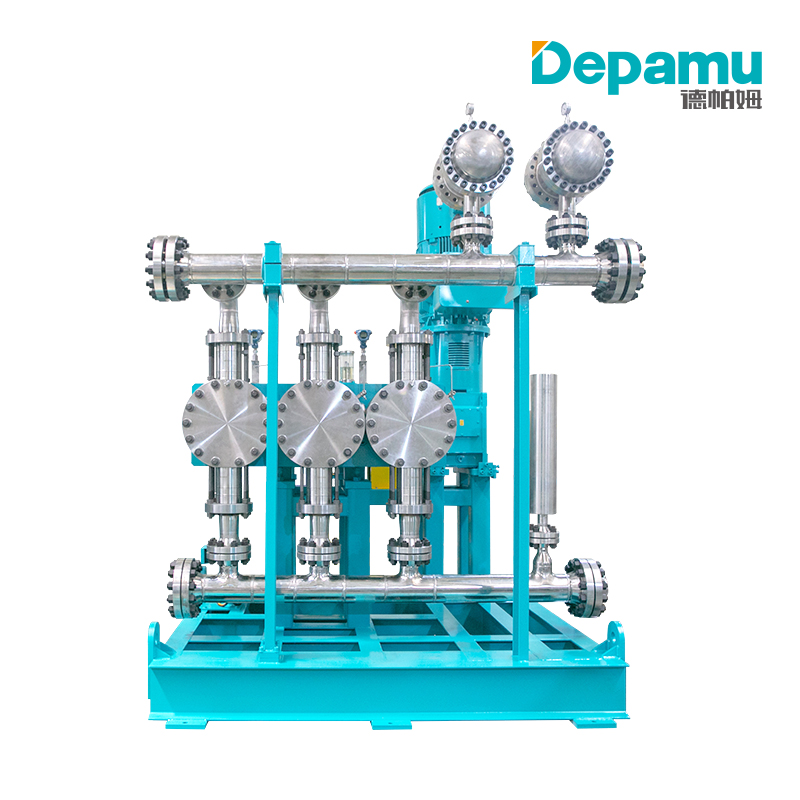
Depamu, a technology enterprise integrating research and development, production, and sales, has established itself as a prominent manufacturer of high-pressure Reciprocating Pumps, Metering Pumps, and process Diaphragm Pumps. Among its extensive product portfolio, the company's High-Pressure Reciprocating Pumps—particularly those in the HD series—have demonstrated exceptional reliability and performance in steam boiler feed applications across the mining sector. This article examines the technical foundations, operational advantages, and practical implementations of Depamu reciprocating pumps in mining boiler feed systems, providing a comprehensive analysis of why these pumps represent a superior choice for this demanding application.
The Critical Role of Boiler Feed Pumps in Mining Operations
The steam boiler feed pump is arguably the single most important auxiliary component in any boiler plant. As authoritative engineering guidelines emphasize, it must operate continuously whenever the boiler is in service, discharging at a rate equal to the boiler's rated capacity. The consequences of feed pump failure are severe: inadequate water supply can lead to boiler tube rupture, catastrophic equipment damage, and potentially life-threatening accidents. Regulatory codes universally require that boilers be equipped with at least two methods of feeding water to ensure an adequate supply is available at all times.
In mining environments, these challenges are amplified considerably. The remote locations of many mining operations make maintenance access difficult and equipment replacement time-consuming. The atmospheric conditions—often characterized by high dust concentrations, extreme temperatures, and corrosive elements—place additional stress on mechanical equipment. Furthermore, the feedwater quality in mining operations frequently presents complications not encountered in conventional power plants. Mine water often contains dissolved minerals, suspended particles, and acidic compounds that can corrode or foul pump components, necessitating robust, wear-resistant designs.
Steam boilers in mining operations are typically located at the surface rather than underground, as underground installations would require extensive excavation, ventilation systems, and fuel transportation infrastructure that would be prohibitively expensive and impractical. This surface placement means that feedwater must be pumped from available sources—which may include treated mine water, borehole water, or stored rainwater—into the boiler at pressures sufficient to overcome boiler steam pressure and piping resistance.
Why Reciprocating Pumps Excel in Boiler Feed Applications
The historical preference for reciprocating positive-displacement pumps in boiler feed service stems from their fundamental design characteristics, which align remarkably well with the requirements of this application. Reciprocating pumps are inherently high-pressure devices, capable of generating discharge pressures that centrifugal pumps cannot easily match, particularly at low flow rates. Commercial reciprocating pumps are available in configurations delivering discharge pressures to 3,000 psi and above, with some specialized designs reaching far higher ratings.
The efficiency of reciprocating pumps in boiler feed service has been documented at 80% to 95%, a figure that substantially exceeds the typical performance of alternative pump types in comparable applications. This high efficiency translates directly into reduced energy consumption and lower operational costs—a significant consideration in mining operations where energy expenses constitute a major portion of total production costs.
Equally important is the characteristic relationship between flow rate and pressure in reciprocating pumps. Unlike centrifugal pumps, whose flow decreases dramatically as system pressure increases, reciprocating pumps maintain essentially constant flow regardless of discharge pressure variations. This means that the pump will deliver the required volume of feedwater even when boiler pressure fluctuates due to varying steam demand—a common occurrence in mining operations where steam consumption patterns may vary significantly throughout the working day.
The suction performance of reciprocating pumps also merits attention. These pumps exhibit excellent priming characteristics and can handle fluids at elevated temperatures without the cavitation problems that plague centrifugal pumps operating under similar conditions. The pump's performance does not vary significantly with changes in fluid viscosity or pressure, providing reliable operation across a wide range of feedwater conditions.
Depamu's Technical Solutions for Mining Boiler Feed
Depamu's high-pressure reciprocating pumps, designed according to the American Petroleum Institute standard API 674, represent the culmination of extensive research and engineering expertise. The API 674 standard specifies requirements for positive displacement pumps used in petroleum, petrochemical, and natural gas industries—a standard that, by extension, ensures reliability in the most demanding industrial environments.
The HD series pumps, including models such as the HD3E(M), HD3H(M), HD3M(M), and HD5J(M), offer performance characteristics well-suited to boiler feed applications. The HD3E(M) model, for instance, delivers flow rates ranging from 0.76 to 10.74 m³/h with discharge pressures from 3.1 to 50.9 MPa, while the HD3H(M) provides flow rates from 2.74 to 32.14 m³/h at pressures from 2.2 to 41.6 MPa. These performance envelopes encompass the typical requirements of industrial steam boilers used in mining operations.
A distinctive technical feature of Depamu's reciprocating pumps is the low-speed, high-load connecting rod design. The connecting rod and main shaft employ roller bearings rather than conventional bushing connections, resulting in a small friction coefficient and low heat generation. This design choice is particularly significant for boiler feed applications, where pumps must often operate continuously for extended periods. While bushing connections under sliding friction cannot form an adequate oil film during low-speed operation, roller bearings maintain effective lubrication regardless of pump speed, ensuring reliable performance even under demanding operating conditions.
The forced lubrication system in the power end further enhances reliability by ensuring long-term stable operation at very low speeds. This is particularly important in mining applications where pumps may operate under variable load conditions and where maintenance intervals are necessarily extended due to logistical constraints.
For applications involving abrasive or corrosive feedwater—common in mining environments—Depamu offers process diaphragm pump configurations that ensure no leakage during transportation of toxic, flammable, or abrasive media. The design separates the pumped fluid from the pump head through a hose diaphragm, eliminating wear and leakage concerns. A diaphragm rupture alarm function provides real-time monitoring, ensuring absolutely secure delivery without any leakage even when handling hazardous fluids.
Reliability Features for Harsh Mining Environments
The operational environment of a mining site presents unique challenges that demand specific design considerations. Dust, vibration, temperature extremes, and the constant presence of abrasive particles require that equipment be constructed to withstand conditions far more severe than those encountered in typical industrial settings.
Depamu's reciprocating pumps incorporate several features specifically addressing these challenges. The modular design and inlet/outlet valve jacket design facilitate maintenance operations, allowing components to be serviced or replaced without extensive disassembly. This is particularly valuable in mining locations where specialized maintenance expertise may be limited and where downtime translates directly into lost production.
The materials of construction for wetted parts can be specified as alloy steel, stainless steel, dual-phase steel, titanium, or Hastelloy, depending on the specific corrosivity of the feedwater. This material flexibility ensures that the pump can be optimized for the particular water chemistry encountered at each mining site, extending service life and reducing maintenance costs.
The pump's ability to handle highly viscous fluids with particles is another advantage in mining boiler feed applications. While boiler feedwater is typically treated to remove suspended solids, upset conditions or treatment system failures can introduce particulate matter into the feed stream. Depamu pumps, with their direct-through wheel and end pump head cavity design without unthreaded parts, are especially suitable for such conditions, providing a margin of operational tolerance that alternative pump designs cannot match.
Depamu pumps can be configured with various drive options, including electric motors, diesel engines, or solar power, and can be installed in horizontal, vertical, stationary, or mobile configurations. This adaptability ensures that the pump can be integrated into virtually any boiler feed system design, whether for a permanent installation at a large mining complex or a temporary setup at a remote exploration site.
Performance Data and Operational Efficiency
The quantitative performance of Depamu reciprocating pumps in boiler feed applications demonstrates their suitability for mining operations. The HD series pumps achieve volumetric efficiencies exceeding 95% and mechanical efficiencies of 90%, surpassing API standards. This high efficiency is maintained across the pump's operating range, ensuring consistent performance even as boiler load varies.
The flow rate of Depamu pumps can be adjusted through variable frequency speed control or by changing the pump speed, providing operational flexibility that matches the variable steam demand typical of mining operations. The flow range of 1 to 450 m³ and pressure range of 0 to 34.5 MPa for the broader product line encompass virtually all boiler feed requirements encountered in mining applications.
The long service life of Depamu pumps—with a design life of 20 years for comparable API 674-compliant models—reduces total cost of ownership by minimizing replacement frequency and associated downtime. In mining operations where equipment replacement requires significant logistical planning and expense, this extended service life represents a substantial economic advantage.
Case Study: Operational Experience in Mining
The practical value of Depamu reciprocating pumps in mining boiler feed applications is best illustrated through operational experience. While specific case studies involving Depamu pumps in mining are proprietary, the general experience of mining companies with high-quality boiler feed pumps provides instructive context.
A mining company in Guangxi, China, procured boiler feedwater pumps for its steam generation facility. After installation, the pumps achieved stabilized pressure meeting design standards, with no leaks and no noticeable vibrations. The failure rate dropped significantly, essentially achieving maintenance-free continuous operation. This experience is consistent with the design philosophy underlying Depamu's pump engineering—prioritizing reliability and durability to minimize unplanned downtime.
The use of reciprocating pumps for boiler feed in mining applications has a long historical precedent. Early mining operations recognized the necessity of robust, reliable feedwater supply systems, and reciprocating pumps were the preferred choice due to their positive displacement action and ability to generate high pressures. Modern Depamu pumps build upon this proven foundation while incorporating contemporary materials science, precision manufacturing, and control technology to achieve performance levels that earlier generations of equipment could not approach.
Installation and Maintenance Considerations
Successful implementation of Depamu reciprocating pumps in mining boiler feed systems requires attention to proper installation and maintenance practices. The pump should be positioned to provide adequate net positive suction head (NPSH) to prevent cavitation, particularly when handling hot feedwater. Proper piping design, including adequate support and expansion provisions, ensures that mechanical stresses are not transmitted to the pump casing.
The modular construction of Depamu pumps facilitates maintenance operations. The stuffing box can be removed without pump disassembly, and valves are provided in cartridge form for easy removal and replacement. This design consideration significantly reduces maintenance time and the level of technical expertise required for servicing—important factors in remote mining locations.
Regular monitoring of pump performance characteristics allows operators to detect developing issues before they result in failure. Parameters such as discharge pressure, flow rate, vibration levels, and lubricating oil condition should be tracked and trended to identify deviations from normal operating conditions. This predictive maintenance approach enables planned interventions rather than emergency repairs, minimizing the impact on boiler availability.
Conclusion
The selection of a boiler feed pump for mining applications requires careful consideration of the unique demands imposed by this operating environment. Reliability, efficiency, pressure capability, and maintainability are all critical factors that must be balanced against economic considerations and logistical constraints.
Depamu's high-pressure reciprocating pumps, designed to API 674 standards and incorporating advanced features such as low-speed high-load connecting rod design, forced lubrication systems, and diaphragm rupture detection, offer a compelling solution for mining boiler feed applications. The pumps' high efficiency, stable flow characteristics regardless of pressure variations, and exceptional durability make them well-suited to the challenging conditions encountered in mining operations.
As mining companies continue to seek ways to improve operational efficiency and reduce unplanned downtime, the role of reliable boiler feed pumps becomes increasingly significant. Depamu's commitment to quality, innovation, and customer satisfaction—evidenced by its extensive patent portfolio and worldwide market presence—positions the company as a trusted partner for mining operations requiring dependable steam boiler feed solutions. The integration of Depamu reciprocating pumps into mining boiler feed systems represents not merely an equipment selection decision, but an investment in operational reliability and long-term productivity.