

Depamu High-Pressure Diaphragm Pumps in Liquid Carbon Dioxide and Monoamine Phosphate Services
Introduction
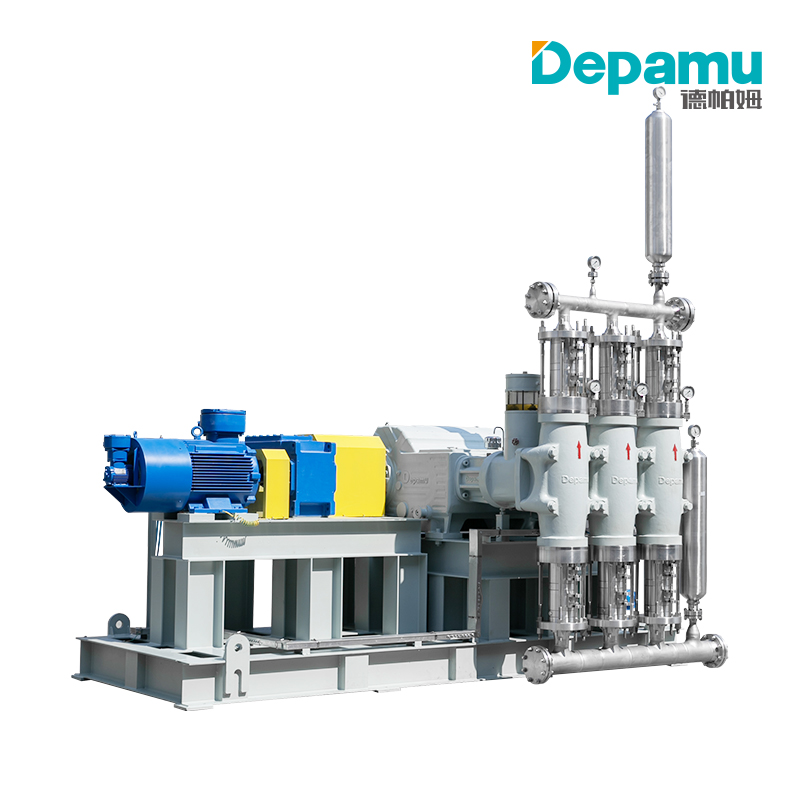
In the landscape of industrial fluid handling, few applications present challenges as formidable as the transfer and metering of liquefied gases and reactive chemical compounds. Liquid carbon dioxide (CO₂) and monoamine phosphate (MAP)—also known as ammonium dihydrogen phosphate (NH₄H₂PO₄)—represent two such demanding media. Their unique physical and chemical properties require pumping solutions that transcend conventional designs. DEPAMU high-pressure diaphragm pumps have emerged as a specialized solution for these services, combining robust engineering with the precision required for critical industrial processes. This article examines the technical requirements of handling liquid CO₂ and monoamine phosphate, the design philosophy behind DEPAMU's diaphragm pump technology, and the specific applications where these pumps demonstrate their capabilities.
Understanding the Challenge: Properties of Liquid CO₂ and Monoamine Phosphate
Liquid Carbon Dioxide: A Cryogenic Challenge
Liquid carbon dioxide is not merely a fluid—it is a substance that exists at the intersection of pressure and temperature extremes. At ambient temperatures, CO₂ must be maintained under significant pressure (approximately 5.2 MPa at 20°C) to remain in liquid state. This creates a pumping environment where:
-
Vapor Pressure Management: Any pressure drop within the pump can induce flash vaporization, leading to cavitation, loss of prime, and severe damage to pump internals.
-
Thermal Sensitivity: The Joule-Thomson effect means that pressure reductions cause significant cooling, potentially leading to dry-ice formation and seal failure.
-
Low Lubricity: Liquid CO₂ has poor lubricating properties, increasing wear on moving parts and demanding materials that can operate with minimal lubrication.
Monoamine Phosphate: The Crystallization Risk
Monoamine phosphate (NH₄H₂PO₄) presents an entirely different but equally demanding set of challenges. As a fertilizer precursor and industrial chemical, MAP solutions are characterized by:
-
Supersaturation Tendency: MAP solutions are prone to crystallization when subjected to temperature or concentration gradients—conditions that can occur within pump dead zones or during pressure fluctuations.
-
Corrosivity: The phosphate chemistry, particularly at elevated temperatures, can be corrosive to common metallurgies.
-
Abrasive Potential: Crystallized MAP particles, if formed within the pump, act as abrasives that rapidly degrade seals, valve seats, and piston surfaces.
The DEPAMU Diaphragm Pump Design Philosophy
DEPAMU Reciprocating Pumps are engineered in accordance with the American Petroleum Institute Standard API 674, a specification that sets the benchmark for positive displacement pumps in severe service applications. This design standard ensures that pumps meet the highest requirements for reliability, safety, and performance under extreme conditions.
The Leak-Proof Diaphragm Principle
The fundamental advantage of the diaphragm pump lies in its hydraulic separation between the power end and the process fluid. Unlike plunger or piston pumps, where the moving element is in direct contact with the pumped media, a diaphragm pump employs a flexible membrane—typically fabricated from PTFE, metallic alloys, or composite materials—that isolates the fluid completely.
This design is not merely a convenience; it is a safety imperative for both liquid CO₂ and MAP services. For liquid CO₂, a leak would result in rapid vaporization and potential asphyxiation hazards in enclosed spaces. For MAP, leakage would lead to crystallization on exposed surfaces and environmental contamination concerns. The DEPAMU diaphragm design ensures zero leakage, meeting the stringent safety requirements of modern chemical and fertilizer process plants.
Material Selection for Aggressive Media
DEPAMU offers wetted parts in a range of materials tailored to specific service conditions. The standard options include alloy steel, stainless steel, duplex steel, titanium, and Hastelloy, with customization available for particularly demanding applications. For liquid CO₂ service, austenitic stainless steels are commonly specified to resist low-temperature embrittlement and provide corrosion resistance against any moisture-induced carbonic acid formation. For MAP services, the selection often gravitates toward duplex or super-duplex stainless steels to combat both corrosion and erosion from any particulate matter.
Technical Specifications and Performance Capabilities
DEPAMU's high-pressure diaphragm pump range includes multiple models optimized for different flow and pressure requirements. The HD3E(M) series, for instance, offers flow capacities from 2.52 to 94.61 m³/h with discharge pressures reaching up to 160.3 MPa, making it suitable for high-pressure injection and transfer applications. For more precise metering duties, the HD3C(M) series provides flows from 0.35 to 8.59 m³/h at pressures up to 38.2 MPa.
Operating Configurations
DEPAMU pumps can be configured in multiple installation forms—horizontal, vertical, stationary, and mobile—to suit plant layouts and operational requirements. Drive options include internal-meshing double helical gears, external reducers, belt pulleys, and variable frequency speed control, offering flexibility in matching pump output to process demands.
Performance parameters for DEPAMU high-pressure diaphragm pumps:
| Model Series | Flow Range (m³/h) | Pressure Range (MPa) | Primary Applications |
|---|---|---|---|
| HD3E(M) | 2.52 - 94.61 | Up to 160.3 | CO₂ injection, enhanced oil recovery, fertilizer process pumps |
| HD3C(M) | 0.35 - 8.59 | Up to 38.2 | Chemical metering, CO₂ booster, fine chemical dosing |
| HD3H(M) | 2.74 - 32.14 | Up to 41.6 | High-pressure injection, polymer and chemical transfer |
Application: Liquid Carbon Dioxide Injection
The application of DEPAMU pumps for liquid CO₂ service spans multiple industries. In enhanced oil recovery (EOR), CO₂ is injected into declining oil reservoirs to reduce oil viscosity and improve sweep efficiency. The pump must deliver CO₂ at injection pressures often exceeding 30 MPa, with precise flow control to manage reservoir breakthrough and optimize recovery economics. The HD3E(M) series, with its API 674 compliance and high-pressure capability, is particularly well-suited for this demanding application.
In the food and beverage industry, liquid CO₂ is used for carbonation, freezing, and modified atmosphere packaging. Here, the emphasis shifts to sanitary design and precise metering. DEPAMU's diaphragm design ensures product purity by eliminating any potential for lubricant contamination, while the leak-free operation prevents product loss and ensures worker safety.
Application: Monoamine Phosphate in Fertilizer Production
Monoamine phosphate is a key intermediate in the production of high-efficiency fertilizers and fire-retardant materials. In fertilizer manufacturing, MAP solutions are pumped through reaction vessels, crystallizers, and drying systems. The DEPAMU diaphragm pump's ability to handle crystallizing slurries without seal failure is particularly valuable.
The pump's low-pulsation flow characteristics are critical in MAP crystallization processes, where pressure fluctuations can induce undesired nucleation and particle size variation. The diaphragm design, combined with precision check valves, ensures smooth, consistent flow that supports product quality and process stability.
Operational Advantages
Reliability Under Severe Conditions
DEPAMU reciprocating pumps are designed for continuous operation in severe conditions, transporting materials accurately and reliably. The compact modular structure, featuring good lubricity and low friction coefficient, contributes to high efficiency and extended service life. The power end design incorporates robust transmission components with low noise characteristics, making these pumps suitable for continuous-duty service in demanding industrial environments.
Maintenance and Lifecycle Considerations
The hydraulic diaphragm design reduces maintenance frequency compared to conventional seal-based pumps. The PTFE diaphragm, mechanically driven without a protection plate at the feeding side, allows smooth material transfer and safe operation. For pressure applications up to 1.0 MPa, maintenance intervals can extend to 4,000 hours, while lower-pressure applications (≤0.7 MPa) may achieve 8,000 hours between services.
The self-cleaning check valve design is particularly beneficial for MAP services where crystallization is a concern. By preventing solids accumulation at valve seats, the self-cleaning feature reduces the risk of sticking and ensures consistent pump performance over extended operating periods.
Conclusion
DEPAMU high-pressure diaphragm pumps represent a mature and reliable solution for the challenging services of liquid carbon dioxide and monoamine phosphate handling. Designed in compliance with API 674 standards, these pumps combine the safety of leak-free diaphragm operation with the performance required for high-pressure, severe-service applications.
The material flexibility offered by DEPAMU—from stainless steel and duplex steel to titanium and Hastelloy—ensures that pumps can be tailored to the specific corrosion, erosion, and temperature challenges of each application. Whether injecting CO₂ for enhanced oil recovery at 160 MPa or metering MAP solutions in fertilizer production, DEPAMU's diaphragm pumps deliver the accuracy, reliability, and safety that modern industrial processes demand.
As industries continue to push the boundaries of process chemistry and operating conditions, the fundamental design principles of the diaphragm pump—leak-free operation, material flexibility, and positive displacement precision—will remain essential. DEPAMU's commitment to API 674 standards and their range of modular, customizable pump designs position them as a key technology provider for these demanding fluid handling applications.