

Depamu Chemical Injection Systems and Pumps for Oil and Gas Applications
The extraction and processing of hydrocarbons from subsurface reservoirs represents one of the most demanding industrial undertakings, requiring precise control over countless variables to ensure both operational efficiency and asset integrity. Among the critical technologies enabling modern oil and gas production, chemical injection systems occupy a position of paramount importance. These systems deliver precisely metered quantities of specialized chemicals into production streams, wellbores, and processing equipment to prevent corrosion, inhibit scale formation, break emulsions, control bacterial growth, and prevent hydrate formation. Depamu, a China-based manufacturer with a global footprint, has established itself as a significant player in this specialized field, offering comprehensive chemical Injection Packages and Metering Pumps designed specifically for the rigors of oilfield service. This article examines the technical specifications, system architecture, and applications of Depamu's chemical injection solutions for the oil and gas industry.
The Critical Role of Chemical Injection in Oil and Gas Operations
Chemical injection serves as a fundamental tool for flow assurance and asset protection across the upstream oil and gas value chain. The produced fluids from hydrocarbon reservoirs typically contain water, salts, carbon dioxide, hydrogen sulfide, and other constituents that, when combined with pressure and temperature changes during production, create conditions conducive to corrosion, scale deposition, and hydrate formation. Without effective chemical treatment programs, pipelines would corrode from within, valves would seize due to mineral scaling, and flowlines would become blocked by gas hydrates or paraffin wax deposits.
The injection of chemicals can be accomplished through either continuous or batch methods, depending on operational requirements and the nature of the chemical being applied. Continuous injection involves the steady introduction of chemicals at a controlled rate through injection ports, providing ongoing protection against corrosion and scale buildup. Batch injection, conversely, delivers larger chemical volumes at scheduled intervals, often employed for more aggressive treatments such as severe scale removal or bacterial control. Modern chemical injection systems increasingly favor continuous, automated approaches that minimize chemical waste while maximizing treatment effectiveness.
Depamu's Chemical Injection Package Architecture
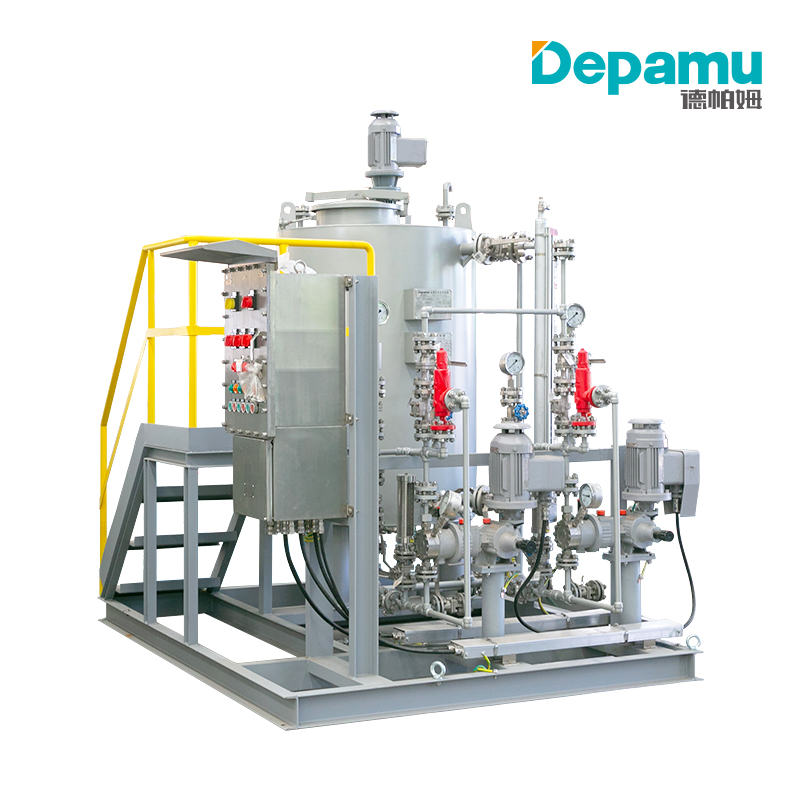
Depamu has developed a comprehensive family of chemical injection packages designed to address the diverse chemical treatment needs of oil and gas operations. These packages are configured as skid-mounted, modular systems that integrate all necessary components into a unified assembly, facilitating transport, installation, and maintenance. The typical Depamu injection package comprises a solution tank, metering pump, level gauge, safety valve, pressure gauge, pulsation damper, piping system with valves, support base, stairway with handrail, and electrical control systems.
The solution tanks are available in a range of materials selected according to corrosion resistance requirements, including 304 and 316 stainless steel, carbon steel, carbon steel with rubber or plastic lining, fiber-reinforced plastic (FRP), and polyethylene. Tank volumes range from 0.5 to 20 cubic meters, accommodating varied chemical consumption rates and site-specific space constraints. For applications requiring high-precision chemical metering, Depamu packages incorporate advanced flow control instrumentation capable of achieving dosing accuracy of ±0.5 to 0.2%.
Metering Pump Technology
At the heart of any chemical injection system is the metering pump, and Depamu offers several configurations tailored to oilfield service conditions. The 3DP(M)ZA series Hydraulic Diaphragm Metering Pumps represent the company's flagship product line for this application. These pumps employ a hydraulic diaphragm design that eliminates leakage concerns while providing the high pressures often required for downhole injection. The pump head can be configured as hydraulic diaphragm, plunger, or piston type depending on specific service requirements.
Technical specifications for the 3DP(M)ZA series demonstrate the breadth of capability available. Flow rates span from 15 liters per hour up to 5,400 liters per hour, with discharge pressures ranging from 0.4 MPa to 72 MPa depending on model and operating configuration. The pumps incorporate a patented integrated sleeve adjustable eccentric transmission mechanism enabling stepless stroke adjustment from 0% to 100% of rated capacity. Metering accuracy of ±0.5% ensures reliable chemical dosing essential for effective treatment programs.
The hydraulic Diaphragm Pump design offers distinct advantages for oilfield service. Internal safety valves and compensation valves provide automatic air discharge and oil replenishment, enhancing reliability in continuous service. The oil-immersion lubrication system ensures long-term durability of the transmission mechanism, while vertical motor installation minimizes the risk of leakage. For applications requiring multi-component chemical injection, up to twelve pump heads can be connected in parallel, enabling either the delivery of a single medium with reduced pulsation or the proportional injection of multiple chemicals with independent flow adjustment for each pump head.
Control and Automation Capabilities
Modern oil and gas operations increasingly demand automation and remote monitoring capabilities to optimize chemical usage while minimizing personnel exposure to hazardous areas. Depamu has addressed these requirements through sophisticated control system integration. Their injection packages can be configured for local manual control, semi-automatic operation, or fully automatic closed-loop control. In automatic mode, the system adjusts chemical injection rates based on real-time process parameters transmitted from online instrumentation, maintaining precise chemical-to-production ratios with accuracy better than ±1%.
For integration into modern distributed control systems (DCS), Depamu packages transmit status and fault signals for pumps and mixers to host computers, enabling remote start-stop control and performance monitoring. Control modes include manual, electric, pneumatic, and frequency conversion adjustment, providing flexibility for varied operational environments. This level of automation aligns with industry trends toward digitalization and remote operations, enabling operators to optimize chemical usage and reduce operational costs.
Application-Specific Configurations
Depamu has developed specialized chemical injection package configurations for different oilfield applications, each optimized for specific chemical types and operating conditions. For petroleum and natural gas exploitation, gathering, and transportation, the company offers dedicated packages for demulsifier injection, corrosion inhibitor injection, deoxidant injection, reverse demulsifier injection, germicide injection, and methanol or ethylene glycol injection for hydrate prevention.
For Enhanced Oil Recovery (EOR) applications, Depamu packages can be configured to inject polymers or other viscosity-increasing agents that improve sweep efficiency through the reservoir. These systems are typically installed near water injection sites and maintain precise injection rates to optimize displacement efficiency. For produced water treatment, the company offers coagulation, dispersion, acid, and alkali injection packages for water conditioning and oily sewage treatment.
Materials and Corrosion Resistance
The handling of aggressive chemicals at high pressures necessitates careful selection of wetted materials. Depamu offers a range of materials for pump heads and wetted parts, including 304 and 316 stainless steel, carbon steel, UPVC, and specialized alloys for more demanding services. This material flexibility ensures compatibility with the specific chemical being injected, whether it is corrosive acid-based treatments or hydrocarbon-compatible demulsifiers.
Industry Standards and Quality Assurance
Chemical injection systems for oil and gas must comply with stringent industry standards to ensure safety and reliability. Depamu's packages are designed to meet relevant API guidelines for oilfield equipment, ISO standards for fluid handling, and applicable local regulations. The company's quality management systems incorporate manufacturing processes based on advanced production technologies from the United States, Germany, and Japan, reflecting a commitment to international quality standards.
Conclusion
Depamu chemical injection systems and pumps represent a comprehensive solution for the demanding requirements of oil and gas production. By integrating precision metering pumps, robust instrumentation, modular skid construction, and sophisticated control systems, the company delivers injection packages capable of protecting pipelines, ensuring flow assurance, and extending equipment life in some of the most challenging operating environments on earth. The availability of multiple pump configurations, extensive material options, and automated control capabilities allows Depamu to address the varied chemical treatment requirements encountered across the oil and gas value chain.
As the industry continues to face challenges related to aging infrastructure, increased water production, and the need to operate in ever more demanding environments, the importance of reliable chemical injection systems will only grow. Depamu's continued development of precision metering technologies and integrated injection packages positions the company as a supplier capable of meeting these evolving requirements, contributing to the safe and efficient production of hydrocarbon resources well into the future.