

The Depamu Twin-Screw Pump: A Robust Solution for Conveying Coal-Water Slurry
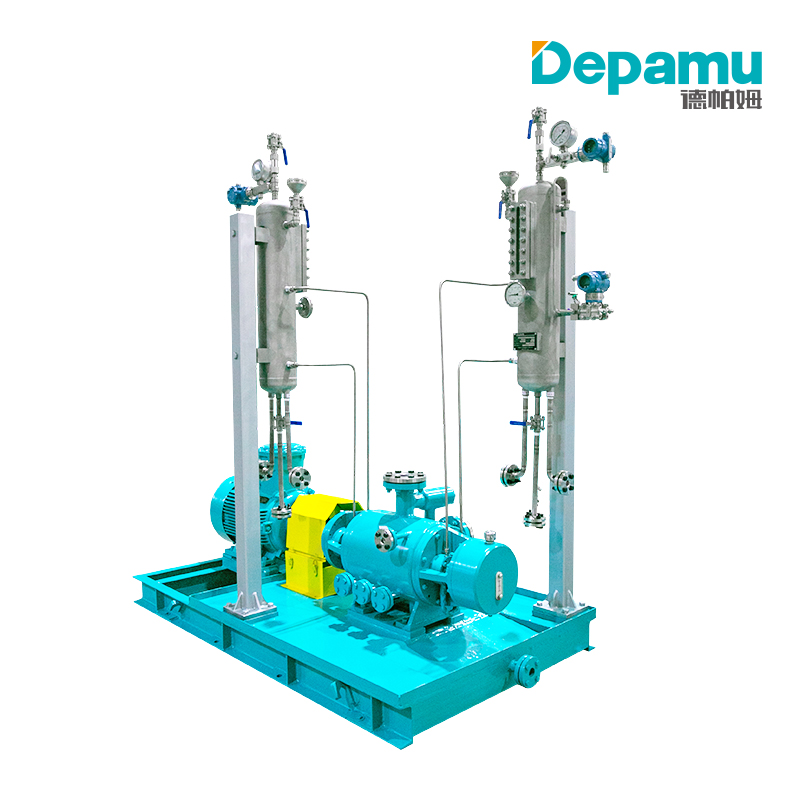
The transportation of coal-water slurry (CWM) represents one of the most demanding challenges in industrial pumping. This mixture of finely ground coal particles suspended in water is abrasive, viscous, and prone to settling, creating an environment that rapidly degrades conventional pumping equipment. Within this challenging domain, the twin-screw positive displacement pump has emerged as a preferred solution, and DEPAMU, leveraging German engineering technology, has developed a Twin-Screw Pump specifically engineered to address the unique demands of this application.
The Technical Challenge of Coal-Water Slurry
Before examining the pump itself, it is essential to understand why CWM presents such a formidable pumping challenge. The slurry is a two-phase mixture with solids content typically ranging from 50% to 70% by weight. This composition creates multiple failure mechanisms for pumps: abrasive wear from coal particles, settling and sedimentation when flow ceases, and viscosity variations that can exceed 500% increase during circulation. Historical testing has demonstrated that the selection of pumping technology significantly impacts slurry stability. One study documented that while a progressive cavity pump showed no change in CWM viscosity after 100 hours of circulation, a twin-screw pump exhibited a viscosity increase of over 500% in less than 70 hours under certain conditions, highlighting the complex interaction between pump design and slurry properties.
The fundamental requirement for CWM pumping is therefore not merely the ability to move the mixture, but to do so without degrading its rheological properties, while withstanding the abrasive attack of suspended solids.
Depamu's Twin-Screw Pump Design Philosophy
DEPAMU's approach to the twin-screw pump centers on a design philosophy that addresses each of these challenges systematically. The pump employs two intermeshing screws synchronized by timing gears, preventing metal-to-metal contact between rotating elements. This synchronization is a critical feature for abrasive slurry applications: because the screws do not contact each other, wear is confined to the screw surfaces and the pump liner, rather than causing catastrophic failure through galling or seizure.
The pump body is constructed to accommodate various medium conditions, with the option of heating jackets beneath the pump body for high-viscosity medium transportation. This thermal management capability is particularly relevant for CWM applications where temperature affects both viscosity and flow characteristics.
Superior Self-Priming and Suction Capability
One of the most significant advantages of the DEPAMU twin-screw pump for CWM service is its exceptional self-priming capability. The pump's design ensures that the working elements always contain pumped liquid as a sealing fluid, enabling it to handle gas-liquid mixtures with gas content up to 98%. This is valuable for CWM applications where the slurry may contain entrained air or where suction conditions are less than ideal.
The pump offers a Net Positive Suction Head (NPSH) requirement as low as 1.5 meters, which represents outstanding suction performance for a positive displacement pump. Low NPSH requirements are crucial for CWM service because the slurry's high solids content and viscosity create significant frictional losses in suction piping, reducing the available NPSH.
Handling Abrasive and Non-Lubricating Media
Conventional pumps often rely on the pumped fluid for lubrication of bearings and sealing surfaces. CWM, being predominantly water with abrasive coal particles, provides poor lubrication while simultaneously accelerating wear. DEPAMU addresses this through the use of independently lubricated external bearings. This design choice allows the pump to handle various non-lubricating media without compromising bearing life. The bearings are isolated from the pumped fluid, ensuring they are not subjected to the abrasive attack that would rapidly destroy internally lubricated designs.
The pump's clearance design further enhances its suitability for abrasive service. The synchronized gear drive eliminates the need for tight clearances to maintain hydraulic efficiency, as is required in gear pumps or three-screw pumps. This means clearances can be set to accommodate the maximum particle size in the slurry without significant performance degradation.
Operational Reliability and Maintenance Characteristics
The DEPAMU twin-screw pump offers operational advantages that directly translate to reduced maintenance costs and improved process reliability. The absence of contact between rotating parts means the pump can tolerate short periods of dry running without damage. This is particularly relevant during startup and shutdown sequences when suction conditions may be inconsistent.
The pump operates with low noise and vibration levels due to the synchronized gear drive, which ensures smooth power transmission without the pulsations characteristic of Reciprocating Pumps. This smooth operation reduces stress on piping systems and associated equipment, extending the overall system life.
Comparison with Alternative Pump Technologies
For CWM applications, DEPAMU's twin-screw pump competes primarily with progressive cavity pumps, Diaphragm Pumps, and centrifugal pumps. Each technology offers distinct advantages and limitations. Progressive cavity pumps provide excellent handling of abrasive slurries but at lower flow rates and with higher shear rates that can affect slurry properties. Diaphragm pumps offer leak-free operation and high pressure capability but with flow pulsation and more complex maintenance requirements. Centrifugal pumps, while offering high flow rates, suffer from rapid impeller wear and performance degradation as viscosity increases.
The twin-screw pump occupies a compelling middle ground: it can handle flow rates up to 18,000 gpm and pressures to 1,500 psig, operates with low shear that preserves CWM properties, and handles the variable fluid consistencies inherent to coal slurry applications. The ability to handle multiphase flows is also relevant where air entrainment occurs.
Conclusion
The DEPAMU twin-screw pump for coal-water slurry conveyance represents a mature engineering solution to a demanding industrial challenge. By combining German technology with design features specifically tailored for abrasive, high-viscosity media, DEPAMU has created a pump that addresses the key failure modes of CWM service: abrasive wear, poor lubrication, and suction limitations.
The independently lubricated bearings, synchronization gear drive, low NPSH requirement, and self-priming capability collectively deliver a pumping solution that maintains slurry properties while providing reliable service in a demanding environment. For industries relying on coal-water slurry for gasification, combustion, or transportation, the DEPAMU twin-screw pump offers the operational reliability and process stability essential for continuous operation. The company's commitment to technical innovation and quality positions its twin-screw pumps as a competitive option in the global market for specialized industrial pumping solutions