

The Depamu Rubber Rotary Pump: A Paradigm Shift in Sludge and Muck Handling
In the demanding world of industrial fluid handling, few challenges are as persistently difficult as the efficient and reliable transfer of sludge and muck. These heterogeneous mixtures—characterized by high viscosity, high solids content, and abrasive properties—are the bane of conventional pumping technologies. Centrifugal pumps falter, losing prime and suffering rapid wear; progressive cavity pumps, while capable, often struggle with high solids concentrations and require frequent, costly maintenance. Enter the Depamu rubber rotary pump, a positive displacement solution engineered to meet these challenges head-on. This article provides a comprehensive exploration of the Depamu rubber rotary pump, detailing its operating principles, key features, and the distinct advantages it offers for the most arduous sludge and muck applications.
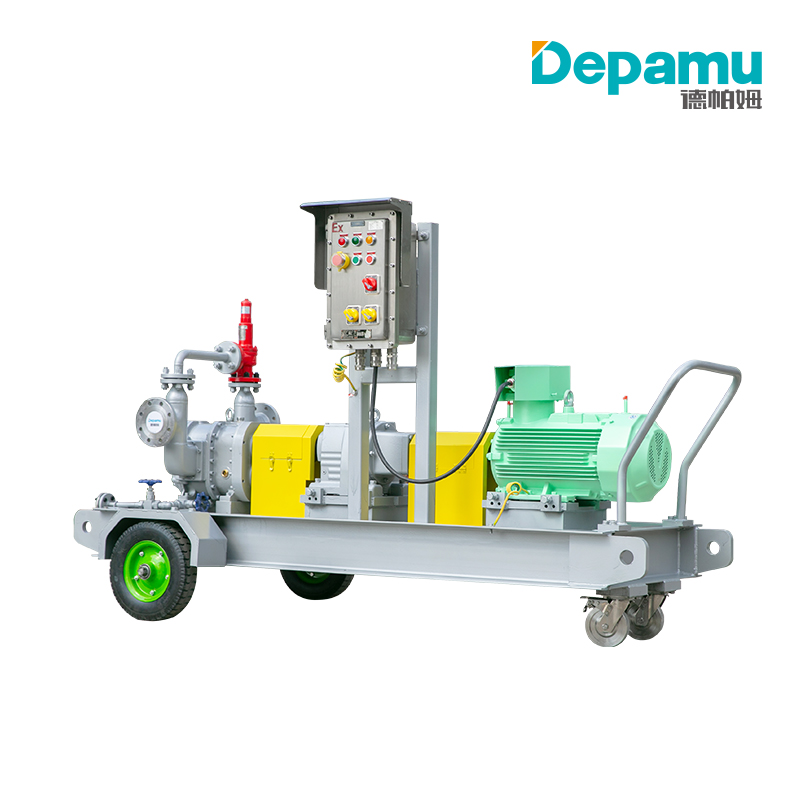
The Anatomy of a Solution: Principles of Operation
The Depamu rubber rotary pump operates on the well-established principle of positive displacement, but with a design specifically refined for handling difficult media. Unlike centrifugal pumps that impart velocity to the fluid, a rotary lobe pump, such as those manufactured by Depamu, uses rotating elements to trap and move a fixed volume of fluid from the suction to the discharge side of the pump .
The core of the pump lies in its two synchronized rotors. These rotors, which are often of a bi-wing or tri-lobe design, are housed within a tight-fitting casing. As they counter-rotate, they create expanding cavities on the suction side, drawing the fluid in. The rotors then seal against each other and the casing, positively displacing the trapped fluid towards the discharge port . This mechanism allows the pump to create a powerful, steady flow that is largely independent of discharge pressure, making it ideal for high-viscosity applications.
Key Performance Specifications
The Depamu rubber rotary pump is available in a range of configurations to suit various operational needs. The company's product line offers a broad spectrum of performance parameters, including flow rates up to 1500 m³/h and discharge pressures up to 1.5 MPa . More specific models, like the CLJ50F0.4-15, demonstrate the versatility of the design, offering a maximum flow rate of 15 m³/h through a 50mm outlet, driven by a 1.2KW explosion-proof motor .
Designed for the Toughest Jobs: Material and Construction
The true genius of the Depamu pump for sludge and muck applications lies in its material selection and robust construction. The pump's ability to handle abrasive and corrosive slurries is a direct result of its "wet end" design.
Rubber Coating and Elastomer Technology
The most critical feature is the rubber coating on the rotors. This is a common and highly effective strategy in positive displacement pumps designed for sludge, as seen in other industry-leading designs . The elastomer coating serves a dual purpose. First, it provides a resilient, non-abrasive surface that can handle the passage of solid particles with minimal wear, significantly extending the service life of the rotors. Second, the rubber creates a superior seal against the pump casing, maximizing volumetric efficiency and suction lift, which can reach up to 9 meters . Depamu pumps can handle media with viscosities as high as 2 million centipoise and solids content up to 60%, a testament to the effectiveness of their rotor design and material science .
Robust Casing and Support Structure
To support the demanding forces involved in pumping high-density slurries, Depamu employs a double-support structure. This design ensures exceptional stability and allows the pump to operate at high pressures, with the output pressure reaching 1.8 MPa . The pump casing and other wetted parts are constructed from durable materials like cast iron and stainless steel, providing a rugged foundation that can withstand the punishing conditions of industrial sludge transfer .
Unmatched Performance in Sludge and Muck Applications
The combination of positive displacement pumping action and rugged, rubber-lined construction makes the Depamu pump an ideal solution for a variety of challenging media. It is designed for "stable transportation of mixed media of solid, liquid and gas with few pulses" . This capability is crucial in applications where the pumped fluid is not homogenous.
-
Wastewater and Sewage Treatment: These pumps are ideally suited for handling primary sludge, waste activated sludge (WAS), thickened sludge, and digested sludge . Their ability to pass large, incompressible solids—up to 80mm in diameter—without clogging makes them superior to other pump types .
-
Industrial Slurries and Mud: In industries ranging from mining and mineral processing to ceramics and paper production, the pump excels at transferring abrasive slurries, mud, and pastes . The rubber lining provides the necessary wear resistance to handle these harsh materials.
-
Petrochemical and Chemical Processing: The pump's ability to handle shear-sensitive media and its explosion-proof motor options make it suitable for pumping a range of chemicals, heavy oils, and for cleaning petroleum sludge .
A Holistic Comparison: Rotary Lobe vs. Centrifugal
To fully appreciate the Depamu pump's value, it's useful to compare it to the more common centrifugal pump.
Centrifugal Pump:
-
Principle: Uses a high-speed impeller to impart velocity to the fluid.
-
Viscosity: Efficiency drops dramatically with increasing viscosity.
-
Solids Handling: Prone to clogging; impeller wear is a significant issue with abrasive solids.
-
Self-Priming: Limited; generally requires a flooded suction or auxiliary priming device.
-
Maintenance: Frequent impeller and wear ring replacements.
Depamu Rubber Rotary Pump:
-
Principle: Positive displacement; moves a fixed volume of fluid with each rotation.
-
Viscosity: Performance is consistent across a wide range of viscosities; efficiency increases with viscosity.
-
Solids Handling: Excellent; can handle high solids content and large particle sizes without clogging.
-
Self-Priming: Excellent; can self-prime with high suction lifts.
-
Maintenance: Designed for easy maintenance; features like online repair capability and low-wear components reduce downtime .
Conclusion
The Depamu rubber rotary pump represents a sophisticated and robust engineering solution for one of industry's most persistent problems: the efficient and reliable transfer of sludge and muck. By marrying the inherent advantages of positive displacement pumping with advanced elastomer technology and robust construction, Depamu has created a pump that excels where others fail.
Its ability to handle high solids content, high viscosity, and abrasive materials with minimal maintenance, all while operating with low pulsation and high efficiency, makes it an indispensable asset for wastewater treatment plants, mining operations, and chemical processing facilities. As industries continue to seek more reliable and cost-effective solutions for handling difficult fluids, the Depamu rubber rotary pump stands out as a durable and highly capable workhorse, proving that the right technology can turn a challenging operation into a smooth and manageable process.