

Precision Under Pressure: How Depamu Metering Pumps Solve the Challenges of Adhesives, Sealants, and Lubricants
Executive Summary
In the world of industrial fluid handling, adhesives, sealants, and lubricants represent the "heavy hitters." Unlike simple water or solvents, these fluids possess high viscosity, non-Newtonian characteristics, thixotropy, and often contain abrasive fillers. Standard centrifugal pumps fail instantly in these environments, unable to generate sufficient suction or maintain flow linearity.
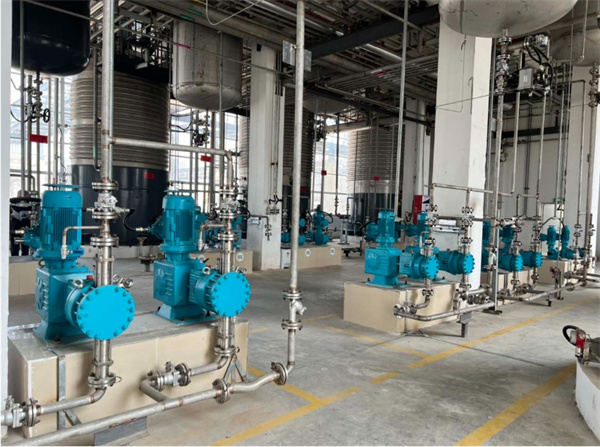
Depamu (DEPA), a globally recognized leader from Hangzhou, China, has engineered a suite of reciprocating metering pumps specifically designed to dominate these challenging media. From high-pressure plunger pumps for silicone sealants to large Diaphragm Pumps for rail lubricants, Depamu offers a solution that marries the Chinese industrial standard of robustness with German-inspired precision engineering. This article explores the specific technologies Depamu employs to handle adhesives, sealants, and lubricants, backed by field data and application analysis.
Section 1: The Unique Physics of High-Viscosity Fluids
Before selecting a pump, one must understand the enemy: the boundary layer. Adhesives and sealants create immense friction against pipe walls and pump internals. Furthermore, many sealants are thixotropic—they shear thin when moved but gel when stationary.
The Metering Challenge:
Unlike centrifugal pumps that lose efficiency with thick fluids, positive displacement pumps excel. However, the specific architecture matters immensely.
-
High Viscosity: Requires large ball valves or special "self-cleaning" check valves to prevent "slamming" or sticking.
-
Abrasive Fillers: Silica in adhesives acts like sandpaper. Standard plunger seals will fail within hours.
-
Accuracy Requirements: In two-part adhesive mixing (e.g., epoxy), a 1% variation in ratio can prevent curing. Depamu’s claim of ±0.5% steady-state accuracy is critical here .
Section 2: The Depamu Technology Stack for Thick Fluids
Depamu does not offer a one-size-fits-all pump. They utilize three primary architectures, each suited for specific viscosity ranges and pressure requirements of adhesives and lubricants.
A. The Plunger Pump (DP(M)WA / 2DPMWA)
Best for: High-pressure lubricants, low-viscosity sealants, and chemical injection.
The plunger pump is the workhorse of the industry. Depamu’s plunger design features a direct-acting plunger that comes into direct contact with the fluid.
-
Sealing Innovation: For adhesives, the "special design stuffing and sealing components" are vital. These are typically chevron-packed seals made of PTFE or graphite-impregnated yarns that prevent the adhesive from "wicking" out of the cylinder .
-
Eccentric Drive: Depamu utilizes an "integrated sleeve adjustable eccentric transmission mechanism." This allows for stepless adjustment of stroke length from 0-100% . For lubricant blending, this means operators can dial in micro-flow rates without stopping the motor, ensuring precise additive ratios .
-
High Pressure: These units can handle the extreme pressures required to push viscous fluids through small nozzles or long distribution lines.
B. The Mechanical Diaphragm Pump (DP Series DPMFXWA)
Best for: Abrasive sealants, corrosive adhesives, and low-shear applications.
The mechanical diaphragm pump creates a barrier between the moving parts and the fluid.
-
No Leakage: For expensive or hazardous adhesives, leakage is not an option. The PTFE diaphragm ensures zero emissions.
-
Abrasive Handling: Because the fluid does not touch the plunger or packing, abrasive fillers (like silica or glass beads in sealants) wear out the pump much slower. The "self-cleaning structure" of the check valves prevents particulates from blocking the flow .
-
Flow Range: With models reaching up to 450 L/h at moderate pressures (0.5-1.2 MPa), these are ideal for transferring bulk sealants into mixing heads .
C. The Hydraulic Diaphragm Pump (DP(M)WA Hydraulic)
*Best for: High-viscosity transfer, polymer metering, and extreme pressure (up to 50MPa).*
For the toughest jobs—such as pumping polyurethane sealants or bitumen-based adhesives—hydraulic diaphragm pumps are the gold standard.
-
Dynamic Relief: These pumps feature an "internal safety valve and compensation valve" . If the discharge line is blocked (common in adhesive dispensing guns), the internal valve recirculates the oil, protecting the pump from the sudden pressure spike that would shatter a mechanical diaphragm.
-
High Pressure Capability: In the specifications, the DP(M)WA series handles pressures up to 8 MPa (and much higher in special configurations), allowing it to spray heavy lubricants or extrude high-viscosity structural adhesives through long hoses .
Section 3: Solving Specific Application Challenges
Depamu’s equipment is not just theoretical; it has been battle-tested in extreme environments, from the Arctic Circle to chemical plants in China.
Case Study 1: Arctic Lubricants & Sealants (Russia LNG-2 Project)
One of the most validating case studies for Depamu is their selection for the Russian Arctic LNG-2 project.
The Challenge: The pumps had to operate in ambient temperatures dropping to -50°C. Lubricants and sealants become near-solid at these temperatures. Standard pumps would seize or fail to start.
The Solution: Depamu supplied high-pressure process diaphragm pumps and Hydraulic Diaphragm Metering Pumps.
The Result: Depamu successfully replaced previously specified American equipment. The pumps met the "special requirements of the polar climate and the conveying medium," proving that Depamu’s drive-end lubrication and material selection are suitable for extreme service . This demonstrates their capability to handle heavy lubricants that require pre-heating and precise injection in harsh conditions.
Case Study 2: High-Pressure Adhesives & Fillers (24/7 Manufacturing)
In standard manufacturing lines, two-part adhesives (like for automotive body assembly) require precise ratios.
The Challenge: Maintaining ±0.5% accuracy while one component is highly abrasive.
The Solution: The Depamu 2DPMWA High-Performance Ram Pump features a "high-precision inlet and outlet check valve" that ensures the fluidity of the medium . The valve design prevents the "dribbling" effect common when sealing thick fluids, ensuring a clean cut-off at the end of the stroke.
Section 4: The Economic Argument for Depamu
Why choose Depamu over European or American brands? The answer is Cost-Effectiveness with No Compromise on Core Components.
-
The "Oude" Gearbox: Depamu integrates the "Oude" worm gear pair. This is a high-efficiency, low-noise transmission component. In a metering pump, the gearbox is the heart. By using premium components here, Depamu ensures longevity and energy efficiency .
-
Modularity: The ability to connect "two heads or multiple heads (12 heads at most)" is a game-changer for multi-component adhesives . Imagine producing polyurethane foam: You need Isocyanate (A) and Polyol (B) in a specific ratio. Instead of buying two separate expensive drive units, Depamu allows you to mount two liquid ends on one drive unit, ensuring perfect synchronization and reducing capital expenditure.
-
Material Science: For corrosive lubricants or adhesives, Depamu offers wetted parts in 304, 316, 316L, PVC, PVDF, PTFE, and even Hastelloy C . This resistance to chemical degradation extends the mean time between repairs (MTBR) significantly.
Section 5: Maintenance and Operational Reliability
Handling "sticky" fluids is notorious for fouling pumps. Depamu addresses this in the engineering phase:
-
Simple Structure: The plunger pumps boast a simple structure, which means "convenient maintenance" . When dealing with cured adhesive that has bonded to a valve, easy disassembly is a requirement, not a luxury.
-
Oil-Immersed Lubrication: Drive components operate in an oil bath. When handling lubricants or sealants, dust and debris can accumulate. A sealed, oil-immersed transmission ensures that the environment does not contaminate the pump's gears .
-
Safety Recommendations: Depamu explicitly states that since their pumps have "no safe relief device," users should install a relief valve on the outlet pipeline . This honesty is crucial for adhesive users, as a dead-head situation (closing a nozzle) with a positive displacement pump creates pressure spikes that can blow hoses or damage mixing equipment.
Section 6: Depamu’s Position in the Global Market
Depamu is not a small local player. They have achieved the status of a National "Little Giant" enterprise in China, a designation for specialized and sophisticated SMEs .
Their 26-ton ultra-large high-pressure diaphragm pump developed for Sinopec’s Isononyl Alcohol project (a precursor for plasticizers and lubricants) broke a long-standing foreign monopoly . This engineering capability to build massive, high-flow pumps translates directly into the precision engineering of their smaller metering pumps for adhesives.
With a market share of 47% in their domestic segment and ranking Top 3 globally in Reciprocating Pumps , Depamu combines the production scale of a Chinese giant with the niche focus of a specialty pump manufacturer.
Conclusion
The handling of adhesives, sealants, and lubricants is a test of a pump’s soul. It requires a machine that is part brute force (to push the thick fluid) and part scientist (to measure the dose to ±0.5%).
Depamu metering pumps rise to this challenge through a specific combination of technologies: High-precision check valves that prevent drooling, specialized stuffing and sealing that resists wicking and abrasion, and robust eccentric mechanisms that provide smooth, pulsation-free flow adjustments .
For the engineer responsible for building a polyurethane foam line, a rail curve greasing system, or a two-part epoxy assembly station, Depamu offers a compelling value proposition: the precision of a high-end metering pump with the durability required for "dirty" fluids.
Their proven track record in replacing American equipment in the Russian Arctic and their technical breakthroughs for Chinese national projects signal that Depamu is not just an alternative—it is a standard in its own right.