

Depamu Water Treatment Dosing Package with Automatic Control for Chemical Feeding
Abstract
Precise chemical dosing is a cornerstone of modern water treatment, directly influencing operational safety, process efficiency, and regulatory compliance. The Depamu Water Treatment Dosing Package represents an integrated, skid-mounted solution that unifies chemical dissolution, preparation, metering, and injection within a single automated platform. This article provides a comprehensive technical overview of the system, examining its design philosophy, core components, automatic control architecture, and application versatility across boiler feedwater treatment, cooling water systems, wastewater processing, and oil and gas operations. Particular attention is given to the system's PLC-based control logic, its capacity for integration with distributed control systems (DCS), and the demonstrated reliability of Depamu packages in demanding environments such as the Yamal LNG project.
1. Introduction
In industrial water treatment, the precise delivery of treatment chemicals—whether for pH adjustment, scale inhibition, corrosion control, or disinfection—determines the effectiveness of the entire process. Inaccurate dosing leads to two equally undesirable outcomes: under-dosing, which permits scale formation, corrosion, or microbial proliferation, and over-dosing, which wastes chemicals, increases operational costs, and may introduce secondary water quality issues. Traditional approaches relying on manually assembled components—pumps, tanks, and controls purchased separately and integrated on site—frequently suffer from compatibility gaps, inconsistent performance, and elevated maintenance burdens. The Depamu Water Treatment Dosing Package addresses these challenges through a systematic design philosophy that treats the entire dosing process as an integrated engineering problem rather than a collection of discrete equipment items.
2. Design Philosophy and System Architecture
2.1 Modular Skid-Mounted Configuration
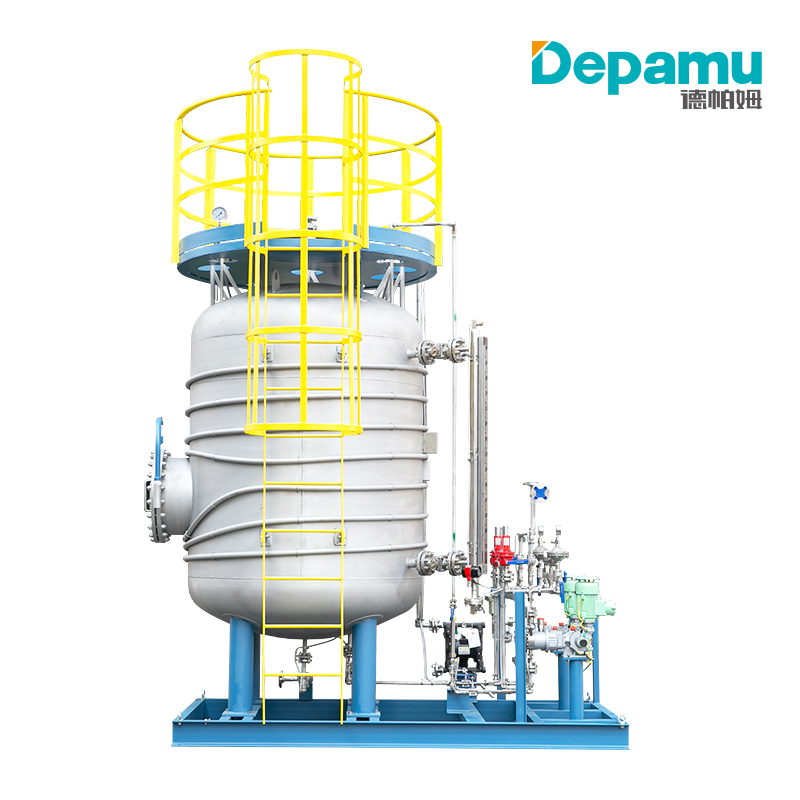
The Depamu dosing package is a factory-assembled, skid-mounted unit that consolidates all essential components onto a common steel base. This modular approach departs fundamentally from conventional configurations in which pumps, storage tanks, and control systems are individually procured and assembled. By adopting a "systematic design" philosophy, Depamu ensures that every component operates in harmony with the others, eliminating the performance inconsistencies that arise from piecemeal integration. The resulting package offers a compact footprint, simplified installation, and straightforward transportation, making it suitable for both new construction and retrofit projects.
2.2 Core Components
The system comprises several key functional units:
Solution Tank. The solution tank serves as the chemical storage and mixing vessel. Depending on the specific chemical and corrosion-resistance requirements, tanks can be fabricated from 304 or 316 stainless steel, carbon steel with rubber or plastic lining, fiberglass-reinforced plastic (FRP), polyethylene (PE), or PVC. Tank volumes range from 0.5 m³ to 2.5 m³ for boiler water applications, with larger capacities available for other industrial uses. Level gauges provide continuous monitoring of solution inventory, and low-level detection safeguards against dry-run operation.
Metering Pump. The metering pump is the heart of the Injection Package, responsible for delivering chemical solutions with high precision. For boiler water applications, pumps typically provide flow capacities of 20–70 L/H with discharge pressures up to 2.5 MPa for ammonia and hydrazine injection, or 5–32 MPa for phosphate injection. The flow rate can be adjusted steplessly from 0 to 100% of rated capacity. Pump wetted parts are constructed from corrosion-resistant materials such as 316/304 stainless steel or UPVC to ensure chemical compatibility.
Pulsation Damper and Safety Valve. The reciprocating action of metering pumps generates flow pulsations that can affect downstream processes and piping integrity. A pulsation damper smooths these fluctuations, ensuring consistent injection. A safety valve provides overpressure protection, automatically relieving excess pressure to protect system components.
Piping and Valve System. A comprehensive network of pipes, valves, and fittings connects all components, enabling flexible flow control, isolation for maintenance, and the ability to alternate between multiple tanks or operate pumps in parallel.
Electrical Control Cabinet. The control cabinet governs the entire package, supporting operational modes ranging from local manual control to semi-automatic operation and fully automatic control integrated with a plant-wide distributed control system (DCS).
3. Automatic Control Architecture
3.1 PLC-Based Control Logic
The intelligence of the Depamu dosing package resides in its programmable logic controller (PLC), which functions as the host controller interfacing with the plant DCS. The PLC receives real-time signals from online analytical instruments—flow meters, pH sensors, conductivity meters, dissolved oxygen analyzers, turbidity meters, and phosphate analyzers—and processes these signals to compute the optimal chemical injection rate. The control logic adjusts the injection rate by regulating either the rotational speed or the stroke length of the metering pump through a variable frequency drive, enabling a flow rate adjustment range of 0 to 100%.
3.2 Control Strategies
The automatic control system supports multiple control strategies tailored to different water treatment processes. Feedback control measures the result—such as residual chemical concentration, pH, or turbidity—and adjusts the dose to correct deviation from the setpoint. This approach is reliable but reactive, responding to changes after they occur. Feed-forward control measures the disturbance, such as raw water flow rate or influent quality, and adjusts the dose proactively based on a mathematical model. This mode is fast but model-dependent. Cascade control combines both: feed-forward provides the bulk dose, while feedback trims for accuracy, achieving both responsiveness and precision.
In practice, the PID (proportional-integral-derivative) algorithm embedded in the PLC calculates the correction amount based on the deviation between the measured value and the target setpoint. For pH neutralization loops, which are highly nonlinear, gain scheduling may be required. For chlorine residual control, which involves long dead time, conservative tuning ensures stability.
3.3 Operational Modes
The system supports three operational modes: local manual control, in which operators directly adjust pump settings at the control cabinet; semi-automatic operation, in which the system executes pre-programmed dosing sequences with operator oversight; and fully automatic control, in which the PLC or DCS governs all aspects of dosing based on real-time sensor inputs. This flexibility ensures the system can adapt to plants with varying levels of automation infrastructure.
4. Application Versatility
4.1 Boiler Feedwater Treatment
In thermal power plants and industrial steam generation facilities, boiler feedwater quality is critical to equipment longevity and thermal efficiency. Depamu offers specialized injection packages for ammonia injection to adjust pH and prevent corrosion, hydrazine injection to scavenge dissolved oxygen and prevent pitting, and phosphate injection to control scale formation. For phosphate injection, trisodium phosphate reacts with calcium ions to form basic calcium phosphate, a soft precipitate that is readily removed via blowdown rather than adhering to heat transfer surfaces. The automatic control system continuously adjusts injection rates based on real-time water quality parameters, ensuring consistent protection of the steam generation system.
4.2 Cooling Water Treatment
In cooling water systems, scale, corrosion, and biological growth present persistent threats to heat exchange equipment. The Depamu system is designed for injection of scale inhibitors, corrosion inhibitors, and biocides, protecting heat transfer surfaces while maintaining system efficiency. The system can be customized for specific chemicals including polyaluminum chloride (PAC), polyacrylamide (PAM), and concentrated sulfuric acid.
4.3 Wastewater and Raw Water Treatment
For municipal and industrial wastewater treatment, flocculation is the key process for solids removal. The Depamu system automatically prepares and injects dry powder flocculants and coagulants with high precision. The system also controls the dosing of dispersants, acids, and bases at various stages of treatment for pH adjustment, supporting both wastewater flocculation and drinking water purification applications.
4.4 Oil and Gas Operations
Petroleum and natural gas extraction demands the injection of demulsifiers, corrosion inhibitors, oxygen scavengers, and methanol for hydrate inhibition. These applications typically require higher-pressure pumps and larger storage tanks. Depamu offers packages capable of accommodating flow rates from 10 to 200 L/H at discharge pressures up to 4.0 MPa, with phosphate injection systems reaching pressures up to 32 MPa.
5. Engineering Validation: The Yamal LNG Case
The reliability of Depamu dosing packages is perhaps best demonstrated by their deployment in the Yamal LNG project, one of the most demanding energy infrastructure developments of the 21st century. Located on the Arctic coast of the Russian Yamal Peninsula, the facility operates in temperatures dropping below -50°C, where process interruption carries extraordinary costs and environmental risks. The Depamu reagent dosing unit serves as a critical component ensuring operational integrity through precise chemical management, maintaining precise performance despite extreme temperature differentials and logistical constraints. This deployment underscores the system's suitability for the most challenging industrial environments.
6. Performance Optimization and Efficiency
Beyond basic dosing control, modern water treatment increasingly demands efficiency optimization. Research has demonstrated that precise dosing systems based on coagulation reaction models can achieve coagulant dosage reductions of up to 33.7% compared to conventional approaches, alongside significant reductions in energy consumption and carbon emissions. The Depamu system's integration of real-time sensor feedback, PLC-based control logic, and flow-proportional dosing enables demand-based chemical addition, ensuring that chemicals are added in proportion to actual treatment demand rather than at fixed rates. This approach minimizes chemical waste, reduces operational costs, and maintains consistent treated water quality.
7. Conclusion
The Depamu Water Treatment Dosing Package represents a mature, integrated approach to chemical dosing automation. By unifying storage, metering, control, and safety functions within a single factory-assembled skid, the system eliminates the compatibility and performance issues associated with conventional component-level procurement. Its PLC-based automatic control architecture—supporting feedback, feed-forward, and cascade strategies—enables precise, demand-responsive chemical injection across a wide spectrum of water treatment applications. From the boiler rooms of thermal power plants to the extreme conditions of Arctic LNG facilities, the Depamu dosing package demonstrates that systematic design, rigorous engineering, and intelligent automation can deliver the precision, reliability, and efficiency that modern water treatment demands.