

The Depamu Chemical Dosing System for Water Treatment: Precision Engineering for Industrial Fluid Management
Abstract
In the complex landscape of modern industrial water treatment, precision chemical dosing stands as a critical operational requirement. Insufficient dosing leads to scaling, corrosion, and biological fouling, while excessive dosing results in chemical waste, increased operational costs, and potential environmental compliance violations. The Depamu chemical dosing system addresses this challenge through integrated, skid-mounted solutions that combine accurate metering, automated control, and robust construction. This article examines the system's architecture, applications across industries, and the engineering principles that position Depamu as a significant player in the global water treatment equipment market.
1. Introduction
Water treatment is the invisible backbone of industrial operations. From thermal power generation to petroleum refining, from chemical manufacturing to municipal wastewater treatment, the quality of process water directly determines equipment longevity, operational efficiency, and regulatory compliance. Central to modern water treatment is the chemical dosing system—equipment designed to introduce precise quantities of treatment chemicals into water streams.
The Depamu chemical dosing system, manufactured by Depamu (Hangzhou) Pumps Technology Co., Ltd., represents a comprehensive approach to this challenge. Established in 2003 and located in Hangzhou Qiantang Area, the company has developed over 100 technical patents and serves as a drafter of pump industry standards. With certifications including API, CE, ISO 9001, ISO 14001, and ISO 45001, Depamu has established itself as a supplier to major enterprises including CNPC, SINOPEC, and CNOOC, with products exported to over 50 countries.
2. System Architecture and Core Components
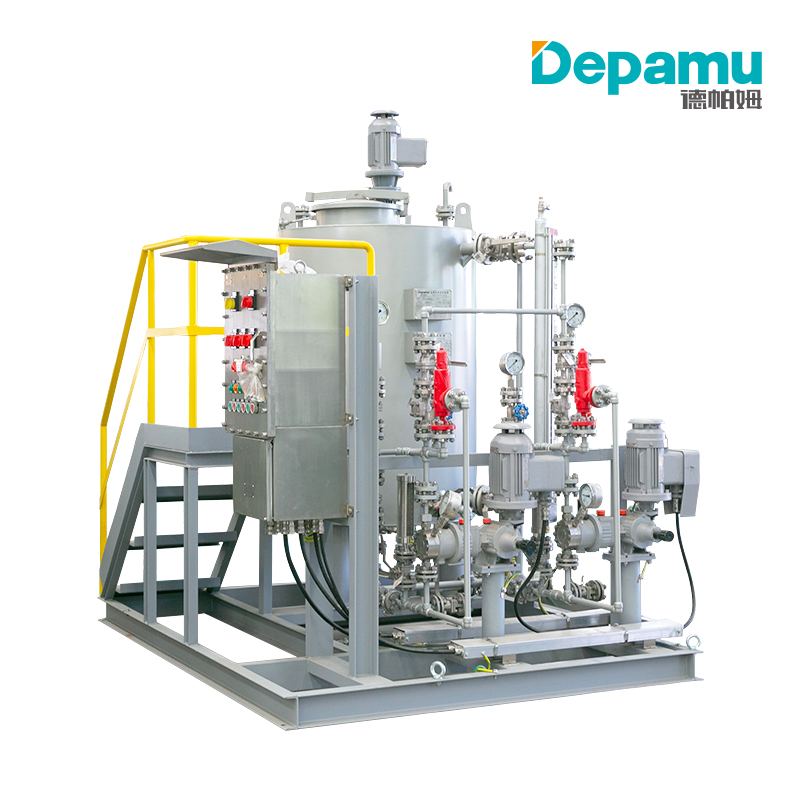
The Depamu chemical dosing system is engineered as an integrated package—a skid-mounted assembly that consolidates all necessary components onto a single base frame. This approach offers several advantages: reduced site installation time, minimized footprint, factory-tested quality assurance, and simplified maintenance.
2.1 Solution Tank
The solution tank serves as the chemical reservoir where treatment chemicals are dissolved, mixed, and prepared for injection. Depamu offers solution tanks in materials selected for chemical compatibility and corrosion resistance, including 304 stainless steel, 316 stainless steel, carbon steel (with rubber or plastic lining), FRP (fiber-reinforced plastic), PE (polyethylene), and PVC. Tank volumes range from 0.5 m³ for boiler water applications to 20 m³ for petroleum and natural gas exploitation.
2.2 Metering Pump
The metering pump is the heart of any dosing system. Depamu produces multiple pump types including plunger-type, mechanical diaphragm, and Hydraulic Diaphragm Metering Pumps. These pumps deliver flow rates ranging from as low as 10 L/h for specialty chemical applications to 1,500 L/h for circulating water treatment, with discharge pressures reaching up to 32 MPa depending on the configuration.
The hydraulic diaphragm metering pump, representing technology introduced from Germany in the early 1990s, is particularly noteworthy for its ability to handle corrosive and abrasive fluids without leakage. This pump design eliminates the need for dynamic seals, reducing maintenance requirements and improving reliability in demanding applications.
2.3 Mixing and Agitation Systems
For chemicals requiring dissolution or suspension, the system incorporates mixers and agitators within the solution tank. These ensure homogeneous chemical concentration before injection, a prerequisite for accurate dosing.
2.4 Piping and Valves
The complete pipe system includes safety valves, pressure gauges, pulsation dampers, and various valves for flow control and system isolation. The pulsation damper is particularly important for metering pump applications, smoothing the intermittent flow characteristic of positive-displacement pumps to ensure consistent injection.
2.5 Control System
The control system distinguishes modern dosing equipment from basic chemical feed systems. Depamu packages incorporate PLC (Programmable Logic Controller) or host computer control, with capabilities for integration into DCS (Distributed Control Systems).
The system accepts input signals including flow rate, pH value, electrical conductivity, turbidity, and dissolved oxygen content, enabling real-time adjustment of dosing rates based on actual process conditions. For ammonia Injection Packages used in thermal power plants, for example, the system continuously monitors boiler water quality and automatically adjusts ammonia solution injection to maintain optimal pH levels.
3. Application-Specific Configurations
Depamu's product line includes specialized configurations for different water treatment applications. The modular design allows customization without requiring complete system redesign.
3.1 Boiler Water Treatment Packages
Boiler feed water and boiler water treatment are critical for thermal power generation and industrial steam systems. Impurities in boiler water lead to scale formation on heat transfer surfaces, reducing efficiency and potentially causing tube failure. Dissolved oxygen causes corrosion, threatening equipment integrity.
Depamu offers several boiler water treatment configurations:
Ammonia Injection Packages are used to regulate pH in boiler feed water. By automatically injecting ammonia solution based on continuous pH monitoring, the system maintains the alkaline conditions necessary to prevent acidic corrosion while avoiding excessive alkalinity that could cause caustic embrittlement.
Hydrazine Injection Packages address dissolved oxygen, which is a primary cause of corrosion in boiler systems. Hydrazine acts as an oxygen scavenger, chemically binding with dissolved oxygen to form harmless nitrogen and water. Precise control of hydrazine dosing is essential—insufficient dosing fails to control corrosion, while excessive dosing wastes chemical and risks environmental contamination. The automated hydrazine injection package maintains optimal hydrazine residual in water, balancing corrosion protection with chemical economy.
Phosphate Injection Packages are used for boiler water internal treatment. Phosphates precipitate calcium and magnesium hardness compounds, preventing scale formation on boiler tubes. The system maintains phosphate concentration within a specified range, typically using a configuration of one solution tank and two pumps or two tanks and multiple pumps depending on the application scale.
Acetoxime Injection Packages serve as a volatile oxygen scavenger alternative to hydrazine, offering similar deoxygenation capabilities with different handling characteristics.
3.2 Circulating Water Treatment Packages
Cooling water systems in power plants, refineries, and chemical facilities face challenges including scale deposition, corrosion, and biological fouling. Treatment programs typically involve multiple chemicals applied in combination.
Scale Inhibitor (Corrosion Inhibitor) Injection Packages introduce chemicals that interfere with crystal formation and precipitation of hardness compounds, maintaining heat transfer efficiency. Corrosion inhibitors form protective films on metal surfaces, reducing corrosion rates in the circulating water system.
Germicide Injection Packages control biological growth—algae, bacteria, and fungi—in cooling towers and other circulating water systems. Without biocidal treatment, biological growth reduces heat transfer efficiency, promotes under-deposit corrosion, and can harbor Legionella bacteria.
Concentrated Sulfuric Acid Injection Packages are used for pH control in cooling water systems where alkalinity must be reduced to prevent scale formation. The acid injection rate must be carefully controlled to achieve the target pH without causing acidic corrosion.
Sodium Hypochlorite Injection Packages provide disinfection of circulating water, controlling biological growth while also oxidizing organic contaminants.
3.3 Wastewater Treatment Packages
Wastewater treatment involves physical, chemical, and biological processes to remove contaminants before discharge or reuse. Chemical dosing is essential for several treatment steps.
Flocculant Injection Packages introduce chemicals such as PAC (polyaluminum chloride) or PAM (polyacrylamide) to promote aggregation of suspended solids, facilitating sedimentation in clarification processes.
Dispersant Injection Packages prevent the deposition of suspended solids on equipment surfaces, maintaining flow capacity and preventing fouling.
Acid and Alkali Injection Packages adjust pH for biological treatment optimization, chemical precipitation processes, or final discharge compliance. Precise pH control is essential for biological treatment, as microorganisms have a narrow pH range for optimal activity.
3.4 Petroleum and Natural Gas Applications
The oil and gas industry presents some of the most demanding chemical dosing challenges, with high pressures, corrosive fluids, and remote locations. Depamu offers specialized packages for these applications.
Demulsifier Injection Packages break water-in-oil emulsions that form during production, enabling separation of oil and water phases. Demulsifiers lower the interfacial tension between oil and water, allowing droplets to coalesce and separate.
Corrosion Inhibitor Injection Packages protect pipelines and production equipment from the corrosive effects of produced fluids containing hydrogen sulfide, carbon dioxide, and organic acids. Continuous injection of corrosion inhibitors at wellheads and along pipelines can extend equipment life from months to decades.
Deoxidant Injection Packages remove oxygen from injection water to prevent corrosion in waterflood systems where produced water is reinjected for pressure maintenance.
Reverse Demulsifier Injection Packages treat oily wastewater to meet discharge standards, breaking oil-in-water emulsions that persist after primary separation.
Methanol and Ethylene Glycol Injection Packages are used for hydrate inhibition in natural gas production and transportation. These chemicals prevent the formation of gas hydrates—ice-like solids that can block pipelines and process equipment at low temperatures and high pressures.
4. Control and Automation Philosophy
The Depamu chemical dosing system's automation capability is central to its value proposition. The system supports multiple control modes to suit different operational requirements and infrastructure capabilities.
4.1 Control Modes
Local Manual Control enables operators to set dosing rates directly at the equipment, suitable for facilities without sophisticated control infrastructure or during commissioning and maintenance.
Semi-Automatic Control allows remote operation with manual set-point adjustment, providing greater operator convenience than full manual control while maintaining direct human oversight.
Fully Automatic Control uses feedback from process sensors to continuously adjust dosing rates. The frequency converter receives standard 4-20 mA signals from flow meters, pH analyzers, conductivity meters, turbidimeters, and other instruments, adjusting metering pump speed and stroke to achieve the target set point.
4.2 Control Loop Integration
The system accepts signals for multiple parameters, enabling complex control strategies. For example, a scale inhibitor dosing system in circulating water treatment might respond primarily to flow rate (flow-proportional control) while adjusting for changes in water chemistry based on conductivity and pH signals.
The control range is specified as 0-100% of metering pump capacity, giving the system substantial flexibility to respond to process variations. The standard speed control input signal is 4-20 mA, compatible with most industrial instrumentation.
4.3 Remote Monitoring and SCADA Integration
For applications in remote locations—such as pipeline corrosion inhibitor injection or unmanned water treatment facilities—the system can transmit pump and mixer status and fault signals to host computers or DCS, enabling remote monitoring and control. This capability reduces the need for on-site personnel and enables rapid response to operational issues.
5. Engineering and Construction Considerations
The skid-mounted design of Depamu chemical dosing systems addresses several engineering challenges common in chemical dosing applications.
5.1 Corrosion Resistance
Chemical dosing systems handle aggressive fluids, including acids, oxidizing biocides, and corrosive polymers. The system's material selection—from tank construction to wetted pump parts—must match the chemical being dosed. Depamu offers solution tanks in materials including 304 stainless steel, 316 stainless steel, carbon steel with rubber or plastic lining, FRP, PE, and PVC. Wetted parts can be supplied in 304 stainless steel, 316 stainless steel, carbon steel, UPVC, and other materials as required.
5.2 Space Efficiency
The integrated skid design reduces footprint compared to individually installed components. The base frame with stairway and handrail provides access for maintenance while maintaining a compact arrangement