

Powering the Black Gold: The Role of Depamu High-Pressure Water Injection Pumps in Modern Oil & Gas Extraction
Abstract
In the contemporary landscape of petroleum engineering, the era of "primary recovery"—where oil simply gushes out due to natural reservoir pressure—is long over. As mature oil fields enter their twilight years and new finds reside in hostile deep-water environments, the industry has turned to Enhanced Oil Recovery (EOR) techniques to sustain output. At the heart of this technical revolution lies the high-pressure water injection pump. This article provides a comprehensive analysis of Depamu (Hangzhou) Pumps Technology Co., Ltd., a Chinese manufacturer rapidly reshaping the global pumping landscape. We will explore the engineering design, operational parameters, and strategic importance of Depamu’s high-pressure Reciprocating Pumps, specifically analyzing their deployment in Floating Production Storage and Offloading (FPSO) units and ultra-deep wells, while comparing their technological trajectory against international standards like API 674.
1. Introduction: The Strategic Necessity of Water Injection
To understand the value of a Depamu pump, one must first understand the geology of oil extraction. Hydrocarbon reservoirs are not empty caves; they are porous rock formations saturated with oil, gas, and water. Initially, the natural pressure within the reservoir pushes oil toward the wellbore. However, as extraction continues, this pressure drops.
Waterflooding is the most cost-effective secondary recovery method. Engineers inject treated seawater or produced water back into the reservoir to sweep remaining oil towards production wells and maintain formation pressure. This is where the high-pressure water injection pump becomes the "heart" of the platform.
In offshore environments, specifically on FPSOs, the requirements for these pumps are extreme:
-
High Pressure: To fracture or displace tight reservoir oil, pressures often exceed 30 MPa.
-
High Flow Rates: Continuous injection requires thousands of cubic meters per day.
-
Corrosion Resistance: Seawater injection requires handling highly corrosive chlorides.
-
Continuous Duty: Offshore pumps cannot fail; intervention costs in the South China Sea or Gulf of Mexico are prohibitive.
Historically, this market was dominated by European and American giants like Lewa, Geveke, and Cat Pumps. Depamu has emerged as a disruptive force, offering ISO and API 674-certified machinery that matches Western durability while integrating advanced digital control systems.
2. Engineering Deep Dive: The Depamu Reciprocating Advantage
Depamu specializes primarily in reciprocating positive displacement pumps. Unlike centrifugal pumps, which lose efficiency at low flows and high pressures, reciprocating pumps maintain consistent volumetric efficiency regardless of pressure changes.
2.1 The API 674 Standard
Most of Depamu’s heavy-duty models for the oil and gas sector are designed according to API Standard 674 (Positive Displacement Pumps - Reciprocating). This standard mandates specific safety factors for pressure containment, valve design, and driver sizing. Depamu’s acquisition of this certification was a deliberate move to signal their entry into the high-end, international market previously closed to non-certified Chinese manufacturers .
2.2 Core Components and Fluid Ends
The product line can be broadly divided into two types of fluid ends: Plunger and Diaphragm.
-
Plunger Pumps (e.g., THP Series): These are used for clean, high-pressure water injection. The THP series utilizes high-precision double helical gears, a feature often reserved for high-speed, high-torque applications. This gear design ensures quieter operation and higher load capacity compared to standard straight-cut gears, translating to longer Mean Time Between Failures (MTBF) .
-
Diaphragm Pumps (e.g., 3HD Series): In chemical injection applications (methanol, corrosion inhibitors), Depamu utilizes hydraulically actuated diaphragm pumps. These are hermetically sealed. The diaphragm isolates the corrosive chemical from the pump's hydraulic fluid, ensuring zero leakage—a critical requirement for handling H2S or methanol on offshore platforms .
2.3 Power Range and Performance
A review of the specification sheets reveals a wide operational envelope:
-
Power Range: 1.5 kW up to 800 kW (utilizing heavy-duty electric motors).
-
Pressure: From standard 30 MPa to specialized ultra-high-pressure units hitting 350 MPa (approx. 50,000 PSI) .
-
Flow: Capable of metering rates from 20 L/h in chemical injection skids to massive volumes of 2,000 m³/day in water injection modules .
3. Case Study: The CNOOC FPSO Project – A Milestone Achievement
The most significant validation of Depamu’s technology to date is their selection for the CNOOC (China National Offshore Oil Corporation) FPSO project operating in the South China Sea. The South China Sea environment is notoriously harsh: high ambient temperatures, extreme humidity, and salt-laden air accelerate corrosion.
3.1 The Technical Challenge
CNOOC required a core injection module for secondary oil recovery on a massive floating vessel. Space on an FPSO is at a premium, weight restrictions are strict, and the unit must operate with minimal vibration to avoid damaging topside processing equipment.
3.2 The Depamu Solution
Depamu delivered a customized ultra-large water injection pump system with the following specifications :
-
Power Unit: 800 kW Electric Motor.
-
Maximum Working Pressure: 30 MPa.
-
Daily Capacity: 2,000 m³ per single unit.
-
Intelligent Control: The system is integrated with a PLC-based (Programmable Logic Controller) closed-loop regulation system. This allows for real-time adjustment of pressure and flow based on downhole sensor data, with a claimed fault prediction accuracy of ≥99%.
3.3 Strategic Impact
This deployment was not just a sale; it was a symbolic breakthrough.
"This success marks the breaking of the long-term monopoly of European and American companies on the core water injection modules of FPSOs." — China General Machinery Industry Association
By replacing an imported system, Depamu saved CNOOC significant capital expenditure (CAPEX) and reduced lead times. Furthermore, the pump included DNV-GL (Det Norske Veritas) certification, ensuring it met the stringent safety and reliability standards required for international maritime operation.
4. Beyond Simple Injection: Chemical Injection Packages (Skids)
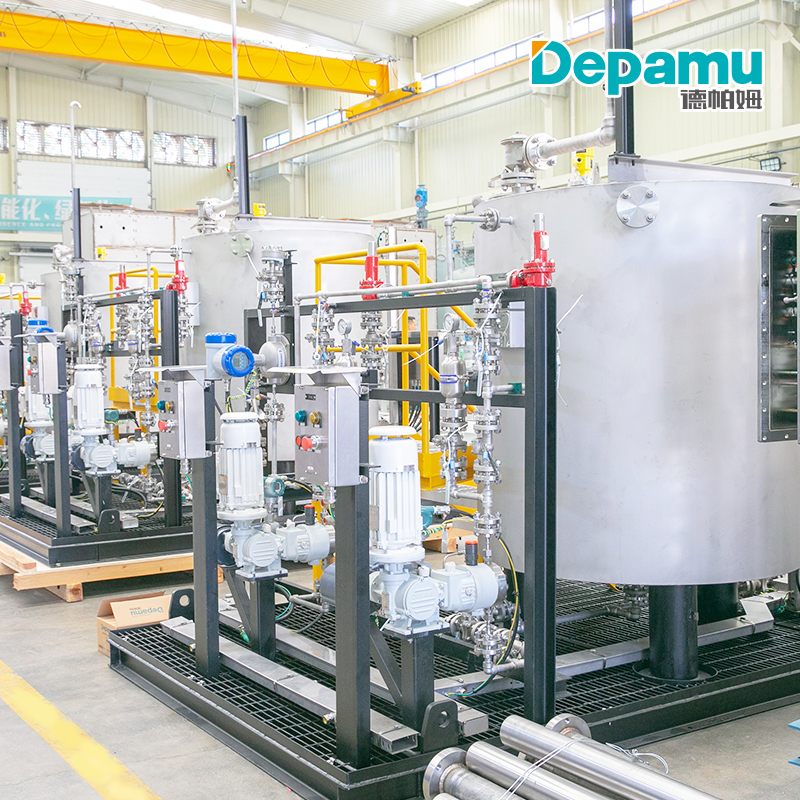
While water injection maintains pressure, chemical injection optimizes the flow and protects the asset. Depamu offers "Injection Packages"—modular skids that integrate the pump, tanks, mixers, and control systems into a single unit. These are vital for:
-
Hydrazine/Ammonia Injection: Used to scavenge oxygen in boiler feed water to prevent corrosion.
-
Methanol/Ethylene Glycol Injection: Prevents the formation of gas hydrates (ice-like crystals that block pipelines) in high-pressure, low-temperature environments.
-
Demulsifier Injection: Breaks the emulsion of oil and water to improve separation efficiency .
These skids utilize variable frequency drives (VFDs) to adjust the stroke speed automatically, integrating with the platform's DCS (Distributed Control System) to precisely meter chemicals based on flow rate fluctuations.
5. Breaking Barriers: The Ultra-Deep Well and Extreme Pressure
Perhaps the most technically impressive feat in Depamu’s portfolio is their involvement in the Enping 21-4 Oilfield. This field features the ENHY-1 well, which set a record for the "First Deepest Well in China" with a depth of 9,508 meters and a horizontal displacement of 8,689 meters .
Extreme depth creates extreme friction loss. To circulate fluids or inject additives at that depth, pressures must reach stratospheric levels. In this project, Depamu successfully overcame the challenge of 120 MPa (17,400 PSI) high-pressure injection.
Achieving 120 MPa is a dimensional challenge. At such pressures:
-
Pipe walls thicken.
-
Valves experience "water hammer" effects that shatter standard steel.
-
Seals extrude out of their grooves.
Depamu’s R&D team solved this using advanced metallurgy and vacuum quenching technology for their valve seats and cone valves. Vacuum quenching creates a hard, wear-resistant surface while maintaining a tough, impact-resistant core—essential for surviving the rapid cycling of a 120 MPa reciprocating pump .
6. The "X-Factor": Digitalization and Predictive Maintenance
Modern oil and gas operations are shifting toward Industry 4.0. A pump is no longer just a dumb piece of iron; it is a data node.
Depamu has heavily invested in digitalizing their pumping systems. Their FPSO package demonstrated a sophisticated PLC system capable of real-time closed-loop adjustment. The system monitors:
-
Thermal signature (to predict bearing failure).
-
Pulsation damping efficiency (to monitor valve wear).
-
Flow stability (to detect diaphragm rupture).
The claim of ≥99% fault prediction accuracy is significant. In offshore logistics, a broken pump costs millions per day in lost production. If a control system can accurately predict failure 48 hours in advance, operators can schedule maintenance weather-windows and spare-parts flights, turning a catastrophic failure into a routine service .
7. Comparative Analysis: Depamu vs. Western Counterparts
To provide a neutral technical assessment, we must compare Depamu’s publicly stated capabilities against established Western incumbents.
Pros of Depamu:
-
Cost-Effective: Lower labor and material costs in China provide a 20-30% cost advantage.
-
Adaptability: Due to China’s rapid industrialization, they are willing to customize heavily for specific "dirty" fluid applications.
-
Digital Native: Their new builds are integrating software controls from the ground up, avoiding legacy hardware lock-in.
Cons of Depamu:
-
Brand Heritage: Lacks the 50+ year field data track record of German or U.S. pumps in Arctic or ultra-deepwater (Brazil/Norway) contexts.
-
Material Certification: While they have API certification, the availability of specific high-grade duplex stainless steel (super duplex) can be constrained compared to European foundries.
8. Operational Considerations and Maintenance
For facility managers considering Depamu, several operational factors stand out:
8.1 Pulsation Dampening
High-Pressure Reciprocating Pumps produce sinusoidal flow. Depamu's systems include pulsation dampeners (often bladder or diaphragm types). The effectiveness of these dampeners in the THP series determines the lifespan of downstream piping. By adjusting the dampener pre-charge pressure to 40-60% of system pressure, users can achieve flow linearity of < ±1% .
8.2 Valve Technology
The "heart" of the reciprocating pump is the valve. Depamu uses a conical valve design with bi-directional positioning. Unlike flat plate valves, conical valves re-seat more consistently in abrasive fluids (produced water contains sand). The use of vacuum quenching on these parts extends their life in sandy environments by approximately 40% compared to untreated steel .
8.3 Skid Integration
Depamu offers "Plug & Play" skids. For a waterflood project, the skid arrives with the tank, pulsation dampener, safety relief valve, calibration column, and all interconnecting piping already mounted. The end-user only needs to connect the suction supply, discharge header, and electrical power. This reduces field installation errors significantly .
9. Future Outlook: The Role of Depamu in Global Energy
As the world transitions toward net-zero carbon, the perception of "Oil & Gas" is changing. However, even in transitional scenarios, oil demand remains robust for plastics, petrochemicals, and heavy transport.
Furthermore, Depamu's high-pressure technology has crossover potential into Carbon Capture and Storage (CCS) . CCS involves injecting supercritical CO2 into depleted reservoirs—a process hydraulically identical to water injection. Depamu’s experience with high-pressure, corrosive fluids on the CNOOC FPSO positions them perfectly to supply injection pumps for the CCS market.
The company’s philosophy, summarized by General Manager Xu Weihua, is aggressive: "Germany has a company that can achieve 350 MPa... Depamu must truly overtake foreign competitors and continue to forge ahead" .
10. Conclusion
Depamu high-pressure water injection pumps represent a maturation of Chinese manufacturing capability from low-cost replicators to high-end engineering solution providers. Through rigorous adherence to API 674, successful deployment on hostile CNOOC FPSOs, and technical victories in 120 MPa ultra-deep wells, Depamu has proven that they are not just an alternative to Western pumps, but a technological peer.
For the oil and gas industry, which is perpetually balancing CAPEX and OPEX, Depamu offers a compelling value proposition: the precision of German engineering, the robustness of API standards, but with the digital agility and supply chain speed of the modern Chinese industrial complex.
As reservoirs grow deeper and colder, and as waterflooding becomes more complex, the role of the humble pump will only grow. Depamu is forging the iron that will power the black gold for the next decade.