

Precision Under Pressure: The Mechanics and Impact of Depamu Chemical Injection Pumps in the Oil and Gas Industry
The modern oil and gas industry operates on a razor's edge. Extraction and processing facilities are often located in some of the harshest environments on Earth—from the deep-water subsalt fields of Brazil to the permafrost zones of Siberia. To maintain operational integrity, maximize output, and ensure safety, operators rely on a critical piece of technology that is often overlooked by the public: the chemical injection pump. Among the leaders in this niche field is Depamu Pump Technology, a company that has integrated advanced automation and robust engineering into systems designed to withstand extreme conditions. Understanding how Depamu chemical injection pumps work requires examining not just the hardware, but the "smart" control systems and chemical processes they facilitate.
The Core Mission: Flow Assurance and Asset Integrity
Before dissecting the machinery, one must understand the "why." Crude oil is not a uniform substance; it is a cocktail of hydrocarbons mixed with water, sand, salts, hydrogen sulfide, and sometimes even methane hydrates . As this mixture travels from the reservoir through high-pressure pipelines, several problems arise. Without intervention, paraffins (waxes) precipitate out, clogging pipes; scale (mineral deposits) hardens on valves; and corrosive gases eat away at carbon steel walls.
Chemical injection pumps solve these problems by precisely introducing "treatment chemicals" into the process stream at specific points . Depamu systems are designed to inject corrosion inhibitors, scale preventers, demulsifiers, and hydrate inhibitors. However, the efficacy of a $10,000-per-barrel chemical is entirely dependent on the pump delivering exactly the right volume at the right time. Too little, and the pipeline fails; too much, and billions of dollars are wasted annually on chemical overspend . This balance is where Depamu’s engineering excels.
Anatomy of a Depamu Injection Skid: A Modular Fortress
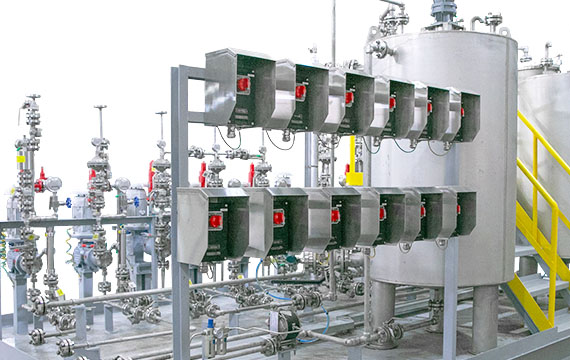
A Depamu chemical injection pump is rarely just a standalone pump. It is typically part of a "skid-mounted device" (often referred to as the DPJY series or similar packages), which is a modular, pre-assembled unit. This skid acts as a mini-factory for chemical dosing .
The primary components of a Depamu injection system include:
-
The Solution Tank: This is the reservoir, usually fabricated from 304 or 316 stainless steel to resist the corrosive nature of the chemicals. For specific applications, tanks can be made of FRP or polyethylene .
-
The Metering Pump (The Heart): Unlike standard centrifugal pumps, Depamu utilizes reciprocating metering pumps. These are typically either plunger (piston) or diaphragm types. Plunger pumps are used for high-pressure applications (up to 50.9 MPa), while Diaphragm Pumps are favored for zero-leakage applications involving toxic or volatile media .
-
The Pulsation Damper: Because Reciprocating Pumps create a "pulse" of fluid rather than a smooth flow, dampeners are installed to smooth out the discharge, ensuring the chemical mixes evenly into the turbulent oil flow .
-
The Control Cabinet (The Brain): This houses the PLC (Programmable Logic Controller), frequency converters, and communication modules that interface with the central DCS (Distributed Control System) .
The Mechanism: How the Fluid is Moved
The operational genius of the Depamu pump lies in its reciprocating mechanism. When the electric motor turns, it drives a series of gears (often double helical gears for quiet, high-torque transmission) that convert rotary motion into linear motion via a connecting rod and crosshead .
-
The Suction Stroke: The piston or plunger moves backward, creating a vacuum in the cylinder head. This suction lifts a check valve, drawing chemical from the solution tank into the cylinder.
-
The Discharge Stroke: The plunger reverses direction, moving forward. The pressure slams the suction valve shut and forces open the discharge valve, pushing the chemical into the pipeline at a pressure exceeding the line pressure.
The defining feature of Depamu technology is the stroke adjustment mechanism. While the motor runs continuously, the length of the plunger's travel can be adjusted from 0% to 100% while the pump is running or stopped . This allows for a turndown ratio that is critical for precision.
Intelligent Control: The Role of Automation and Industry 4.0
The traditional chemical injection pump was a manual device requiring an operator to turn a dial based on a lab report from six hours ago. Depamu pumps, however, operate in the realm of real-time closed-loop control .
Modern Depamu systems utilize frequency converters (VFDs) to alter the motor's speed. More importantly, they integrate directly with upstream sensors. For example, on a natural gas pipeline, a "turbidimeter" or "water cut meter" measures the amount of liquid water in the gas. If the water content spikes, the risk of hydrate formation (ice-like solids that block valves) skyrockets.
The Depamu control system receives this data (often via 4-20 mA standard signals), calculates the necessary adjustment, and automatically alters the pump speed or stroke to inject more Monoethylene Glycol (MEG – a common hydrate inhibitor) . This PPM (parts per million) regulation ensures that chemical concentration is maintained within a tolerance of less than ±1%, and in high-precision configurations, accuracy can reach ±0.2% .
Diverse Applications Across the Oil and Gas Value Chain
Depamu pumps are not limited to one sector. They are versatile enough to handle the three main stages of the industry:
-
Upstream (Extraction): In Enhanced Oil Recovery (EOR), polymer injection pumps thicken water to push more oil out of old wells. In offshore platforms, methanol injection prevents hydrates in subsea flowlines .
-
Midstream (Transportation): As oil travels via pipeline, friction and temperature drops cause issues. Depamu systems inject drag-reducing agents (DRA) to speed up flow and corrosion inhibitors to protect the pipe walls. Hydrazine Injection Packages are also used to scavenge dissolved oxygen in water systems, preventing rust .
-
Downstream (Refining): In refineries, Depamu systems add anti-static agents to jet fuel, anti-wear agents to diesel, and catalysts into cracking units .
Design Philosophy: Redundancy and Safety
Given the hazardous nature of the oilfield, Depamu designs prioritize safety. Many skids feature "2 Tanks + 3 Pumps" configurations . If one pump fails or needs maintenance, the duty pump switches to a standby pump without shutting down the well (a concept known as "parallel operation").
Furthermore, the selection of ceramic plungers is a notable innovation . Oilfield chemicals are often abrasive. Traditional metal plungers wear down quickly, leading to leaks. Ceramic materials offer extreme hardness and resistance to chemical attack, significantly extending the Mean Time Between Repairs (MTBR).
Market Context and Economic Impact
The reliance on such precise machinery is growing. The global chemical injection pump market is projected to grow from roughly $44 billion in 2025 to over $60 billion by 2030 . This growth is driven by the shift toward "mature assets"—older oil fields that require aggressive chemical treatment to keep producing.
Depamu competes on a global stage with giants like Schlumberger and Milton Roy by offering modular customization . Their ability to integrate with existing DCS systems (like Siemens or Allen-Bradley PLCs) makes them a plug-and-play solution for retrofitting old platforms with new technology.
Conclusion
The Depamu chemical injection pump is far more than a simple motor and tube. It is a precise, intelligent, and robust instrument that serves as the immune system for the body of the oil and gas industry. By fighting corrosion, stopping scale, and destroying hydrates, these pumps directly influence the profitability and safety of energy production. Through the marriage of high-pressure reciprocating engineering and smart automation, Depamu ensures that the lifeblood of the global economy—crude oil and natural gas—flows smoothly from the reservoir to the refinery.