

Depamu Stainless Steel Sanitary Single Screw Pump: High Viscosity Slurry Transfer for the Petrochemical Industry
Introduction
The petrochemical industry is characterized by the handling of some of the most challenging fluids found in any industrial setting. From heavy crude oils and bitumen to polymer solutions, catalyst slurries, and oil-water emulsions, petrochemical processes demand pumping equipment capable of managing extremely high viscosities, abrasive solids, and chemically aggressive media — often simultaneously and under demanding operating conditions. Conventional centrifugal pumps, which dominate many fluid transfer applications, are fundamentally unsuited to these tasks. When viscosity exceeds approximately 300 cSt, centrifugal pump efficiency declines sharply, with documented head losses of 8 meters or more and efficiency reductions of 20% at viscosities approaching 800–1000 cP. Above this threshold, positive displacement (PD) pumps become the preferred solution, and among PD pump technologies, the single screw pump — also known as the progressive cavity pump (PCP) — has emerged as the reference technology for viscous, solids-laden, and shear-sensitive fluids.
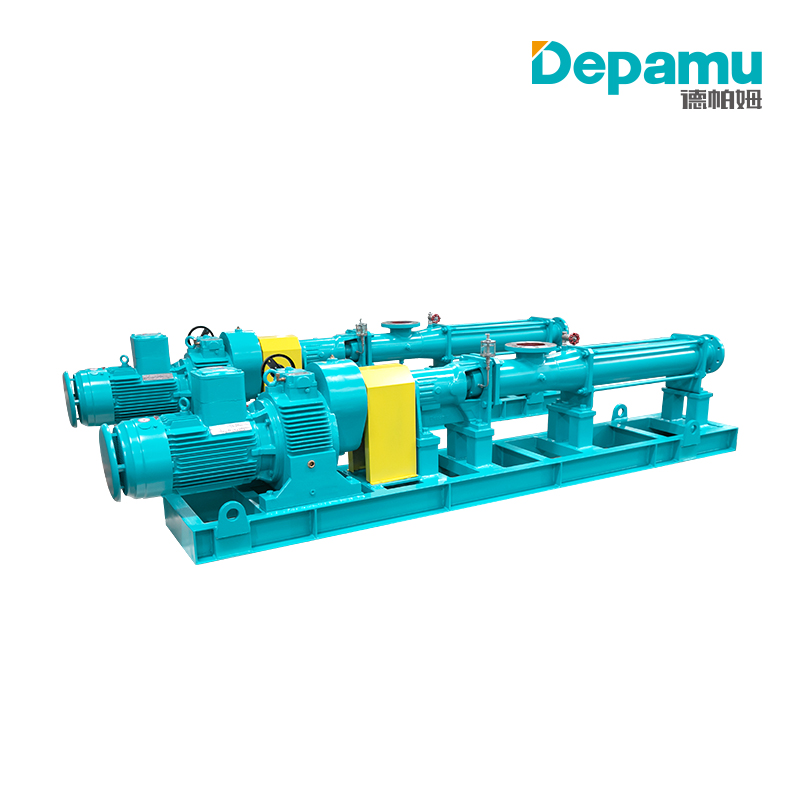
Depamu (Hangzhou) Pumps Technology Co., Ltd., established in 2003 and based in Hangzhou, China, has become a significant player in this specialized pump market. The company manufactures a comprehensive range of fluid transfer equipment, including single screw pumps that leverage advanced German technologies and hold numerous international patents. Depamu’s stainless steel sanitary single screw pump, in particular, addresses the unique challenges of high viscosity slurry transfer in petrochemical applications, combining the robust construction required for industrial service with the hygienic design principles essential for chemical purity and equipment longevity.
The Challenges of High Viscosity Slurry Transfer in Petrochemical Operations
Petrochemical facilities handle an extraordinary diversity of fluid streams. In downstream operations alone, progressing cavity pumps are called upon to transfer bitumen, pitch, heavy vacuum gas oil (HVGO), chemical additives, complex byproducts, catalysts, sludges, emulsions, polymers, and wastewater containing solids. Each of these streams presents distinct pumping challenges. Heavy hydrocarbons such as vacuum residue may exhibit viscosities exceeding 100,000 cP at ambient temperatures, requiring a pump with a positive displacement mechanism that generates flow independent of fluid viscosity. Slurries containing catalyst fines or process solids introduce abrasive wear potential, demanding careful material selection for wetted components. Many petrochemical fluids are shear-sensitive, meaning that excessive agitation or turbulence during transfer can degrade molecular chain structures and alter critical product properties. Furthermore, the presence of corrosive chemicals — from acidic process streams to caustic solutions and organic solvents — necessitates wetted parts constructed from high-grade stainless steel or more exotic alloys.
A further complication arises from the variable nature of petrochemical feedstocks. Refinery operations frequently process crude slates with widely varying physical properties, meaning that a single pump may be required to handle fluids ranging from thin condensates to heavy residual streams. Centrifugal pumps cannot accommodate such variability without significant performance penalties, whereas positive displacement pumps deliver consistent volumetric flow regardless of viscosity fluctuations. This operational flexibility is a critical advantage in petrochemical environments where feedstock composition may change on a daily or even hourly basis.
Principle of Operation: Why Single Screw Technology Excels
The single screw pump operates on the positive displacement principle. Its pumping element consists of a precision-machined, single-helix metallic rotor that rotates eccentrically within a double-helix elastomer stator. As the rotor turns, a series of sealed cavities is formed along the axis of the rotor-stator assembly. These cavities progress continuously from the suction end to the discharge end of the pump, carrying a fixed volume of fluid with each rotation. Because the sealing line between rotor and stator is maintained under both static and dynamic conditions, the pump can generate significant differential pressure without the need for check valves or complex reciprocating mechanisms.
This operating principle confers several advantages that are particularly relevant to petrochemical slurry transfer. First, the flow rate is directly proportional to rotational speed and independent of discharge pressure, enabling precise flow control through variable frequency drive (VFD) adjustment. This means that a single pump can serve simultaneously as a transfer device and a Metering Pump, eliminating the need for separate flow control valves and their associated pressure drop, erosion, and maintenance issues. Second, the gentle, low-shear pumping action preserves the integrity of shear-sensitive polymers and emulsions, a critical requirement in many petrochemical processes. Third, the pump is inherently self-priming, capable of drawing fluid from depths of up to 8 meters without auxiliary priming equipment. Fourth, the absence of valves and narrow clearances allows the pump to handle fluids containing solid particles — including hard suspended solids and fibrous materials — without clogging, with Depamu’s progressive cavity pumps accommodating solids concentrations up to 60% and maximum particle diameters of 10 mm or more.
Depamu Single Screw Pump: Technical Capabilities and Specifications
Depamu’s single screw pumps are engineered to meet the most demanding petrochemical requirements. The pumps feature a transfer capacity ranging from 30 liters per hour to 150 cubic meters per hour, with discharge pressures reaching 4.8 MPa (approximately 48 bar) or higher depending on configuration. Maximum viscosity handling reaches 100,000 cP, and the pumps are designed to comply with API 676 standards, the American Petroleum Institute’s specification for rotary positive displacement pumps used in oil and gas applications. The pumps operate across a temperature range of -12°C to +150°C, making them suitable for both ambient-temperature chemical transfer and elevated-temperature process streams.
The construction of Depamu’s sanitary single screw pumps emphasizes both durability and cleanliness. Wetted components are available in AISI 316L stainless steel, a molybdenum-bearing austenitic alloy that provides superior resistance to pitting and crevice corrosion compared to standard 304 stainless steel. This material is particularly important in petrochemical service, where chlorides, sulfides, and organic acids can rapidly degrade lower-grade alloys. The pump casing and rotor are precision-machined to tight tolerances, ensuring consistent volumetric efficiency and minimal slip even at high differential pressures. The stator, which forms the outer boundary of the pumping cavities, is available in a range of elastomer materials including NBR rubber and fluoroelastomers, allowing the pump to be tailored to specific chemical compatibility and temperature requirements. For particularly aggressive media, the stator can be configured with PTFE or other advanced polymer linings.
The “sanitary” designation of these pumps refers not only to their suitability for food and pharmaceutical applications but more broadly to their hygienic design principles: polished product-contact surfaces that prevent fluid accumulation and facilitate cleaning, absence of dead spaces or crevices where process fluids could stagnate and degrade, and compliance with FDA and EU 1935/2004 regulations for materials in contact with process fluids. In petrochemical contexts, these design features translate directly into operational benefits: reduced risk of cross-contamination between product batches, easier cleaning and maintenance procedures, and extended pump service life by minimizing sites for corrosion initiation and solids build-up.
Petrochemical Applications: Where Depamu Single Screw Pumps Deliver Value
The versatility of Depamu single screw pumps makes them suitable for a wide spectrum of petrochemical applications. In crude oil transportation, these pumps efficiently move heavy and extra-heavy crudes that would overwhelm centrifugal equipment. The positive displacement mechanism generates the pressure required for pipeline transfer without the cavitation risks that plague centrifugal pumps under high-viscosity conditions. In refinery operations, single screw pumps are used for transferring vacuum tower bottoms, catalytic cracker slurry, and asphalt, where high temperatures and abrasive solids demand robust construction and reliable performance.
Chemical injection is another critical application. Petrochemical facilities inject a variety of additives — corrosion inhibitors, scale inhibitors, demulsifiers, and antifoaming agents — into process streams at precise dosages. Depamu single screw pumps, with their flow rate directly proportional to speed and metering accuracy typically within ±1%, are well-suited to these dosing duties. The pumps can be equipped with VFD-controlled motors for automatic flow adjustment in response to process signals, integrating seamlessly into distributed control systems.
Tank farm operations represent a further area of strength. Petrochemical storage facilities require reliable pumps for tank-to-tank transfers, blending operations, and bottom sludge recovery. The self-priming capability of single screw pumps allows them to draw fluids from below-grade sumps and tank pits, while their ability to handle high solids content makes them effective for recovering the heavy sludge that accumulates at the bottom of crude storage tanks. The low NPSH requirement of progressive cavity pumps — significantly lower than that of centrifugal alternatives — further enhances their suitability for these challenging suction conditions.
Wastewater treatment in petrochemical plants also benefits from single screw pump technology. Oily wastewater streams containing emulsified hydrocarbons and suspended solids are difficult to pump with conventional equipment. The gentle, low-shear action of progressive cavity pumps preserves droplet integrity, enhancing the performance of downstream separation equipment and helping facilities meet environmental discharge regulations.
Comparative Advantages Over Alternative Pump Technologies
The choice of pump technology for high viscosity slurry transfer involves a systematic evaluation of viscosity range, solids content, shear sensitivity, pressure requirements, and chemical compatibility. Centrifugal pumps are typically unsuitable for fluids above 300 cSt, with performance deteriorating rapidly as viscosity increases further. Reciprocating plunger and Diaphragm Pumps offer high viscosity tolerance but are limited by valve response issues and mechanical complexity, particularly when handling abrasive slurries that accelerate valve wear. Rotary lobe and gear pumps can handle moderate viscosities but are sensitive to abrasive particles and may experience slip at high differential pressures.
The single screw pump occupies a unique position in this landscape. Its positive displacement mechanism provides reliable performance across viscosities from 1 mPa·s to over 1,000,000 mPa·s. The large cavity openings and sealing line design accommodate solid particles without clogging, while the low internal velocities minimize wear even when handling abrasive media. Flow is uniform and pulsation-free, eliminating the pressure fluctuations that can cause pipe vibration, instrument error, and mechanical seal failure. The pump is reversible, capable of operating with equal efficiency in either direction, which facilitates line clearing and pigging operations. Perhaps most importantly for petrochemical service, the single screw pump can be constructed entirely from corrosion-resistant materials, with no internal valves, springs, or close-clearance metal-to-metal contacts that could become initiation sites for corrosion or erosion.
Depamu’s implementation of single screw technology incorporates several refinements that enhance these inherent advantages. The pumps are available in multiple modular structural combinations, allowing customization for specific flow, pressure, and material requirements. A flexible rod design minimizes connection parts and reduces the risk of foreign matter contamination. The pumps can be configured for horizontal or vertical mounting, with flange or threaded connections, and can be driven by fixed-speed motors, gear reducers, or variable frequency drives as required by the application.
Material Selection and Corrosion Resistance
The petrochemical environment is inherently corrosive. Process streams may contain hydrogen sulfide, carbon dioxide, chlorides, organic acids, and other aggressive species that attack pump components through general corrosion, pitting, stress corrosion cracking, and erosion-corrosion mechanisms. Material selection is therefore a critical determinant of pump reliability and service life.
Depamu addresses this challenge through a tiered approach to materials of construction. The standard sanitary single screw pump features AISI 316L stainless steel for all wetted parts, providing excellent resistance to a broad range of petrochemical media. For more aggressive service — such as streams with high chloride content or low pH — alternative alloys including duplex stainless steel, super duplex, and Hastelloy C can be specified. The stator elastomer is selected based on the specific chemical composition and temperature of the pumped fluid, with fluoroelastomer (FKM) offering superior resistance to hydrocarbons and aromatic solvents compared to NBR rubber.
Surface finish also plays a role in corrosion resistance. Depamu’s sanitary pumps feature polished product-contact surfaces that minimize the adhesion of solids and facilitate cleaning. In petrochemical service, this design feature reduces the risk of under-deposit corrosion, where localized attack occurs beneath accumulated solids or scale. The absence of crevices and dead spaces similarly eliminates sites where stagnant fluid could concentrate corrosive species and initiate pitting.
Operational Reliability and Maintenance
In petrochemical plants, unplanned pump downtime can have cascading consequences — process upsets, production losses, and in some cases, safety incidents. Pump reliability is therefore paramount. Single screw pumps are inherently reliable due to their simple construction: a single rotating element, no valves, and only one dynamic seal. The absence of reciprocating components eliminates the fatigue failure modes that affect diaphragm and plunger pumps, while the low rotational speeds (typically 100–500 rpm depending on size) reduce wear rates and extend bearing life.
Depamu supports operational reliability through a comprehensive after-sales service system, offering 24-hour response to customer inquiries and, when necessary, on-site assistance for troubleshooting. The modular design of Depamu single screw pumps facilitates maintenance: worn stators and rotors can be replaced without disturbing piping connections, and the pumps can be rebuilt in situ for minimal downtime. This serviceability is a significant advantage in petrochemical facilities where access to pump installations may be restricted and where every hour of downtime carries substantial cost.
Conclusion
The transfer of high viscosity slurries in the petrochemical industry demands pumping technology that can accommodate extreme viscosities, abrasive solids, shear-sensitive fluids, and corrosive chemicals — often within a single application. Depamu’s stainless steel sanitary single screw pump addresses these requirements through the proven principles of progressive cavity technology, enhanced by careful material selection, precision manufacturing, and hygienic design. With viscosity handling up to 100,000 cP, solids tolerance to 60%, flow rates to 150 m³/h, discharge pressures to 4.8 MPa, and API 676 compliance, these pumps deliver the performance and reliability that petrochemical operators require. As the industry continues to process heavier feedstocks, more complex chemical streams, and increasingly stringent environmental standards, the role of the single screw pump as the reference technology for difficult fluid transfer is set to expand further. Depamu’s continued investment in research and development, evidenced by over 100 technical patents and a global installed base spanning more than 50 countries, positions the company to meet these evolving challenges with confidence.