

The transport of high-viscosity lubricants in industrial environments presents unique challenges for Depamu-pumps.com/Metering-pump.html target='_blank'>Metering Pump technology. This article examines the suitability of Depamu Mechanical Diaphragm Metering Pumps for handling ISO VG 150 DTE Extra Heavy Oil supplied by Skylink, specifically within the demanding context of paper machine chemical areas. The analysis addresses critical operational parameters including variable flow rate requirements (1–70 LPM and 1–140 LPM), oil temperature ranges (40°C–60°C), and the inherent challenges of suction lift, air ingestion, and low-pressure system dynamics. Furthermore, this article explores the dual-actuation capability (pneumatic or electric motor) specified for future determination, providing engineering guidance for final selection based on site-specific conditions.
1. Introduction
Paper manufacturing facilities represent some of the most challenging environments for fluid handling equipment. The combination of ambient heat, chemical vapors, humidity, and continuous operation demands robust pumping solutions that can maintain precision over extended periods . Within this environment, the lubrication of critical paper machine components requires consistent, metered delivery of high-performance industrial oils such as ISO VG 150 DTE Extra Heavy Oil.
ISO VG 150 viscosity grade oils exhibit a kinematic viscosity of approximately 135–165 cSt at 40°C, placing them in the medium-to-high viscosity range for industrial lubricants. At the specified operational temperature of 60°C, the viscosity of such oil typically reduces to approximately 70–90 cSt. While this reduction facilitates pumping, the fluid remains significantly more viscous than water or light chemicals, demanding careful pump selection .
The Depamu family of mechanical diaphragm metering pumps offers distinct advantages for this application. Unlike centrifugal pumps, which experience performance degradation with viscous fluids, positive displacement metering pumps maintain volumetric efficiency across a wide viscosity range . The reciprocating diaphragm design provides the additional benefit of leak-free operation—a critical consideration in chemical areas where fluid containment is paramount.
2. Pump Technology Overview
2.1 Mechanical Diaphragm Operating Principle
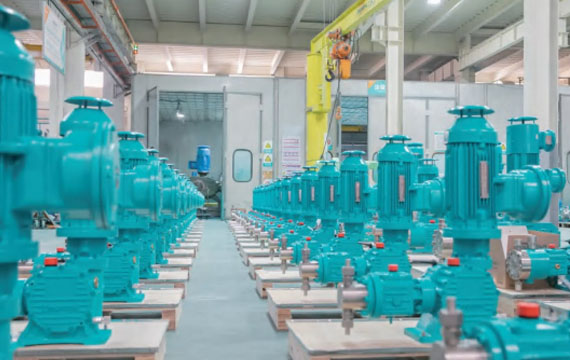
Depamu mechanical diaphragm metering pumps operate on a proven reciprocating principle. An electric motor or pneumatic actuator drives a worm gear pair, converting rotary motion into reciprocating movement through an eccentric mechanism . This reciprocating motion is transmitted to a mechanical diaphragm, typically constructed from PTFE, which undergoes periodic deformation to alternately draw fluid through the inlet check valve and discharge it through the outlet check valve.
The mechanical diaphragm design offers distinct advantages over plunger-type metering pumps when handling industrial oils. The absence of dynamic seals on the wetted end eliminates potential leak paths, while the PTFE diaphragm provides excellent chemical compatibility with petroleum-based lubricants. Furthermore, the diaphragm acts as a hermetic barrier between the process fluid and the pump's power end, protecting internal components from contamination .
2.2 Suitability for ISO VG 150 DTE Extra Heavy Oil
ISO VG 150 DTE Extra Heavy Oil is formulated with advanced additive packages including anti-wear agents, rust inhibitors, and demulsifiers. These additives enhance lubricant performance but impose specific requirements on pump materials. The Depamu pump's wetted-end material options—including 316 stainless steel, PVC, PVDF, and PTFE—provide flexibility to ensure chemical compatibility .
For this specific application, 316 stainless steel wetted components are recommended. This material offers:
-
Excellent corrosion resistance against chemical vapors present in paper mill environments
-
Superior wear resistance when handling fluids containing additive packages
-
Thermal stability across the specified 40°C–60°C temperature range
-
Compatibility with potential future fluids without component degradation
3. Operational Specifications and Challenges
3.1 Flow Rate Requirements
The specified flow rate ranges—1 to 70 LPM and 1 to 140 LPM—represent two distinct operational regimes. In metering pump terminology, these ranges correspond to approximately 60–4,200 L/h and 60–8,400 L/h respectively. The broader range necessitates either dual pump configurations or a pump with exceptional turndown capability.
Depamu mechanical diaphragm metering pumps offer turndown ratios of 10:1 with steady-state accuracy of ±2% . However, achieving the full 140:1 turndown required for the 1–140 LPM range exceeds the practical capability of a single metering pump operating with manual stroke adjustment. The industry recommendation for metering pump operation advises maintaining minimum stroke settings above 10% of capacity to preserve accuracy .
Engineering Recommendation: For the 1–140 LPM requirement, a two-pump configuration is advisable. A larger pump sized for 70–140 LPM operation (approximately 4,200–8,400 L/h) would handle high-flow requirements, while a smaller pump sized for 1–70 LPM (60–4,200 L/h) would address low-flow conditions. Both pumps would be piped in parallel with appropriate isolation valves and a common discharge header.
3.2 Low Pressure System Considerations
The specification indicates a low-pressure system, which significantly influences pump selection. Metering pumps are capable of generating substantial discharge pressures—Depamu units accommodate up to 1.2 MPa (174 psi)—but they require positive differential pressure across the check valves for proper operation . A common failure mode in low-pressure systems is simultaneous opening of inlet and outlet check valves when downstream pressure drops below inlet pressure, resulting in uncontrolled flow.
For low-pressure applications, the installation of a backpressure valve downstream of the pump is recommended. This device maintains a minimum consistent pressure (typically 2–3 bar) on the pump discharge, ensuring proper check valve seating and flow control. The backpressure valve should be specified with materials compatible with ISO VG 150 oil and adjustable for the specific pressure requirements .
3.3 Suction Lift and Air Ingestion
The specification acknowledges two critical operational concerns: potential oil starvation at the intake and air ingestion during suction. These conditions are particularly relevant to metering pumps, which are positive displacement devices intolerant of vapor locking .
Suction Lift Challenges: Metering pumps are designed to push against pressure rather than pull from a distance. While Depamu pumps specify a maximum suction lift of 4 meters (approximately 5.8 psi) with water-like fluids, this capability diminishes significantly with ISO VG 150 oil due to:
-
Higher fluid density increasing the static head requirement
-
Greater viscous friction losses in the suction line
-
Reduced net positive suction head available (NPSHa) at elevated temperatures
Air Ingestion Management: When the suction line draws air or when oil levels deplete, air enters the pump head. Unlike incompressible liquids, gases compress during the discharge stroke, preventing check valve actuation and resulting in vapor lock . This condition stops fluid delivery until manually primed.
Mitigation Strategies:
-
Flooded Suction Configuration: Where possible, position the oil supply tank above the pump centerline, creating positive pressure at the pump inlet
-
Suction Line Design: Minimize suction line length and diameter; maintain continuous slope upward toward the pump
-
Air Release Valves: Install manual or automatic air release valves at high points in the suction piping
-
Low-Level Detection: Implement level sensors in the supply tank with pump interlock to prevent dry operation
For applications where flooded suction is impractical, the installation of a small day tank or priming reservoir, as described in patent literature for low-flow metering applications, provides a robust solution . This approach uses a small transfer pump to maintain a constant head of oil at the metering pump suction, decoupling the metering function from supply conditions.
3.4 Temperature Effects on Pump Performance
The specified oil temperature range of 40°C–60°C has significant implications for pump operation. ISO VG 150 oil at 40°C has a viscosity of approximately 150 cSt; at 60°C, this reduces to approximately 70–80 cSt. This reduction improves flow characteristics and reduces suction losses.
Depamu pumps accommodate fluid temperatures up to 80°C with PTFE diaphragms and appropriate material selection . Within the 40°C–60°C range, no special cooling or heating measures are required, though thermal expansion of the oil should be considered when calibrating flow rates.
4. Actuation Options: Pneumatic vs. Electric Motor
The specification indicates that the pump will be capable of actuation by either air or electric motor, with final determination to be made later. Both options present distinct advantages and limitations for this application.
4.1 Pneumatic (Air-Driven) Actuation
Depamu offers pneumatic stroke adjustment as an option on their mechanical Diaphragm Pump platform . Air-driven actuation provides several benefits for paper machine environments:
Advantages:
-
Intrinsically Safe: No electrical components in the pump drive, eliminating ignition sources in potentially hazardous chemical areas
-
Variable Speed Control: Air motor speed adjustment provides infinite flow rate variation without mechanical stroke adjustment
-
Stall Capability: Air motors can operate at deadhead conditions without damage
-
Low Maintenance: Simpler construction with fewer wearing components than electric motors
Limitations:
-
Air Quality Requirements: Requires clean, dry, lubricated compressed air (typically 5–7 bar)
-
Energy Efficiency: Pneumatic systems are generally less energy-efficient than electric drives
-
Speed Stability: Air motor speed may vary with compressed air supply pressure fluctuations
-
Noise: Pneumatic systems generate higher noise levels than electric drives
Application Suitability: Pneumatic actuation is particularly well-suited for paper machine chemical areas where electrical equipment requires hazardous location ratings. If the installation area contains solvent vapors, dust, or other flammable materials, pneumatic drives may reduce classification requirements and associated costs.
4.2 Electric Motor Actuation
Depamu mechanical diaphragm pumps can be equipped with electric motors ranging from 0.37 kW to 1.5 kW depending on flow and pressure requirements . Variable frequency drive (VFD) compatibility allows electronic speed control for flow regulation.
Advantages:
-
Precise Speed Control: VFD operation provides accurate, repeatable flow adjustment
-
Energy Efficiency: Electric motors consume power only when pumping
-
Remote Monitoring: Integration with plant control systems for flow monitoring, alarms, and automation
-
Clean Operation: No exhaust air or oil mist from the drive system
-
Lower Operating Cost: Electric power typically costs less than compressed air energy
Limitations:
-
Hazardous Area Compliance: Motor and controls must be rated for chemical area classification (e.g., Class I, Division 2 or ATEX)
-
Starting Torque: Requires adequate starting torque for viscous oil at ambient temperatures
-
Thermal Protection: May require external cooling in high-ambient-temperature paper machine environments
Application Suitability: Electric actuation is preferred where precise flow control, SCADA integration, and energy efficiency are priorities. However, the electrical equipment must be properly specified for the chemical area classification.
4.3 Hybrid Approach Consideration
Given that the final actuation method remains undetermined, a hybrid design approach warrants consideration. The pump can be specified with a standard worm gear input shaft configured for motor mounting, while incorporating a pneumatic stroke adjuster for flow control . This arrangement provides:
-
Electric motor drive for efficient continuous operation
-
Pneumatic stroke control for remote flow adjustment
-
Compatibility with either actuation philosophy depending on final site conditions
5. Environmental Considerations: Paper Machine Chemical Area
The installation environment significantly influences material selection, enclosure ratings, and auxiliary equipment requirements.
5.1 Chemical Compatibility
Paper machine chemical areas typically contain chlorine dioxide, sodium hydroxide, hydrogen peroxide, and various biocides. While ISO VG 150 oil is not inherently corrosive, airborne chemical vapors can attack pump components. The following material selections are recommended:
| Component | Recommended Material | Rationale |
|---|---|---|
| Pump Head | 316 Stainless Steel | Superior corrosion resistance |
| Diaphragm | PTFE | Chemical inertness, temperature stability |
| Check Valves | 316 SS with ceramic balls | Wear resistance, corrosion protection |
| Enclosure | Cast aluminum with epoxy coating (NEMA 4X / IP66) | Protection against washdown and chemical exposure |
| Fasteners | 316 SS or better | Prevent galvanic corrosion |
5.2 Ambient Temperature and Humidity
Paper machine environments often experience elevated temperatures and high humidity from drying sections and steam systems. The pump should be specified with:
-
Enclosure ventilation or cooling if ambient temperatures exceed 50°C
-
Appropriate lubricants for the power end (synthetic oils recommended for extended temperature range)
-
Sealed electrical connections to prevent moisture ingress
Conclusion
The Depamu mechanical diaphragm metering pump family offers a robust solution for metering ISO VG 150 DTE Extra Heavy Oil in paper machine chemical environments. The positive displacement design maintains volumetric efficiency across the specified viscosity range, while the mechanical diaphragm provides leak-free operation essential for chemical area safety.
The flow rate requirements spanning 1 to 140 LPM exceed the practical turndown capability of a single metering pump and are best addressed through a dual-pump parallel configuration. The low-pressure system specification necessitates the installation of a backpressure valve to ensure proper check valve operation. Challenges associated with suction lift and potential air ingestion require careful piping design and, where conditions are unfavorable, the installation of a flooded suction arrangement or day tank.