

Depamu Anti-Foam Injection Packages for Oilfield and Refining Applications: Engineered for the Russian Market
Introduction
Foam formation is one of the most persistent and costly operational challenges in the oil and gas industry. From wellhead separation and gas gathering systems to crude oil distillation and vacuum resid processing, uncontrolled foaming reduces equipment efficiency, accelerates corrosion, causes product loss, and in severe cases triggers emergency shutdowns. For Russia—the world's second-largest producer of natural gas and among the top three crude oil producers—the effective management of foam across upstream and downstream operations is not merely a technical concern but an economic imperative.
Depamu, a globally recognized manufacturer of Metering Pumps and fluid injection systems headquartered in Hangzhou, China, has developed a comprehensive line of anti-foam injection packages specifically engineered to meet the demanding requirements of Russian oilfields and refineries. With a proven track record in Russia that includes supplying critical fluid equipment for the Arctic LNG 2 project, Depamu combines high-precision metering technology with robust, cold-climate-ready engineering to deliver foam control solutions that perform reliably across the full spectrum of Russian operating conditions.
The Technical Challenge of Foam in Oil and Gas Operations
Foaming occurs when gas becomes entrained in liquid hydrocarbons or aqueous process streams, creating stable bubbles that resist coalescence and collapse. In oilfield gathering and separation systems, foam reduces the effective liquid capacity of separators, carries over into gas lines, and interferes with level control instrumentation. In refineries, foaming during crude distillation, coking, and vacuum tower operations can lead to entrainment of heavy fractions into overhead products, fouling of downstream units, and reduced throughput.
The fundamental mechanism of foam stabilization involves the adsorption of surface-active species—naturally occurring naphthenic acids, asphaltenes, and added surfactants—at the gas-liquid interface. Anti-foam agents, also known as defoamers, function by reducing interfacial tension and promoting bubble coalescence. Silicone-based formulations, particularly polydimethylsiloxane (PDMS) compounds, are the most widely used class of anti-foam agents in the oil and gas industry due to their exceptionally low surface tension and thermal stability. Oil-based and water-based antifoams offer complementary performance characteristics depending on the nature of the process stream and the compatibility requirements of downstream catalysts or refining steps.
The efficacy of any anti-foam program depends not only on the chemical formulation but equally on the precision of its injection. Over-dosing wastes expensive chemistry, may contaminate process streams, and can itself create secondary foaming or fouling issues. Under-dosing leaves foam problems unresolved. This is where Depamu's injection package technology becomes critical: the packages are designed to deliver the optimum chemical volume with a metering accuracy of ±0.5% or better, ensuring both process reliability and cost efficiency.
Depamu Anti-Foam Injection Packages: Technical Architecture and Capabilities
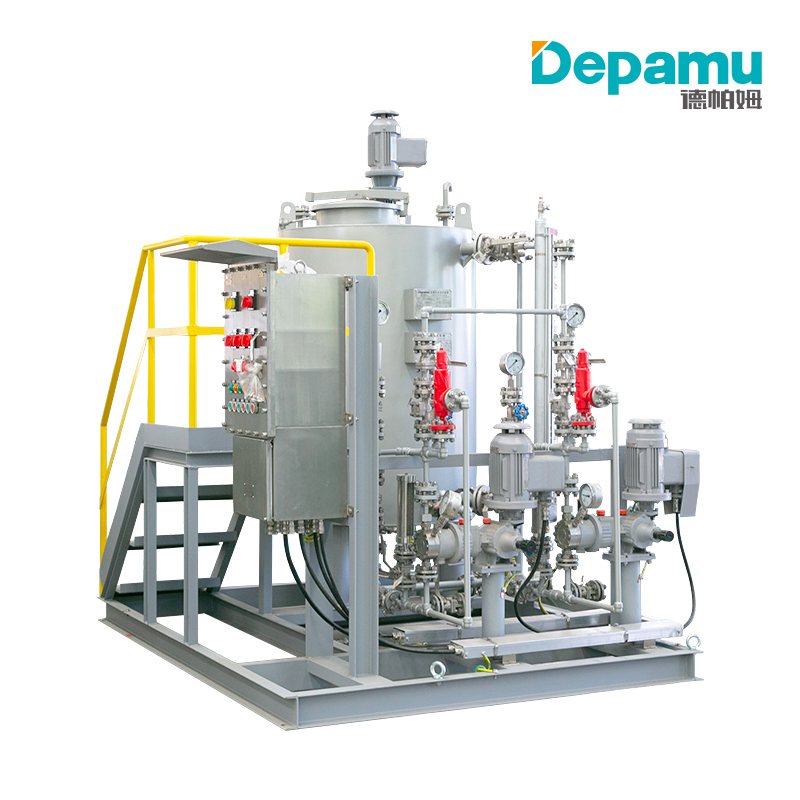
Depamu's anti-foam injection packages are integrated skid-mounted systems that combine solution tanks, metering pumps, level gauges, safety valves, pulsation dampeners, piping, valves, and electrical control cabinets on a single structural base. This compact, factory-assembled configuration enables rapid installation and commissioning at field locations, reducing on-site construction time and minimizing the risk of assembly errors.
The packages are available in multiple configurations to match different operational scales. Standard combinations include one tank with two pumps (1T+2P), two tanks with three pumps (2T+3P), and two tanks with four pumps (2T+4P), with solution tank volumes ranging from 0.5 m³ to 20 m³ depending on the application. Metering pump capacities span from 10 L/h to 1500 L/h, with discharge pressures from 0.3 MPa to 4.0 MPa for typical oilfield and refining applications. For high-pressure wellhead injection or hydrate inhibitor service, Depamu's Hydraulic Diaphragm Metering Pumps can achieve discharge pressures of up to 32 MPa and beyond, making them suitable for the most demanding upstream conditions.
The heart of each injection package is Depamu's precision metering pump. Available in plunger and hydraulic diaphragm configurations, these pumps are engineered for continuous duty with minimal maintenance. The hydraulic diaphragm design eliminates the risk of process fluid leakage to the environment, a critical advantage when injecting anti-foam agents into high-pressure hydrocarbon streams. Diaphragm Pumps in the package are equipped with PTFE or other chemically resistant diaphragm materials, and wetted parts can be specified in 316 stainless steel, 304 stainless steel, carbon steel with rubber or plastic lining, FRP, PE, or PVC to accommodate the specific corrosion environment of each application.
At the control level, Depamu's intelligent injection packages incorporate online instrument testing and feedback systems that allow real-time adjustment of chemical injection rates. The system can concentrically or remotely receive process media parameters and automatically regulate the chemical injection volume in proportion to the process medium flow rate, maintaining the target parts-per-million (PPM) concentration within a closed-loop control architecture. This level of automation ensures consistent foam control even as production rates and process conditions fluctuate—an essential capability in mature Russian fields where water cuts and gas-oil ratios change continuously over the production life cycle.
Adapting to Russian Operating Conditions
Russia's oil and gas provinces span an extraordinary range of climatic and geological conditions. The West Siberian basin, which accounts for the majority of Russian oil production, presents operating temperatures that routinely fall below −40°C in winter. The Arctic offshore fields and the Yamal Peninsula projects experience even more extreme conditions, with ambient temperatures dropping to −52°C. Meanwhile, refining complexes in the Volga-Ural region and the Black Sea coast operate in more moderate but still demanding industrial environments.
Depamu has demonstrated its capability to engineer fluid equipment for these extreme conditions. For the Arctic LNG 2 project on the Gydan Peninsula, Depamu supplied high-pressure process diaphragm pumps and hydraulic diaphragm metering pumps designed to meet the project's extremely low-temperature operating conditions and specialized medium transportation requirements. The company's equipment was selected to replace what had previously been supplied by American vendors for Arctic LNG 1, marking a significant milestone in Depamu's ability to deliver technology that meets or exceeds the standards of established Western suppliers in Russia's most challenging energy projects. This project serves as a powerful reference for the deployment of Depamu anti-foam injection packages in Russian oil and gas facilities, where proven cold-climate reliability is a non-negotiable requirement.
For Russian oilfield deployment, Depamu injection packages can be specified with low-temperature steel and heating jackets for solution tanks and piping, ensuring that anti-foam agents remain pumpable and injectable even in winter conditions. The metering pumps themselves are designed for reliable operation with liquids ranging from −60°C to +200°C, with heating jackets for valve and hydraulic block components extending the upper temperature limit to +400°C for high-temperature refinery streams.
Market Context and Regulatory Compliance
The Russian anti-foaming agents market was valued at approximately USD 174.6 million in 2024 and is projected to reach USD 197.1 million by 2030, with a compound annual growth rate of 2.05%. The oil and gas sector remains the primary driver of demand, as foam control is essential in drilling, refining, and petrochemical operations to maintain smooth processing and prevent equipment damage. Increasing investment in upstream and downstream projects, combined with enhanced refinery operations, is generating strong demand for high-performance silicone-based anti-foaming agents across Russia.
For equipment suppliers, the Russian market presents both opportunities and challenges. Economic sanctions and disrupted supply chains have impacted the import of specialty chemicals and raw materials, leading Russian operators to prioritize suppliers who can offer localized support, robust supply chains, and technology that complies with Russian regulatory standards. The GOST R 58367-2019 standard, which governs the arrangement of onshore oilfield facilities, specifically requires the provision of chemical dosing units for the introduction of reagents—including anti-foam agents—into pipeline systems for oil, gas, and water treatment. This regulatory framework creates a clear mandate for the type of integrated, automated injection packages that Depamu manufactures.
Depamu's presence in the Russian market has been reinforced by its participation in major industry exhibitions such as NEFTEGAZ, where the company has showcased its full range of metering pumps, high-pressure Reciprocating Pumps, pneumatic diaphragm pumps, and water treatment equipment to Russian oil and gas operators. The company maintains a representative office in Moscow and has established distribution relationships with Russian industrial partners, enabling localized technical support and after-sales service.
Integration with Depamu's Broader Injection Package Portfolio
The anti-foam injection package is one component within Depamu's comprehensive portfolio of chemical injection solutions for the petroleum and petrochemical industry. The same platform technology is used for demulsifier injection, corrosion inhibitor injection, scale inhibitor injection, deoxidant injection, germicide injection, methanol injection, and hydrate inhibitor injection. This standardization across product lines offers significant advantages to Russian operators: a single supplier can provide all chemical injection requirements for a field development or refinery complex, with consistent engineering standards, compatible control systems, and consolidated spare parts inventories.
For oilfield applications, anti-foam injection is typically deployed at multiple points in the production system: at the wellhead to prevent foam formation in flowlines, at the inlet of three-phase separators to enhance separation efficiency, and in gas gathering systems to prevent foam carryover into compression and dehydration units. In refinery applications, anti-foam injection is employed in crude distillation units, vacuum distillation towers, delayed cokers, and fluid catalytic cracking units. Depamu injection packages can be configured for each of these service points, with materials of construction, pump specifications, and control algorithms tailored to the specific fluid properties and operating parameters of each location.
Service, Support, and Lifecycle Value
The value proposition of Depamu injection packages extends beyond the initial equipment supply. The company emphasizes engineering support throughout the project lifecycle, from initial process consultation and system sizing through installation supervision, commissioning, and ongoing maintenance. In the Russian context, where remote field locations and harsh winter conditions can complicate service logistics, the reliability of injection equipment is paramount. Depamu's design philosophy prioritizes robustness and maintainability: metering pumps are engineered for long service intervals, components are modular for rapid replacement, and the skid-mounted configuration allows for pre-commissioning testing at the factory before shipment to site.
The company's track record in Russia—including successful deliveries to Arctic LNG 2 and its established presence at Russian industry exhibitions—demonstrates a commitment to the market that goes beyond transactional equipment supply. For Russian oil and gas operators seeking to reduce dependence on Western suppliers while maintaining high standards of process reliability and safety, Depamu offers a technologically mature, cost-competitive alternative.
Conclusion
Foam control is an often-underappreciated but critically important aspect of oil and gas operations, and the injection equipment that delivers anti-foam chemistry must perform with absolute reliability across a wide range of temperatures, pressures, and fluid compositions. Depamu's anti-foam injection packages address this requirement with a combination of precision metering technology, robust construction, intelligent control systems, and proven cold-climate engineering. For Russian oilfields and refineries—where operating conditions are among the most demanding in the world and where the regulatory framework explicitly requires reliable chemical dosing infrastructure—Depamu offers a solution that is technically capable, market-appropriate, and backed by an expanding record of successful deployments in the Russian energy sector. As the Russian oil and gas industry continues to modernize its infrastructure and optimize production efficiency, the adoption of advanced, locally supported anti-foam injection systems will remain a practical and high-return investment.