

How Does Depamu Food Grade Pumps (Rotor Pump) Transform Fluid Handling in the Food Industry?
Introduction
The food and beverage industry demands exceptional precision, hygiene, and reliability in every stage of production. From transferring delicate dairy products to handling viscous sauces and syrups, the equipment used to move these sensitive materials directly impacts product quality, safety, and operational efficiency. Among the various types of pumps deployed in food processing facilities, the rotary lobe pump—often referred to as a rotor pump—has emerged as one of the most versatile and dependable solutions. Depamu, a leading Chinese pump manufacturer based in Hangzhou, has developed a comprehensive range of rotor pumps that address the unique challenges of food-grade fluid handling, combining German engineering principles with advanced manufacturing capabilities. This article provides an in-depth examination of how Depamu food-grade rotor pumps work, what distinguishes them from alternative pumping technologies, and why they have become indispensable in modern food and beverage production.
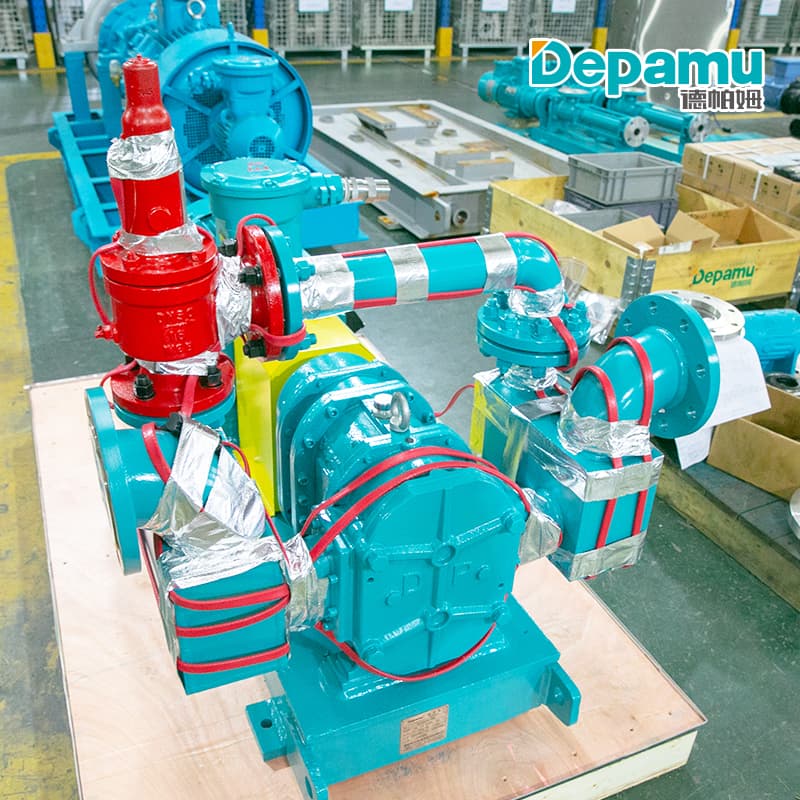
Understanding the Fundamentals of Rotor Pump Technology
To appreciate the value of Depamu's rotor pumps, one must first understand the fundamental operating principles of rotary lobe pump technology. Rotary lobe pumps belong to the category of positive displacement pumps, meaning they move fluid by trapping a fixed volume of liquid and forcing it into the discharge pipe rather than relying on centrifugal force. The working principle is based on two synchronized rotors rotating inside the pump chamber, creating periodic changes in the working volume to achieve suction, transfer, and discharge of fluids.
During operation, a low-pressure area is formed at the suction side as the rotors rotate and separate, allowing fluid to enter the pump chamber. As the rotors continue their rotation, the sealed chamber volume decreases, and the fluid is smoothly discharged under the extrusion effect of the rotors. A precise clearance is maintained between the rotors and between each rotor and the pump body—typically ranging from 0.05 to 0.3 millimeters depending on the viscosity and characteristics of the transported fluid—avoiding direct contact and significantly reducing wear for long-term reliable operation.
Depamu offers two principal categories of rotor pumps: metal rotor pumps and rubber rotor pumps. The metal variants are designed as per API 676 standards, featuring a compact structure and small mounting space, making them suitable for a wide range of industrial applications. The rubber rotor pumps, on the other hand, employ elastomeric wide-blade rotors based on 5-axis linkage or three-dimensional flow technology, providing enhanced flexibility and durability in demanding conditions.
The Depamu Advantage: Engineering Excellence and Innovation
Depamu (Hangzhou) Pumps Technology Co., Ltd., established in 2003, has grown to become one of the leading rotor pump manufacturers and suppliers in China, with a registered capital of 54 million yuan and a 35,000-square-meter manufacturing facility. The company has successfully integrated advanced German technology with domestic innovation, securing over 100 technical patents and participating as a drafter of pump industry standards.
What truly distinguishes Depamu's rotor pumps is their modular design philosophy. Every Depamu Rotor Pump adopts the design of an integral pump body and gear cavity, realizing low maintenance costs and a long service life. The company offers five series and seven models of rotor pumps, with flow rates ranging from 0.1 to 10,000 cubic meters per hour and working temperatures spanning from -40°C to 280°C. Same-series models share common components including rotors, gears, bearings, axial linings, and mechanical seals, which simplifies spare parts inventory management and reduces operational costs for food processing facilities.
One of the most innovative features of Depamu rotor pumps is their online maintenance capability. All wearing parts can be easily replaced at the site by an operator without the need for dismantling any pipeline or driver, and an easy-open pump cover enables simple servicing of the internal pump body. For food production environments where downtime translates directly into lost revenue, this design feature represents a substantial operational advantage.
Key Technical Specifications and Performance Characteristics
Depamu rotor pumps are engineered to handle an impressive range of operating conditions. The pumps are capable of transporting media with viscosities of up to 2 million centipoise and can handle solid content of up to 60 percent at flow rates ranging from 0.1 to 3,000 cubic meters per hour. The discharge pressure reaches 1.8 megapascals for standard configurations and up to 3.0 megapascals for multi-stage pump designs.
The maximum diameter of compressible materials that can pass through the pump is 80 millimeters, enabling the stable transportation of solid, liquid, and gas mixtures with minimal pulsation. This capability is particularly valuable in food processing applications involving fruit pieces, vegetable chunks, or other particulate-laden products. The three-dimensional flow finishing die and five-axis linkage techniques employed in manufacturing contribute to high efficiency with minimal noise output.
The pumps feature excellent self-priming capability with a maximum suction head of up to 9 meters, eliminating the need for auxiliary water irrigation devices or priming equipment. The dual-support structure provides superior stability, and the low operating speed range of 10 to 650 revolutions per minute ensures minimal wear while extending the pump's operational lifespan. The flow rate can be conveniently adjusted and controlled through rotational speed regulation, making the pump particularly suitable for applications with variable flow requirements.
Hygiene and Food Safety: Meeting the Highest Standards
For food-grade applications, hygiene is not merely a feature—it is an absolute necessity. Depamu rotor pumps are designed with food safety as a primary consideration, incorporating materials and construction methods that comply with the stringent requirements of the food and beverage industry.
The pumps are capable of handling shear-sensitive media including specialty materials, and they are suitable for conveying flammable and explosive chemical liquids. The low-shear conveying mechanism prevents damage to fluid structure and properties, which is critical when processing products such as yogurt, creams, and emulsions where shear damage can irreversibly alter texture and consistency.
Depamu rotor pumps feature a reliable mechanical sealing design suitable for corrosive and toxic media, with a large seal chamber that accommodates various mechanical seal types. The completely symmetric structure allows for simple interchange of inlet and outlet directions, providing flexibility in installation and facilitating cleaning procedures. The compact structure, with minimal dead spaces, supports effective Cleaning in Place and Sterilization in Place protocols, which are essential for maintaining sanitary conditions in food production environments.
The positive displacement design also enables reverse operation, which facilitates quick blockage removal and reduces maintenance costs—a significant advantage in food processing where product buildup can occur. The flexible rotor design allows the passage of small particles while reducing the risk of damage to both the pump and the product being conveyed.
Comparative Advantages Over Alternative Pump Technologies
Understanding why rotary lobe pumps are preferred over other pump types in specific food processing applications requires a comparative analysis. Centrifugal pumps, while efficient and cost-effective for low-viscosity fluids such as water and thin fruit juices, are generally unsuitable for high-viscosity products. As viscosity increases, centrifugal pump efficiency drops dramatically, and the shear forces generated can damage sensitive food products.
Rotary lobe pumps, by contrast, maintain consistent performance across a wide viscosity range. They are particularly suited to high-viscosity and shear-sensitive fluids, designed for continuous operation across nearly all industrial sectors. The lobe design can be selected depending on the viscosity and lumpiness of the fluids to be conveyed, with five different lobe designs and five different seal options available to match specific application requirements.
Compared to progressive cavity pumps, rotary lobe pumps offer advantages in terms of maintenance accessibility and the ability to handle larger solid particles without damage. The absence of valves in the pumping chamber reduces the risk of clogging and simplifies cleaning procedures. Furthermore, the reversible operation capability of rotary lobe pumps provides a significant operational advantage when blockages occur, as the pump direction can simply be reversed to clear the obstruction.
For food manufacturers evaluating pump options, the decision typically comes down to the specific characteristics of the product being handled. Thin, low-viscosity liquids can be efficiently moved using centrifugal pumps, while viscous, particulate-laden, or shear-sensitive products are better served by positive displacement alternatives such as rotary lobe pumps.
Applications Across the Food and Beverage Spectrum
Depamu rotor pumps find extensive application across the full spectrum of food and beverage production. The company's products are widely used in the green food and beverage industries, as well as in pharmaceutical chemical processing, water treatment, and new material development.
In dairy processing, rotary lobe pumps handle products ranging from raw milk to thick yogurt and cheese curds. The gentle, low-shear pumping action preserves the structural integrity of dairy products, while the CIP/SIP compatibility ensures that stringent hygiene standards can be maintained between production runs. The pumps' ability to handle products with high solid content makes them particularly suitable for applications involving cottage cheese, fruit-on-the-bottom yogurt, and other particulate-containing dairy products.
In beverage production, Depamu rotor pumps transfer fruit juices, concentrates, syrups, and purees. The pumps' ability to handle high-viscosity fluids and shear-sensitive products ensures that flavor compounds and texture characteristics remain intact throughout the production process. The compact structure and flexible installation options allow integration into space-constrained production lines, while the stable, low-pulsation flow ensures accurate filling and portioning operations.
Beyond dairy and beverages, Depamu rotor pumps serve the broader food industry in applications such as sauce and condiment production, confectionery manufacturing, edible oil processing, and food flavor and fragrance extraction. The pumps are also employed in supercritical CO2 fluid extraction equipment for the extraction of oils and fats, flavors and fragrances, animal and plant fat-soluble components, plant alkaloids, and food colorings.
Reliability, Longevity, and Operational Economics
The economic case for Depamu rotor pumps extends beyond their initial purchase price. The pumps are designed for exceptional durability, with wear-resistant and corrosion-resistant axial and radial supply components that ensure extended pump life. The low operating speed contributes to minimal wear, while the precision manufacturing tolerances—maintained at 0.05 to 0.3 millimeters between rotors and between rotor and pump body—minimize internal leakage and maintain volumetric efficiency over time.
The modular design and online maintenance capability significantly reduce total cost of ownership. Because wearing parts can be replaced without dismantling pipelines or drivers, maintenance labor costs are substantially lower compared to pumps that require complete removal for servicing. The shared components across same-series models further reduce spare parts inventory requirements.
Depamu's commitment to quality is evidenced by its multiple certifications, including CE, EAC, ISO 9001, ISO 14001, and ISO 45001, along with its participation as a drafter of pump industry standards. The company maintains a professional after-sales service team providing 24/7 hotline support, with response mechanisms activated immediately upon receiving equipment failure or technical support requests, and solutions provided within 24 hours.
Conclusion
Depamu food-grade rotor pumps represent a sophisticated engineering solution to the complex challenges of fluid handling in the food and beverage industry. By combining positive displacement pumping principles with advanced materials, precision manufacturing, and thoughtful design features, Depamu has created a product line that delivers exceptional performance across the full range of viscosity, solid content, and temperature conditions encountered in food processing.
The pumps' ability to handle high-viscosity fluids, shear-sensitive products, and particulate-laden media while maintaining hygienic standards makes them indispensable in modern food production facilities. The emphasis on online maintenance, modular design, and operational reliability translates directly into reduced downtime and lower total cost of ownership—critical factors in an industry characterized by thin margins and demanding production schedules.
As the global food industry continues to evolve toward higher standards of quality, safety, and efficiency, the role of advanced pump technology will only grow in importance. Depamu's rotor pumps, with their combination of German-inspired engineering, Chinese manufacturing efficiency, and comprehensive technical support, are well-positioned to meet these evolving demands. For food manufacturers seeking reliable, hygienic, and cost-effective fluid handling solutions, Depamu food-grade rotor pumps offer a compelling answer to one of the industry's most fundamental operational questions: how to move sensitive products safely, gently, and efficiently from one production stage to the next.