

The Depamu Metal Rotor Pump: An Engineered Solution for Acrylic Fiber Slurry Transfer
Abstract
The transfer of acrylic fiber slurry represents one of the most demanding applications in chemical fiber processing. This viscous, abrasive, and shear-sensitive medium challenges conventional pumping technologies, often resulting in premature equipment failure, product degradation, and costly downtime. The Depamu metal rotor pump emerges as a purpose-engineered solution for this critical process application. This article examines the technical characteristics of acrylic fiber slurry, analyzes the operational challenges it presents, and demonstrates how the Depamu Rotor Pump's design features—including its positive displacement mechanism, non-pulsating flow characteristics, and robust construction—specifically address these challenges. The pump's compliance with API 676 standards, exceptional solids-handling capability, and low-speed operation are evaluated in the context of chemical fiber production environments.
1. Introduction
Acrylic fiber production involves a complex chemical process in which acrylonitrile-based polymers are dissolved in solvents and extruded through spinnerets to form continuous filaments. A critical intermediate stage in this process is the handling of acrylic fiber slurry—a mixture of polymer solids, solvents, and processing aids that exhibits challenging rheological properties. This slurry must be transferred between process stages with precision, reliability, and without compromising the integrity of the fibers being formed.
The selection of pumping equipment for acrylic fiber slurry is not a trivial matter. The medium's abrasive character, high viscosity, and tendency to cause clogging in conventional pumps have historically made this application a source of operational headaches. Among the solutions available to process engineers, the Depamu metal rotor pump has gained recognition for its ability to meet these challenges. This article explores why this particular pump design is well-suited for acrylic fiber slurry transfer and how its technical features translate into operational advantages.
2. Understanding Acrylic Fiber Slurry: A Demanding Medium
Before examining the pump solution, it is essential to understand the nature of the medium being pumped. Acrylic fiber slurry typically possesses several characteristics that make it problematic for conventional pumping equipment.
2.1 Viscosity and Rheology
Acrylic fiber slurry exhibits high viscosity, often exceeding 100,000 centipoise (cP) depending on polymer concentration and temperature . More importantly, the slurry often displays non-Newtonian behavior—its apparent viscosity changes with shear rate. This means that the pump must not only handle high viscosity but also accommodate variable rheological properties as the slurry moves through the system.
2.2 Abrasive Solids Content
The slurry contains significant quantities of solid polymer particles and, in some processes, fibrous material. These solids are abrasive, accelerating wear on pump components . In conventional centrifugal pumps, this abrasiveness leads to rapid impeller and casing wear, while in progressing cavity pumps, the elastomer stator is particularly vulnerable to erosion and chemical degradation.
2.3 Shear Sensitivity
Acrylic polymer chains are susceptible to mechanical degradation under high shear conditions. Excessive shear during pumping can reduce molecular weight, affecting the final fiber properties. This shear sensitivity demands a pumping solution that delivers gentle, low-turbulence transfer.
2.4 Chemical Corrosiveness
The solvents and processing chemicals present in acrylic fiber slurry can be chemically aggressive. Equipment must withstand both the chemical attack of the process fluid and the abrasive action of its solid content.
3. The Depamu Metal Rotor Pump: Design Philosophy
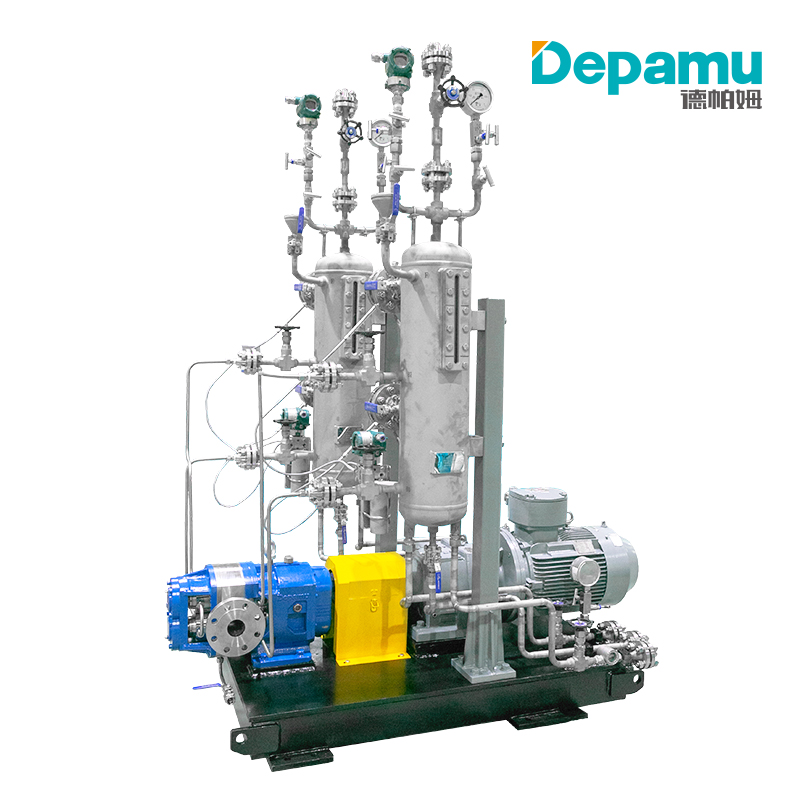
The Depamu metal rotor pump belongs to the family of positive displacement rotary lobe pumps. Its fundamental operating principle involves two synchronized rotors rotating in opposite directions within a close-clearance casing. As the rotors turn, they create cavities that trap fluid on the suction side and transport it to the discharge side . The Depamu design incorporates several features specifically relevant to challenging slurry applications.
3.1 Positive Displacement Principle
Unlike centrifugal pumps, which rely on imparting velocity to the fluid and converting that velocity to pressure, the Depamu rotor pump is a positive displacement device. Each rotation displaces a fixed volume of fluid, generating pressure independent of the fluid's viscosity . This characteristic makes it inherently suitable for high-viscosity fluids that would render centrifugal pumps ineffective.
3.2 Metal Rotor Construction
The use of metal rotors, typically in stainless steel or specialized alloys, distinguishes the Depamu pump from designs that employ elastomeric components. Where a progressing cavity pump relies on a rubber or polymer stator that contacts the rotating metal rotor , the Depamu design features rigid metal rotors with precisely controlled clearances. This eliminates the wear and degradation issues associated with elastomers in abrasive slurry service .
3.3 Non-Pulsating Flow
The rotor geometry and synchronized operation produce a flow that is substantially pulsation-free . This is critical for acrylic fiber slurry, as pressure pulsations can disturb the homogeneity of the suspension and contribute to fiber degradation. The smooth flow characteristic also simplifies downstream process control.
3.4 High Solids Capability
The Depamu rotor pump is capable of handling slurries with solid contents up to 60% . The rotor design features a high "passing rate"—the ability to accommodate solids without clogging. The maximum particle size that can be handled without blockage is substantial, and the pump's construction ensures that fibrous materials pass through without wrapping around the rotors.
4. Technical Specifications and Operational Capabilities
The Depamu rotor pump's specifications demonstrate its suitability for the demanding acrylic fiber slurry application.
4.1 Flow and Pressure Range
The pump can deliver flows ranging from 0.2 to 1,500 m³/h, with discharge pressures up to 1.5 MPa . This flexibility allows the pump to serve various process stages, from low-pressure transfer between vessels to higher-pressure delivery to filtration or spinning equipment.
4.2 Self-Priming and Suction Lift
A significant operational advantage is the pump's self-priming capability. The Depamu rotor pump can achieve suction lifts up to 9 meters . This eliminates the need for foot valves or priming chambers, simplifying installation and reducing the risk of dry-running damage.
4.3 Speed Range and Operational Life
The pump operates at low speeds, typically between 10 and 650 RPM . Low-speed operation is advantageous for several reasons: it reduces wear on all components, minimizes shear imposed on the pumped medium, and contributes to quiet operation. The low speed, combined with the pump's robust construction and available wear-resistant materials, results in extended service life even in abrasive slurry service.
4.4 Temperature and Viscosity Range
The pump can handle fluids with viscosities up to 2 million cP and temperatures appropriate for chemical processing applications . For acrylic fiber slurry, which is often handled at elevated temperatures to reduce viscosity, the pump's thermal capabilities are more than adequate.
5. Technical Challenges in Acrylic Fiber Slurry Transfer
To fully appreciate the Depamu pump's advantages, it is helpful to understand the specific challenges that arise when other pump types are applied to acrylic fiber slurry transfer.
5.1 Limitations of Centrifugal Pumps
Centrifugal pumps, while widely used in many industrial applications, perform poorly with high-viscosity fluids. Their performance curve drops sharply as viscosity increases, requiring excessive energy input and often failing to achieve the required flow or pressure. The abrasive solids in the slurry cause rapid erosion of the impeller and volute, and the high shear generated by the impeller can degrade the polymer .
5.2 Limitations of Progressing Cavity Pumps
Progressing cavity pumps (also known as progressive cavity pumps or PC pumps) are sometimes used for slurry applications due to their positive displacement character and gentle pumping action . However, they have a fundamental weakness when handling abrasive slurries: the elastomeric stator that contacts the rotating metal rotor is susceptible to wear and chemical attack . Acrylic fiber slurry, with its abrasive solids and aggressive chemistry, can quickly degrade the stator, leading to declining performance and eventual pump failure. Replacement of the stator is a maintenance-intensive and costly operation.
5.3 The Wrap-Around Problem
Slurries containing fibrous materials present a particular risk in some pump designs: fibers can wrap around rotating shafts or protrusions, eventually causing binding, seal failure, or catastrophic pump damage. The Depamu design, with its flush-mounted rotors and absence of exposed shafting, mitigates this risk.
6. Design Features Addressing Slurry Challenges
The Depamu metal rotor pump incorporates several specific design features that address the challenges of acrylic fiber slurry transfer.
6.1 Clearance Design and Flushing
Patent literature reveals important aspects of rotor pump design for abrasive fiber slurries. One key feature is the maintenance of clearances between the rotors and the casing end surfaces. In abrasive slurry service, these clearances can become packed with fibrous material, causing accelerated wear. The Depamu design incorporates means for introducing flushing fluid into these critical clearance areas to keep them free of particles and fibers .
This flushing strategy, which may use sealing water or a compatible process fluid, ensures that abrasive solids do not accumulate in the critical clearances between the rotors and the casing. The flushing fluid is introduced at a pressure slightly higher than the pump's internal pressure, preventing slurry from entering the clearance zones. This approach extends the operational life of the rotors and casing significantly .
6.2 Bearing Arrangement
The Depamu rotor pump features a double support structure that provides superior stability under high-pressure operation . The bearings are located away from the pumping chamber, isolating them from abrasive slurry and ensuring long bearing life. This robust bearing arrangement enables discharge pressures up to 1.8 MPa, and in multistage configurations, up to 3.0 MPa.
6.3 Rotor Geometry Options
The pump can be fitted with various rotor geometries—bi-wing, tri-impeller, multi-impeller designs—to optimize performance for specific applications . For acrylic fiber slurry, the choice of rotor geometry influences shear rates, solids passage, and pressure generation characteristics. The ability to select the optimal rotor design for the specific slurry characteristics represents a significant advantage.
6.4 Online Maintenance
A practical operational advantage is the pump's design for online maintenance . The pump can be serviced without dismantling the pipeline, reducing downtime when maintenance is required. Given that acrylic fiber production is typically a continuous process, minimizing downtime is of paramount importance to production economics.
7. Application in Chemical Fiber Production
The Depamu metal rotor pump has found application in various stages of chemical fiber production, with acrylic fiber slurry transfer being a primary use case.
7.1 Process Integration
In the acrylic fiber production process, the pump is typically used for transferring slurry between process vessels, feeding filter presses, delivering material to spin dope preparation, and recycling process streams. The pump's ability to handle both the high viscosity and abrasive solids of the slurry makes it a versatile component in the production train.
Industry literature confirms that rotor pumps of this type are specifically recommended for "viscose, PVA, vinylon, acrylic slurry, ammonia slurry, polyester slice, terylene, polypropylene fiber, rayon, functional fiber" applications . The recognition of rotor pumps as a standard solution for these applications reflects their proven performance in demanding chemical fiber service.
7.2 Reliability and Total Cost of Ownership
While the initial cost of a metal rotor pump may be higher than that of a centrifugal pump or some progressing cavity pumps, the total cost of ownership is often lower. Key factors include:
-
Extended wear life: The metal construction and flushing design reduce wear on critical components
-
Reduced maintenance frequency: Less downtime for repairs or replacement of elastomeric components
-
Energy efficiency: The positive displacement principle ensures that energy input is translated into pressure and flow, not wasted in recirculation losses
-
Product quality preservation: Gentle pumping minimizes polymer degradation, reducing the production of off-specification material
7.3 Industry Standards
The Depamu rotor pump is manufactured in accordance with API 676 standards, providing assurance of quality and reliability for demanding industrial applications . This standard covers positive displacement pumps of the rotary type, specifying requirements for design, materials, and testing.
8. Operational Best Practices
To achieve optimal performance and service life from a Depamu metal rotor pump in acrylic fiber slurry service, several operational practices are recommended.
8.1 Speed Selection
Operation at the lowest practical speed reduces wear and shear, extending pump life while preserving product quality. Variable speed drives are commonly used to match pump output to process requirements, and the Depamu pump's design is well-suited to speed variation.
8.2 Flushing Fluid Management
Where flushing is employed to protect clearance zones, careful attention to flushing fluid quality and pressure is important. The flushing fluid should be compatible with the process, and its pressure must be maintained above the slurry pressure to ensure effective exclusion of solids from the clearances.
8.3 Monitoring and Diagnostics
Regular monitoring of pump performance—flow rate, pressure, power consumption—can provide early warning of wear or developing issues. The pump's modular design facilitates quick inspection and replacement of components when needed.
9. Conclusion
The transfer of acrylic fiber slurry poses a demanding challenge that tests the limits of conventional pumping equipment. The combination of high viscosity, abrasive solids, chemical corrosiveness, and shear sensitivity requires a pump that combines robust construction, positive displacement operation, and gentle pumping action.
The Depamu metal rotor pump addresses these requirements through a design that features metal rotors operating with controlled clearances, low-speed operation, solids-handling capability, and self-priming performance. Its compliance with API 676 standards and availability of design options tailored to chemical fiber applications make it a suitable choice for this demanding service.
The pump's ability to handle viscous fluids up to 2 million cP and solids content up to 60%, combined with features for online maintenance and extended service life, addresses the operational challenges faced by acrylic fiber producers. While specific pump selection depends on the exact process conditions, the Depamu metal rotor pump represents a proven solution for acrylic fiber slurry transfer, helping to ensure reliable production and consistent product quality