

Depamu Chemical Plunger Metering Dosing Pumps in Acid Service: Engineering Precision Against Corrosion
Abstract
Acid dosing is one of the most unforgiving duties in industrial fluid handling. The fluid itself attacks the very materials meant to contain it, while the process demands volumetric accuracy that leaves little room for drift, pulsation, or leakage. Depamu (Hangzhou) Pumps Technology Co., Ltd., a Chinese manufacturer founded in 2003 and now exporting to more than sixty countries, has positioned its plunger Metering Pump platforms—most notably the DP(M)ZA series—as credible instruments for acid service across chemical processing, water treatment, and petrochemical applications. This article examines the engineering logic behind Depamu’s acid-service plunger pumps, the material strategies that determine their corrosion envelope, and the operational boundaries within which they represent a rational specification choice.
1. The Acid Dosing Problem: Why Plunger Pumps Occupied an Ambiguous Space
Positive displacement metering pumps fall into three broad families: diaphragm, plunger, and hybrid architectures. The plunger pump’s advantage is mechanical directness. A solid plunger reciprocates within a cylinder, displacing a geometrically defined volume on each stroke, and the only compliance in the system is the fluid itself. This yields excellent volumetric efficiency and pressure capability. The disadvantage is equally direct: the plunger must pass through a dynamic seal—the stuffing box—to connect the wetted chamber to the drive mechanism. In acid service, that seal is a chronic liability. Packing materials degrade, weepage occurs by design to lubricate the packing, and the resulting leakage is unacceptable for concentrated mineral acids or toxic process streams.
Diaphragm Pumps solve the sealing problem by interposing a flexible barrier between the process fluid and the drive. A mechanical diaphragm pump uses an eccentric or crank to deform the diaphragm directly; it is leak-free but concentrates mechanical stress at the diaphragm’s attachment point and typically settles at an accuracy of around ±2% of setpoint. A hydraulic diaphragm pump transmits force through a trapped volume of hydraulic oil, distributing pressure evenly across the diaphragm face, but adds complexity and cost.
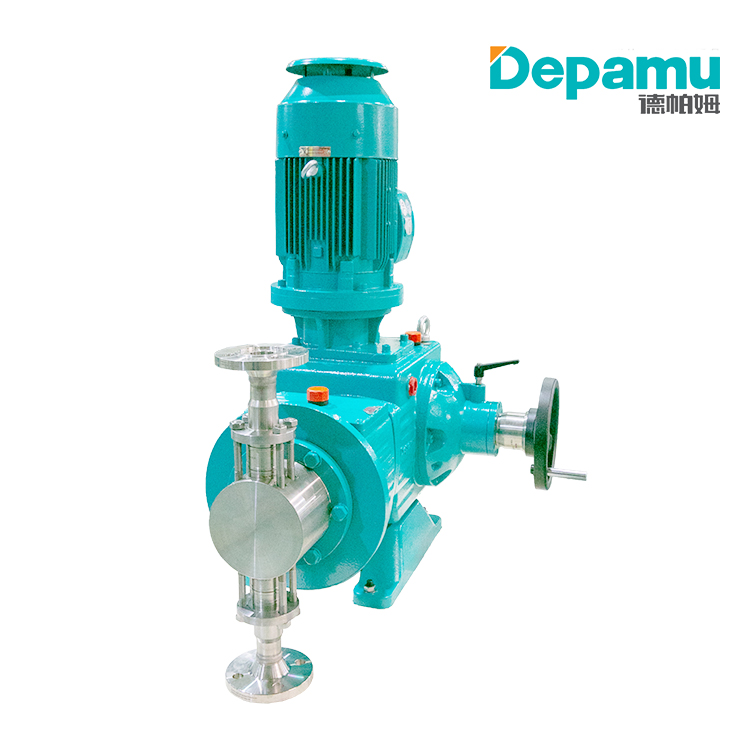
Depamu’s Plunger Metering Pump line occupies a distinct position in this taxonomy. The DP(M)ZA series is a true plunger pump: the plunger contacts the process fluid directly, and the working chamber volume changes cyclically as the plunger reciprocates, drawing fluid through the inlet check valve and discharging it through the outlet check valve. What separates Depamu’s approach from a conventional packed-plunger design is the engineering surrounding that fundamental mechanism. The drive train integrates a worm gear pair for variable-speed transmission and a patented integrated sleeve adjustable eccentric mechanism, permitting stepless stroke adjustment from 0% to 100% while the pump is running or stationary. Metering accuracy is specified at ±0.5% within the 10–100% stroke adjustment range—a figure that places it in the same accuracy class as far more expensive hydraulic diaphragm platforms, and an order of magnitude tighter than typical mechanical diaphragm performance.
2. Performance Envelope: The Numbers That Define Acid-Service Viability
The DP(M)ZA series is specified with a single-pump-head flow range of up to 12,100 L/h and a pressure range reaching 228 MPa. These are headline figures, and they deserve contextualization. The flow and pressure maxima are not simultaneously achievable in a single configuration; they represent the outer boundaries of a broad hydraulic design space. For acid dosing duties, the practical operating point typically falls well inside those extremes. A nitric acid dosing application in a chemical synthesis train may require a few hundred litres per hour against a moderate discharge pressure; a sulfuric acid injection point in a petrochemical process may demand higher pressure at lower flow. The DP(M)ZA platform’s value lies in its ability to be configured across that space without changing the fundamental pumping principle.
The accuracy specification of ±0.5% (10–100% stroke range) is particularly consequential in acid service because acid dosing errors propagate nonlinearly. In pH control, a small volumetric overdose of strong acid produces a disproportionately large pH excursion. In reaction stoichiometry, an acid feed deviation shifts conversion and selectivity. The DP(M)ZA’s high-precision inlet and outlet check valves are designed to minimize pressure drop and suppress flow irregularities that would otherwise erode dosing accuracy. The worm gear drive contributes low noise and high mechanical efficiency, while oil-immersed lubrication protects transmission components over extended service intervals.
Multi-head configurations extend the platform’s applicability. Up to twelve pump heads can be connected in parallel, either to transport the same fluid with reduced pulsation or to proportionally dose multiple media. In acid service, this capability is relevant to systems that require simultaneous injection of virgin acid and a corrosion inhibitor, or to processes where acid is introduced at multiple points along a flow path.
3. Materials: Where the Corrosion Battle Is Actually Fought
A plunger pump’s acid-service suitability is determined less by its drive mechanism than by the metallurgy and polymer science of its wetted path. Depamu offers pump heads in 304, 316, 316L, 904 stainless steel, Hastelloy C, and high-polymer materials, with wetted components additionally available in PVC, PVDF, PP, and PTFE. This breadth is not marketing garnish; it reflects the reality that no single material handles the full spectrum of industrial acids.
Nitric acid illustrates the complexity. As a strong oxidizing mineral acid, its corrosion behavior varies sharply with concentration, temperature, and impurity content. Dilute nitric acid solutions used for pH adjustment attack many common metals, while concentrated nitric acid used in nitration reactions demands materials that resist oxidizing attack. Depamu’s technical literature acknowledges this by recommending non-metallic wetted materials—polypropylene, PVDF, and PTFE—for commercial-grade nitric acid concentrations, with Hastelloy and titanium reserved for more severe conditions. Above 50% concentration, technopolymers such as PVDF and ETFE offer superior chemical resistance, while Viton and PTFE represent the most robust elastomer options.
Hydrochloric acid presents a different challenge. Muriatic acid—typically 31.45% HCl—is a harsh, fuming liquid that punishes imprecise material selection. Depamu’s hydraulic plunger mechanical diaphragm architecture is specifically positioned for hydrochloric acid service in pool water treatment, where the diaphragm serves as the only barrier between the acid and the pump mechanism. The hydraulic transmission eliminates the mechanical attachment through the diaphragm that would otherwise create a fatigue point, and the diaphragm is driven by fluid pressure rather than a concentrated mechanical linkage, yielding smoother motion and more uniform stress distribution. For concentrated hydrochloric acid, PTFE-sealed pump heads are the appropriate selection; Viton seals are commonly used in less aggressive HCl duties.
Sulfuric acid occupies yet another materials space. Concentrated sulfuric acid dosing typically calls for PTFE pump heads with PTFE sealing, while dilute sulfuric acid can be handled by PVC or PVDF liquid ends at ambient temperatures. Depamu’s cast aluminum housings with plastic-spray treatment provide a lightweight, heat-dissipating external structure, but the wetted-path decision remains the controlling variable.
The practical implication is that a Depamu plunger pump is not a single product but a configurable materials system. The same DP(M)ZA drive train can be paired with a 316L stainless head for a mildly acidic aqueous stream, a Hastelloy C head for a hot concentrated mineral acid, or a PTFE-lined head for hydrochloric acid service. This modularity is the platform’s central engineering proposition: the user buys one mechanical architecture and selects the wetted materials appropriate to each acid stream.
4. Where Depamu Fits—and Where It Does Not
A candid assessment of Depamu’s acid-service positioning requires comparison with the established Western competitors, ProMinent and Milton Roy. Depamu’s own technical comparisons acknowledge that Milton Roy’s high-pressure plunger platforms, such as the PRIMEROYAL series, reach pressures up to 1,034 bar, while Depamu’s standard metering pumps typically operate in the 0.4–2.5 MPa range, with higher pressures available through its high-pressure process diaphragm pump lines. In the ultra-high-pressure, low-flow domain—offshore chemical injection, subsea wellhead dosing—Milton Roy and Williams retain a clear technical advantage. Depamu does not claim otherwise.
The comparison shifts in the medium-pressure, medium-to-high-flow domain. Depamu’s DP(M)ZA series offers flow capacities up to 12,100 L/h per head at pressures that, while not extreme by oilfield standards, are entirely adequate for chemical processing, water treatment, and petrochemical acid dosing duties. In this regime, the cost-performance calculus favors Depamu. A PVC- or PVDF-headed Depamu pump costs a fraction of a comparable 316 stainless steel Milton Roy or ProMinent unit, and the ±0.5% accuracy specification is competitive with platforms that carry a significant brand premium.
The trade-offs are real. Depamu’s standard metering pumps are grid-dependent, relying on electric motors (0.37–0.75 kW) with optional inverters, and their worm-gear drive train, while robust and efficient under normal conditions, is not optimized for solar or pneumatic autonomy. For remote, off-grid acid dosing sites, the pneumatic or solar-powered architectures offered by Williams remain the more practical specification. Depamu’s plastic-headed configurations also carry temperature limitations—PVC heads are generally limited to around 40°C, PTFE to approximately 80°C—whereas stainless-steel liquid ends from Western competitors can accommodate steam-traced high-temperature service. These are not deficiencies in Depamu’s engineering; they are boundary conditions that define the applications for which the platform is and is not appropriate.
5. Operational Safety and Maintenance in Acid Service
Acid dosing pumps operate under conditions where a mechanical failure can become a safety incident. Depamu’s DP(M)ZA series is specified without an integrated safety relief device, and the manufacturer explicitly recommends installing a relief valve on the outlet pipeline. This is sound practice for any positive-displacement pump in a blocked-discharge scenario, but it is particularly important in acid service, where overpressure can rupture seals or fracture wetted components.
The stuffing box—the interface between the reciprocating plunger and the stationary pump head—is the primary wear and leakage site in any plunger pump. Depamu addresses this with special-design stuffing and sealing components intended for long service life and sealing performance. In acid service, the selection of packing and seal materials is as consequential as the selection of the pump head material. PTFE-based packing is the default for broad acid compatibility; graphite or specialized elastomer packings may be specified for specific acid chemistries. The operator’s maintenance regime should treat the stuffing box as a consumable interface and monitor for weepage, which is the earliest indicator of packing degradation.
The DP(M)ZA’s oil-immersed lubrication system protects the transmission components from the corrosive environment outside the pump head, but it does not protect the wetted path. The separation between the drive and the fluid is maintained entirely by the plunger–stuffing box interface. In this respect, the DP(M)ZA is a conventional plunger pump: its accuracy and pressure capability derive from direct plunger contact with the process fluid, and its maintenance burden is concentrated at the dynamic seal. Depamu’s hydraulic plunger mechanical diaphragm variant addresses this differently, using hydraulic oil to transmit force to a PTFE diaphragm and eliminating the dynamic process-fluid seal entirely. For the most aggressive acid duties—concentrated hydrochloric acid, mixed acid streams, or services where even trace weepage is unacceptable—the hybrid architecture may be the more appropriate Depamu configuration, at the cost of some pressure capability and added hydraulic complexity.
6. Conclusion: A Rational Specification, Not a Universal Solution
Depamu’s chemical plunger metering dosing pumps are best understood not as a monolithic product but as a configurable engineering platform for acid service. The DP(M)ZA series delivers ±0.5% metering accuracy across a 10:1 turndown range, flow capacities up to 12,100 L/h per head, and a materials menu that spans stainless steels, Hastelloy C, and high-performance polymers, all at a cost point that undercuts established Western competitors in medium-pressure, medium-flow acid duties.
The platform’s limitations are equally clear. It does not compete in the ultra-high-pressure, ultra-low-flow domain occupied by Milton Roy and Williams. Its plastic-headed configurations carry temperature ceilings that stainless-steel alternatives do not. And its fundamental reliance on a dynamic stuffing box means that the most aggressive acid services may still favor a diaphragm-based architecture—either Depamu’s own hydraulic diaphragm variant or a competitor’s platform—where zero process-side leakage is a non-negotiable requirement.
For the chemical processing plant dosing nitric acid into a synthesis train, the water treatment facility feeding sulfuric acid for pH correction, or the petrochemical unit injecting a corrosion inhibitor alongside an acidic process stream, Depamu’s plunger metering pumps represent a technically defensible and economically compelling specification. The engineering is sound, the materials strategy is appropriately granular, and the accuracy specification is credible. What the platform demands in return is a clear-eyed assessment of the specific acid, its concentration and temperature, and the consequences of seal wear—precisely the variables that separate a successful acid dosing installation from an expensive maintenance liability.