

The Depamu Chemical Injection Package for Ammonia Dosing: A Technical Overview
Abstract
In modern thermal power generation, precise water chemistry management is fundamental to operational safety, equipment longevity, and thermal efficiency. The Depamu Chemical Injection Package for ammonia dosing represents a sophisticated engineered solution designed to address the critical requirement of pH control in boiler feedwater systems. This article provides a comprehensive technical examination of the system, exploring its design philosophy, component architecture, control methodologies, and operational parameters. Through analysis of available technical documentation and industry context, this paper demonstrates how the Depamu ammonia injection package embodies the convergence of modular engineering, automated process control, and material science to deliver a reliable, skid-mounted solution for the power generation industry.
1. Introduction
The management of water chemistry in thermal power plants is a discipline of exacting precision. Feedwater quality directly influences the integrity of boiler tubes, turbine blades, and the entire steam-water cycle. One of the most critical parameters requiring control is pH, which, if allowed to deviate from optimal ranges, can lead to either acidic corrosion or alkaline embrittlement—both of which compromise plant reliability and safety .
Ammonia dosing has emerged as a preferred method for pH adjustment in high-pressure boiler systems. By injecting a controlled volume of ammonia solution into the feedwater, plant operators can elevate and stabilize pH levels, thereby mitigating corrosion risks and maintaining the protective magnetite layer on carbon steel surfaces . However, the efficacy of this approach depends entirely upon the precision and reliability of the dosing system employed.
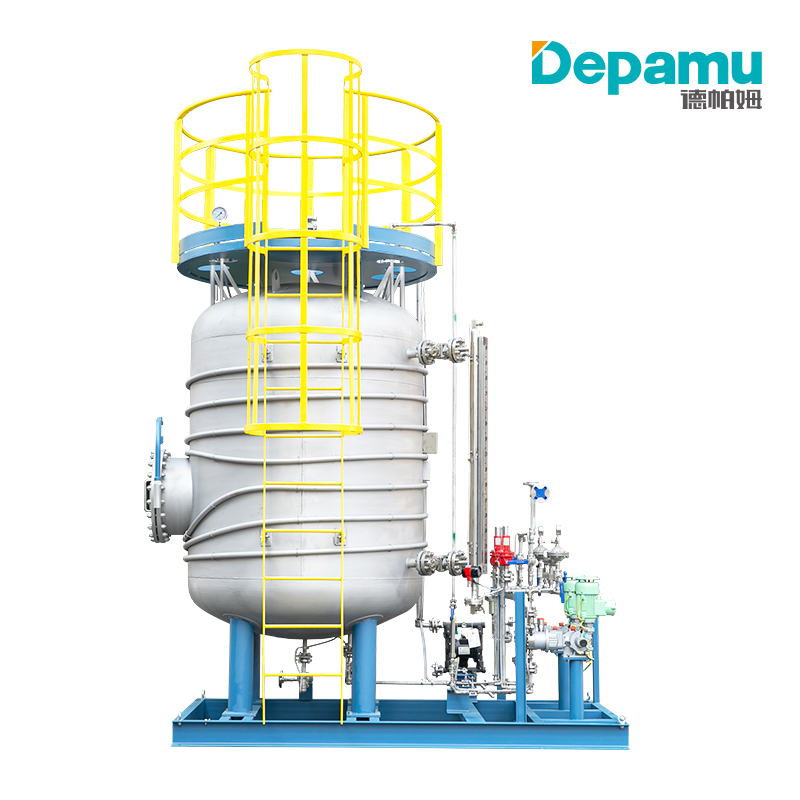
The Depamu Chemical Injection Package, specifically designed for ammonia dosing, addresses this requirement through an integrated, skid-mounted design that combines storage, metering, control, and safety functions into a unified assembly . This article examines the system in detail, exploring its technical specifications, operational principles, and significance within the broader context of industrial water treatment.
2. System Overview and Design Philosophy
The Depamu ammonia injection package is classified within the company's DPJY series of chemical injection systems, a product line developed for boiler feedwater treatment, boiler water treatment, and various industrial applications . The design philosophy underlying this system emphasizes three core principles: integration, modularity, and flexibility.
Integration manifests in the system's physical configuration. All components—including solution tanks, Metering Pumps, piping, valves, instrumentation, and electrical control cabinets—are mounted on a single steel base skid . This approach contrasts sharply with traditional installations where individual components are sourced and assembled piecemeal on-site. The integrated design delivers several significant advantages: reduced footprint, simplified transportation, accelerated installation, and elimination of compatibility issues between components .
Modularity permits system configuration to be tailored to specific project requirements. The DPJY series offers multiple combination forms, ranging from "1 Tank + 2 Pumps" to "2 Tanks + 4 Pumps" and beyond . This flexibility enables users to select configurations that match their capacity demands, redundancy requirements, and available space constraints. Furthermore, the modular approach facilitates future capacity expansion without requiring complete system replacement .
Flexibility extends to material selection and control options. The solution tank can be fabricated from various materials—including 304 stainless steel, 316 stainless steel, carbon steel, carbon steel with rubber lining, FRP, PE, PP, or PVC—depending on corrosion resistance requirements . Similarly, wetted parts for fluid handling can be specified in 304 stainless steel, 316 stainless steel, carbon steel, or UPVC . This material flexibility ensures compatibility with a wide range of chemical formulations and environmental conditions.
3. Component Architecture
The ammonia injection package comprises several discrete subsystems, each performing a specific function within the overall dosing operation.
3.1 Solution Tank and Storage System
The solution tank serves as the primary reservoir for prepared ammonia solution. Available capacities range from 0.5 to 2.5 cubic meters, depending on the specific configuration . The tank is equipped with a level gauge that provides continuous monitoring of solution inventory, enabling operators to maintain adequate supply and prevent pump starvation .
In configurations featuring multiple tanks, valve switching allows for alternating or simultaneous usage, providing operational flexibility and redundancy .
3.2 Metering Pump Assembly
The metering pump represents the heart of the dosing system, responsible for delivering precise volumes of ammonia solution against system pressure. The DPJY series accommodates metering pumps with capacities ranging from 20 to 70 liters per hour and discharge pressures from 0.5 to 2.5 MPa for boiler water applications .
Pump flow rate can be regulated through stroke adjustment and frequency control, enabling a turndown ratio of 0–100% . This wide range of flow control ensures the system can respond to varying load conditions and water quality fluctuations.
In typical configurations, pumps are arranged as "working" and "standby" units, ensuring uninterrupted operation during maintenance or in the event of pump failure . This redundancy is critical in power generation applications where unscheduled shutdowns carry substantial economic penalties.
3.3 Piping and Valves
The piping network interconnects all system components, facilitating the transport of ammonia solution from the storage tank to the injection point. Safety valves and pulsation dampers are incorporated to protect system integrity . The pulsation damper is particularly important in reciprocating pump systems, where pressure fluctuations can affect dosing accuracy and create vibration issues.
3.4 Electrical Control System
The electrical control cabinet houses the automation infrastructure that governs system operation. Available control modes include manual local control, semi-automatic operation, and fully automatic control .
In automatic mode, a Programmable Logic Controller (PLC) receives process signals from field instruments monitoring flow rate, pH value, electrical conductivity, and other relevant parameters . Based on these inputs, the control system automatically adjusts the speed and stroke of the metering pump to maintain the desired water chemistry setpoints.
The control system also provides connectivity to plant-wide Distributed Control Systems (DCS) or host computers . Standard analog signals (4–20 mA) are used for both control inputs and feedback signals, ensuring compatibility with common industrial automation protocols. Pump and mixer status indicators, along with fault alarms, can be transmitted to the central control room, and remote start/stop capability enables integrated plant operation .
4. Operational Principles
4.1 Process Overview
The ammonia dosing process begins with the preparation of ammonia solution, typically by diluting concentrated aqueous ammonia with deionized water in the solution tank. The prepared solution is then drawn into the metering pump suction line and discharged against system pressure into the boiler feedwater line.
The injection point is strategically located where the ammonia solution can be thoroughly mixed with the feedwater before entering the boiler. Proper mixing ensures uniform pH distribution throughout the steam-water cycle.
4.2 Automatic Control Strategy
The automatic control function operates through a closed-loop feedback mechanism. As water flows through the feedwater system, online analyzers continuously measure pH, conductivity, and other relevant parameters . These measurement signals are transmitted to the PLC, which compares them against user-defined setpoints.
When a deviation is detected, the PLC calculates the required adjustment to the ammonia injection rate and sends a corresponding signal to the pump drive. The adjustment is achieved through one or both of two methods: varying the pump stroke length or adjusting the motor speed via a variable frequency drive .
The speed control input signal from the frequency converter is a standard 4–20 mA analog signal, with the same format used for feedback . This standardized signaling ensures accurate and reliable communication between system components.
4.3 Manual and Semi-Automatic Modes
For commissioning, maintenance, or conditions where automatic control is not desired, the system can be operated manually. In manual mode, operators directly control pump speed and stroke through the electrical control panel . Semi-automatic modes provide intermediate levels of automation, such as automatic pump speed control with manual setpoint adjustment.
5. Technical Specifications and Configuration Options
The Depamu ammonia injection package is available in a range of configurations to suit diverse application requirements. The following table summarizes the key specification categories for boiler water injection packages as documented in Depamu's product literature :
6. Industry Context and Significance
The Depamu ammonia injection package operates within a broader ecosystem of industrial water treatment solutions. Similar systems are offered by other manufacturers for applications including low-pressure and high-pressure boiler dosing, phosphate dosing, hydrazine dosing, and corrosion inhibitor dosing .
Industry standards such as API 675 (American Petroleum Institute standard for controlled-volume metering pumps) provide benchmarks for system design and performance . Compliance with such standards ensures that dosing packages meet minimum requirements for accuracy, reliability, and safety.
The importance of these systems extends beyond power generation. Boiler feedwater treatment is equally critical in oil and gas processing, petrochemical production, district heating, and various manufacturing industries. In each of these contexts, precise chemical dosing directly influences equipment life, energy efficiency, and operational reliability.
7. Conclusion
The Depamu Chemical Injection Package for ammonia dosing represents a mature, engineered solution to a fundamental challenge in thermal power generation and industrial boiler operations. By integrating storage, metering, control, and safety functions into a single skid-mounted assembly, the system delivers reliability, precision, and ease of installation that surpass traditional piecemeal approaches.
The system's modular architecture provides flexibility to accommodate diverse requirements while its automatic control capability, based on feedback from pH, conductivity, and flow sensors, ensures consistent water chemistry under varying operating conditions. Material selection flexibility permits adaptation to specific corrosion challenges, extending service life and reducing maintenance requirements.
In an industry where water chemistry management directly impacts safety and profitability, the Depamu ammonia injection package offers a capable and configurable solution. As power generation and industrial processes continue to evolve toward greater efficiency and environmental responsibility, the importance of precise chemical control systems is likely to increase, making products like the Depamu dosing package increasingly indispensable